Expert analysis of Nikolay Bogdanov-Belsky’s Still Life
Style: Realism · Genre: still life
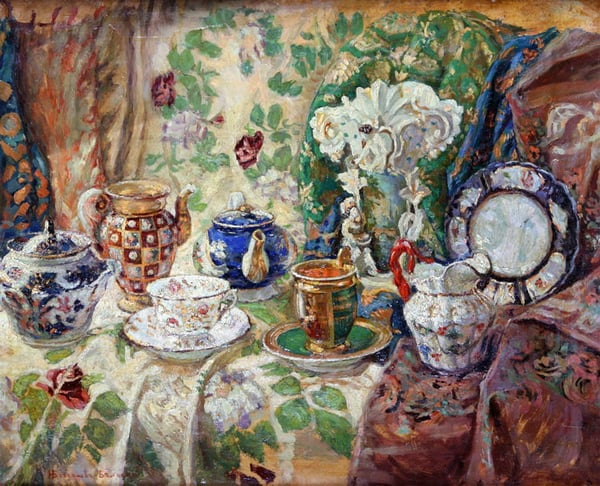
Expert Analysis: "Still Life" by Nikolay Bogdanov-Belsky
Nikolay Bogdanov-Belsky (1868–1945) is primarily celebrated for his empathetic portrayals of rural Russian childhood and village life, often executed in a refined academic-Realist style. His turn to the still-life genre, as seen in this work, is significant because it demonstrates the breadth of his technical command and his deep engagement with the core principles of 19th-century Realism—namely, the faithful and unidealized representation of the material world.
Key Elements and Execution: In this still life, Bogdanov-Belsky applies the same meticulous observation and nuanced handling of light that characterizes his better-known narrative scenes. The composition is likely simple: a modest arrangement of objects—perhaps fruit, a vase, or table linens—rendered with exacting precision. The brushwork emphasizes texture and surface: the soft bloom of a peach, the reflective gleam of glass or metal, the weave of a cloth. The palette is rich but restrained, grounded in earthy tones that anchor the image in a tangible, domestic reality.
Significance within Realism: Bogdanov-Belsky’s still life is a testament to Realism’s core tenet: that the ordinary, overlooked objects of daily life possess a quiet dignity worthy of the highest artistic attention. Unlike the dramatic, symbolic still lifes of the Baroque era or the later decorative arrangements of Impressionism, this work insists on a straightforward, almost scientific scrutiny of form, light, and material presence. It is not merely an exercise in imitation but an attempt to reveal the inherent beauty in the humble and the transient.
Contextual Importance: For an artist whose reputation rests on humanistic narrative, this still life offers a rare, focused study in pure visual perception. It underscores the Russian Realist tradition’s versatility—proof that even in a still-life format, the artist could achieve the same intensity of truthfulness and expressive restraint found in his figure paintings. In the broader history of Realism, such works serve as a reminder that the movement’s power lay not only in storytelling but in the profound observation of everyday things. Bogdanov-Belsky’s Still Life stands as a quiet but masterful declaration that the mundane, when seen clearly, becomes extraordinary.
Visually similar
20 works with related composition and palette
Still Life with a red tray
Pyotr Konchalovsky
Still Life with a red tray.
Pyotr Konchalovsky
Still Life with Cup and Sugar Bowl
Pierre-Auguste Renoir
Bortnyik Sándor, Kancsó
Sandor Bortnyik
Teapot, Ginger Jar and Slave Candlestick
Pieter Gerritsz. van Roestraten
House of Venus IV
Rosemarie Beck
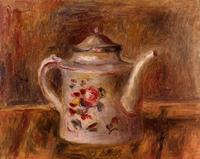
Watering Can
Pierre-Auguste Renoir
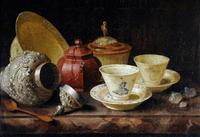
Still Life with Tea Cups
Pieter Gerritsz. van Roestraten
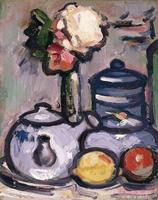
Still Life: Teapot with Flowers and Fruit
John Duncan Fergusson
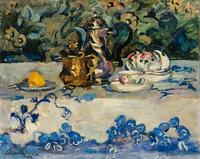
Still Life. Gold and silver in Japanese cloth.
Pyotr Konchalovsky
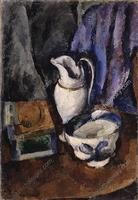
Still Life with a jug
Pyotr Konchalovsky
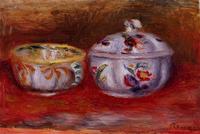
Still Life with Fruit Bowl
Pierre-Auguste Renoir
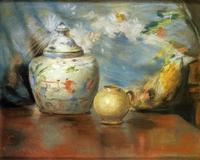
Still LIfe with Flowers
William Merritt Chase
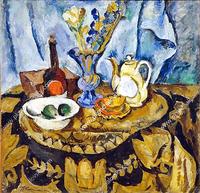
Still Life with a Coffeepot
Pyotr Konchalovsky
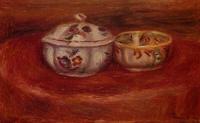
Sugar Bowl and Earthenware Bowl
Pierre-Auguste Renoir
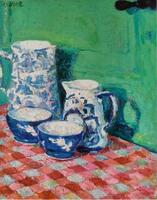
Nu Allongé Sur Le Ventre
Bela Czobel
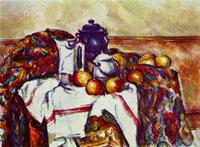
Still Life with Blue Pot
Paul Cezanne
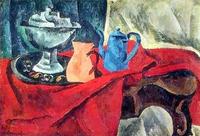
Vessels on the red tablecloth
Pyotr Konchalovsky
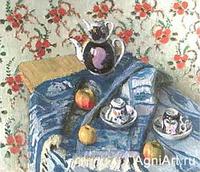
Blue Tablecloth
Igor Grabar
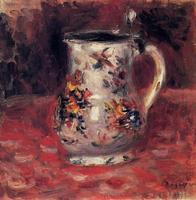
Jug
Pierre-Auguste Renoir