Expert analysis of Kazimir Malevich’s Landscape with Yellow House
Style: Pointillism · Genre: landscape
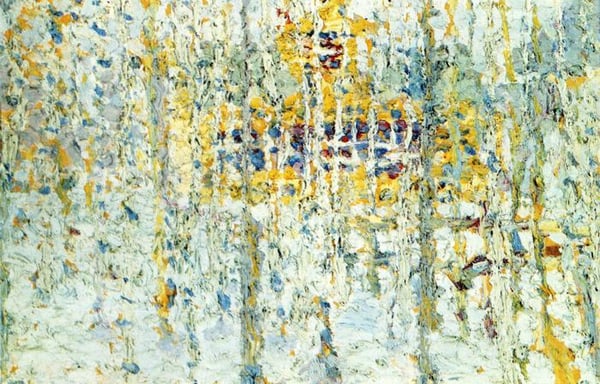
Kazimir Malevich’s Landscape with Yellow House offers a fascinating glimpse into the artist’s early stylistic experiments, executed here in the Pointillist idiom. While Malevich is renowned as the pioneer of Suprematism—an entirely non-objective, geometric abstraction—this work roots his practice in the rigorous color theory and optical mixing of Neo-Impressionism.
What makes this artwork significant within its style and period:
-
Pointillist technique applied to Russian subject matter: Malevich adopts the quintessential Pointillist method of applying tiny, separate dabs of pure color—complementary blues, oranges, greens, and yellows—which the viewer’s eye optically blends to create a luminous, vibrating surface. The “yellow house” anchors the composition as a warm focal point, its saturated hue set against cool, dappled foliage and sky. This demonstrates Malevich’s absorption of French avant-garde principles (especially Seurat’s and Signac’s) while adapting them to a modest, rural landscape.
-
Transitional moment in Malevich’s career: Created around 1906-1907, this painting belongs to Malevich’s “Impressionist” and “Neo-Primitivist” phases, preceding his move toward Cubo-Futurism and eventually pure abstraction. It reveals his deep engagement with the science of color division—a crucial step before he would famously dissolve form entirely. Here, the house and trees are still recognizable, but the Pointillist dabs begin to break the solidity of objects, prefiguring the dematerialization of the physical world in his later work.
-
Contrast with his suprematist legacy: Most viewers associate Malevich with Black Square (1915) and geometric zero-forms. Landscape with Yellow House is valuable precisely because it shows the foundational skill and sensitivity to atmospheric light and color that Malevich later deliberately rejected. It proves his mastery of traditional landscape painting before he deliberately dismantled it—making his radical leap to abstraction all the more dramatic and intentional.
-
Distinctive pointillist palette: The painting’s “yellow house” is not a flat local color but a mosaic of cadmium yellow, ochre, and small touches of violet and blue—creating a vibrating, sun-drenched effect. The surrounding greens are built from overlapping dots of Prussian blue, emerald green, and pale yellow, giving the foliage a shimmering, almost ephemeral quality. This optical mixture is more tactile and energetic than a smooth blend, emphasizing the act of perception itself.
In summary, Landscape with Yellow House is significant as a document of Malevich’s early mastery of Pointillism—a style he would soon transcend. It captures a fleeting moment of pure, joyful color sensation, standing as a delightful antithesis to the severe, iconic abstraction that would later define his legacy.
Visually similar
20 works with related composition and palette
Winter Landscape
Kazimir Malevich
Spring landscape
Kazimir Malevich
February Azure
Igor Grabar
The Frost
Igor Grabar
The Frost
Igor Grabar
Morning Sunlighton the Snow, Eragny-sur-Epte
Camille Pissarro
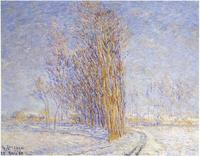
Landscape in Snow
Gustave Loiseau
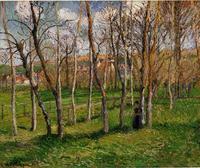
Meadow at Bazincourt
Camille Pissarro
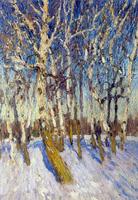
Winter
Igor Grabar
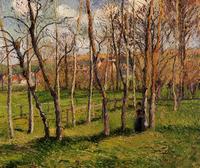
Meadow at Bazincourt
Camille Pissarro
Spring Woods
Childe Hassam
Birches Valley
Igor Grabar
Winter in the Forest (sketch)
Petro Kholodny (Elder)
Church
Kazimir Malevich
The Frost
Igor Grabar
The Ledges
Childe Hassam
Garden under Snow
Paul Gauguin
Impressionist Landscape
Harry Phelan Gibb
Loading Ice
Julian Alden Weir
Autumn near Saint Cyr du Vaudreuil
Gustave Loiseau