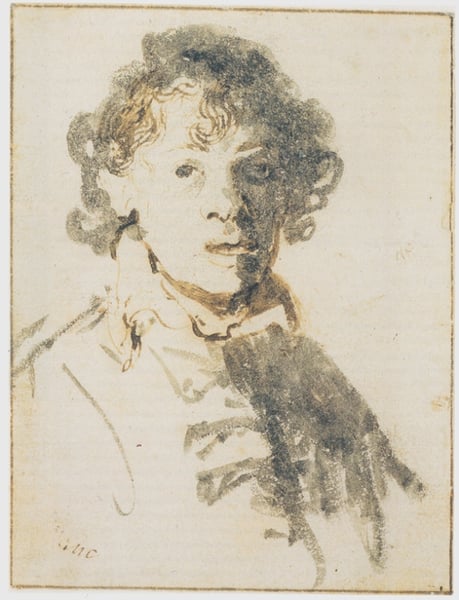
Analisi esperta di Self-portrait, Open Mouthed di Rembrandt
Stile: Baroque · Genere: sketch and study, tronie
Expert Analysis: "Self-portrait, Open Mouthed" by Rembrandt
Rembrandt van Rijn’s Self-portrait, Open Mouthed (c. 1629–1630) is a masterful example of Baroque artistic experimentation, executed as both a sketch/study and a tronie—a Dutch term for a character study focusing on exaggerated expression or costume rather than a conventional portrait. This work is significant for its raw, uninhibited exploration of human emotion and the artist’s own face as a laboratory for chiaroscuro and psychological depth.
Stylistic and Period Significance
Painted early in Rembrandt’s career during the Dutch Golden Age, this piece exemplifies the Baroque fascination with transient, dramatic moments. Unlike formal self-portraits that project dignity or status, Rembrandt here captures a fleeting, almost comical expression—mouth agape, eyes wide, perhaps in surprise, laughter, or shock. The loose, rapid brushwork and dark, atmospheric background typify the Baroque preoccupation with tenebrism, focusing light on the face to heighten emotional immediacy. This study allowed Rembrandt to practice rendering the subtleties of facial musculature and spontaneity, skills that later defined his mature portraits.
Genre Innovation: The Tronie
As a tronie, the work transcends mere self-depiction. Rembrandt treats his own features as a mask to investigate universal human reactions, aligning with the Baroque interest in theatricality and the expression of the soul through physical gesture. By omitting fine details of clothing or setting, he isolates the face as the sole narrative vehicle—a technique that influenced generations of genre painters. This piece also reflects the artist’s commitment to direct observation over idealized beauty, a hallmark of his Realist tendencies within the Baroque.
Technical and Artistic Legacy
The sketch-like quality reveals Rembrandt’s working method: rapid, confident strokes that define the shadowed eye socket and the subtle contour of the open mouth. The painting functions as a visual diary entry, a candid moment of self-scrutiny that bridges the gap between preparatory study and finished work. Its significance lies in how it demystifies the artist’s process, showing Rembrandt not as a distant genius but as a perpetual student of human nature. This unfiltered authenticity—a raw, unvarnished face caught in mid-expression—foregrounds the Baroque drive to capture life’s fleeting, emotive force, making Self-portrait, Open Mouthed a pioneering work of psychological portraiture and a testament to Rembrandt’s relentless curiosity.
Museum / Gallery
Visivamente simili
20 opere con composizione e palette affini
Bust of an old man with a flowing beard, the head bowed forward, the left shoulder unshaded
Rembrandt
Self-portrait
Rembrandt
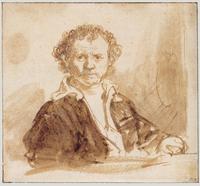
Self-portrait
Rembrandt
Self-portrait as a young man
Caspar David Friedrich
Portrait of Ivan Krylov
Orest Kiprensky
Portrait of John Everett Millais
John Everett Millais
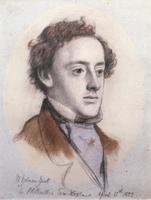
Portrait of John Everett Millais
William Holman Hunt
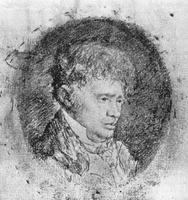
Portrait of Javier Goya, the Artist's Son
Francisco Goya
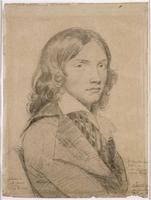
Portrait of Mr. Revoil to 18 in bust
Jean Auguste Dominique Ingres
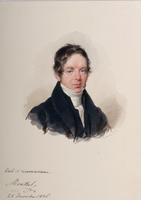
Le Comte Guillaume Isidore De Montbel
Josef Kriehuber
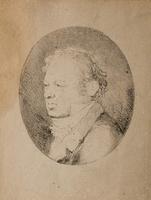
Retrato De Goya
Rosario Weiss Zorrilla
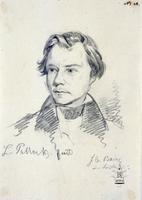
Portrait of Johann Karl Baehr
Leopold Pollak
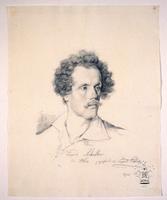
Portrait of Eduard Schaller from Vienna
Leopold Pollak
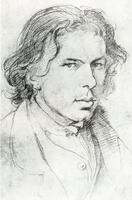
Portrait of Mikoláš Aleš
Maximilian Pirner
Chopin
Franz Xaver Winterhalter
Self-portrait in a fur cap bust
Rembrandt
Portrait Suvée, director of the Academy of France in Rome
Jean Auguste Dominique Ingres
Self-portrait
Dmitry Levitzky
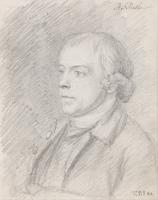
The Reverend Anthony Stephen Mathew
John Flaxman
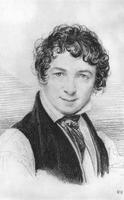
Self-portrait
Orest Kiprensky