Expertenanalyse zu Rembrandts The Sense Of Sight
Stil: Baroque · Genre: genre painting
Expert Analysis of "The Sense of Sight" by Rembrandt
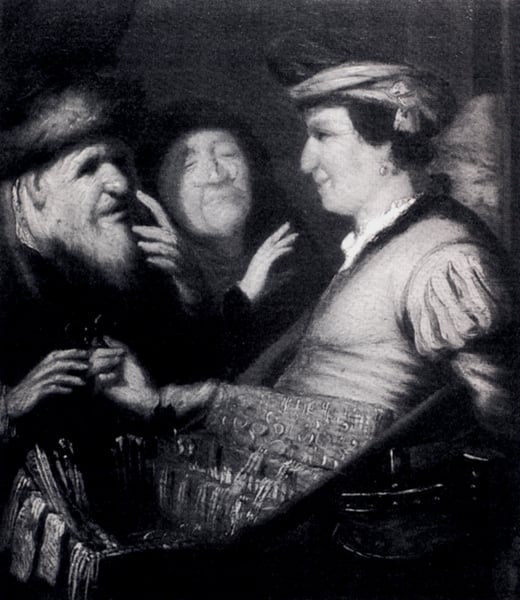
As a Baroque genre painting, Rembrandt’s The Sense of Sight exemplifies the period’s revolutionary approach to depicting everyday life with heightened drama and psychological depth. Created early in his career, this work is part of a series on the five senses—a popular allegorical theme—but Rembrandt transforms it into a distinctly Baroque exploration of human perception.
The painting draws the viewer into a dim, intimate interior where a figure examines an object (likely an optical instrument or a print) with intense focus. Rembrandt’s masterful use of chiaroscuro—the stark contrast between deep shadows and a single, raking light source—illuminates the act of seeing itself. This dramatic spotlighting not only heightens the sense of physical sight but also suggests a spiritual or intellectual awakening, a hallmark of Baroque art’s fusion of the mundane with the transcendent.
As a genre painting, it elevates a simple daily activity—someone looking—into a profound meditation on human experience. The figure’s absorbed expression and the careful rendering of textures (fabric, skin, objects) demonstrate Rembrandt’s early commitment to realism and psychological insight. Unlike idealized depictions, this work captures the unposed, transient moment of observation, making the viewer complicit in the act of seeing.
Significantly, The Sense of Sight reveals Rembrandt’s departure from the more static, emblematic treatments typical of earlier allegories. Instead, he injects Baroque dynamism through the immediacy of the gaze, the interplay of light and shadow, and the raw, human quality of the subject. This work thus stands as a foundational example of how Baroque genre painting could transform a simple sensory theme into a powerful, immersive encounter—one that celebrates sight as both a physical and a philosophical act.
Museum / Gallery
Genre
Stil
Visuell ähnlich
20 Werke mit ähnlicher Komposition und Farbpalette
Card Players
Gerard Terborch
Christ and the Adulteress
Peter Paul Rubens
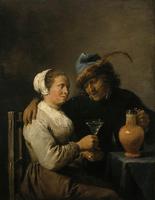
Tavern Scene
David Teniers the Younger
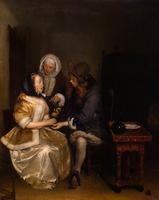
The Glass of Lemonade
Gerard Terborch
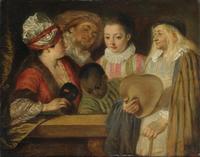
Masquerade
Antoine Watteau
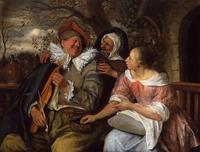
Merry Threesome
Jan Steen
Husband and Wife
Lorenzo Lotto
The Glass of Lemonade
Gerard Terborch
Drinking Party with a Lute Player
Nicolas Tournier

Robbed violin player
Jan Steen
A Soldier, An Old Woman and a Young Woman
Pieter Codde
The Bean King (The King Drinks)
Jacob Jordaens
Scene
Daniel Huntington

Christ Driving the Moneychangers from the Temple
Rembrandt
The Denial of Saint Peter
Gerard van Honthorst
An interior with an amorous couple
Cornelis Pietersz. Bega
The Prodigal Son Receives His Rightful Inheritance
Bartolome Esteban Murillo

Scene
Domenico Maroli
The King Drinks
Jacob Jordaens
The Reading Lesson
Gerard Terborch