
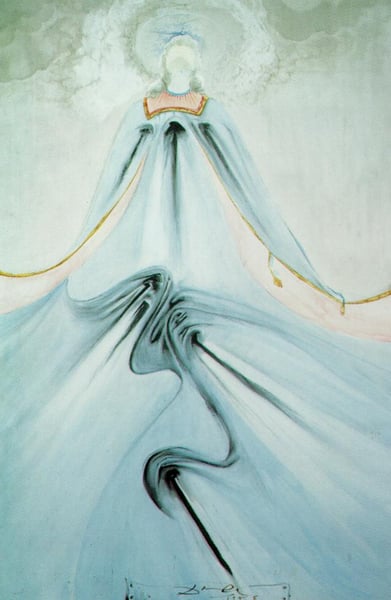
Salvador Dali sanatçısının Assumpta Canaveral eseri hakkında uzman analizi
Tarz: Surrealism · Tür: religious painting
Expert Analysis: "Assumpta Canaveral" by Salvador Dalí
This work belongs to Dalí’s Classic Period (1941–1989), a phase defined by his return to traditional religious and scientific themes filtered through a Surrealist lens. Painted as a religious work within the Surrealist style, Assumpta Canaveral is a striking example of Dalí’s nuclear mysticism—a personal synthesis of Catholic iconography, atomic physics, and modern technology.
Title and Symbolism:
The title merges Assumpta (the Assumption of the Virgin Mary into heaven) with Canaveral (Cape Canaveral, the NASA rocket-launch site). This juxtaposition is the key to the painting’s significance. Dalí reimagines the traditional Assumption not as a miraculous bodily ascent into a medieval heaven, but as a cosmic launch—the Virgin Mary becomes a figure of spiritual energy blasted upward by the forces of gravity and atomic particles, akin to a rocket lifting off. Cape Canaveral, the cradle of space exploration, is recast as a modern holy site where faith and science converge.
Composition and Surrealist Techniques:
Characteristic of Dalí’s later style, the painting likely employs double imagery and perspective distortion. The upward-sweeping forms—suggesting both a roiling cloud of glory and a plume of rocket exhaust—dissolve the boundary between the sacred and the technological. Dalí often painted his religious figures as suspended or fragmented, using a technique of “dismembered” anatomical parts that reconfigure into symbolic wholes. Here, the Virgin’s form may be rendered as a series of floating, geometric modules (reminiscent of nuclear particles), each retaining her traditional blue-and-white robe but reassembled in a manner that evokes a spacecraft or an atom.
Significance within Surrealism and Dalí’s Oeuvre:
Assumpta Canaveral is significant because it epitomizes Dalí’s belief that Surrealism could illuminate a universal, mystical truth beyond Freudian dreams. In the aftermath of the atomic bomb and the dawn of the Space Age (the Classic Period coincides with 1945–1969), Dalí boldly married faith and futurism. The painting challenges the viewer to see the Assumption not as a medieval fantasy but as an allegory for humanity’s own technological ascension—a spiritual payload carried by the rockets of science. It is a landmark example of how Surrealism, once dedicated to the irrational subconscious, could be repurposed to explore the transcendent and the modern cosmos.
In essence, Assumpta Canaveral is a visionary hybrid—part Catholic altar piece, part space-age manifesto—that asserts Dalí’s role as a prophet of a new artistic age where the miraculous and the mechanical are one and the same.
Stil
Görsel olarak benzer
İlişkili kompozisyon ve renk paletine sahip 20 eser

Nature Forms Gasp
Georgia O'Keeffe
I Have Trodden the Wine Press Alone
Mainie Jellette
Space Travel (Star Travel)
Roberto Matta
Anti-Protonic Assumption
Salvador Dali
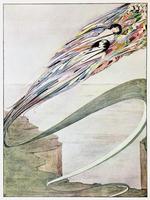
The Year's at the Spring
Harry Clarke

Memory
Agnes Lawrence Pelton
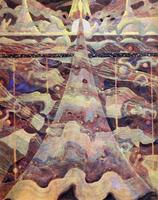
Allegro (Sonata of the Stars)
Mikalojus Konstantinas Ciurlionis
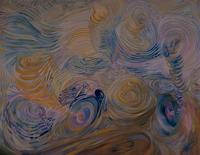
Space Unbound
Wolfgang Paalen
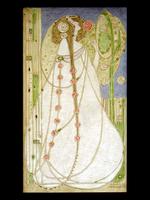
Décor de la salle à manger (House for an art lover, Glasgow)
Charles Rennie Mackintosh
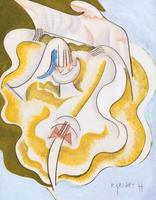
Scheiber Hugó, Sárga Ruhás Táncosnő
Scheiber Hugó
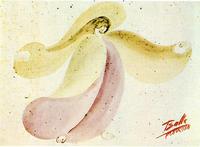
Mimicry synoptic': costume design for the Valle
Giacomo Balla

The White Rose and the Red Rose
Margaret Macdonald
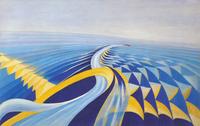
Speeding Motorboat
Benedetta Cappa
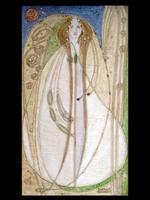
Décor de la salle à manger (House for an art lover, Glasgow)
Charles Rennie Mackintosh
Margin of Silence
Kay Sage
Untitled
Lee Bontecou
Jugend magazine
Otto Eckmann
Come Beloved
Debs Margolin
Day Break - Modality Series
Jock Macdonald
Scheiber Hugó, Sárga Ruhás Táncosnő
Scheiber Hugó