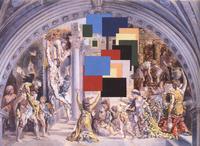
Athens Is Burning! The School of Athens and the Fire in the Borgo
Details
Expert analysis of Salvador Dali’s Athens Is Burning! The School of Athens and the Fire in the Borgo
Style: Surrealism · Genre: genre painting
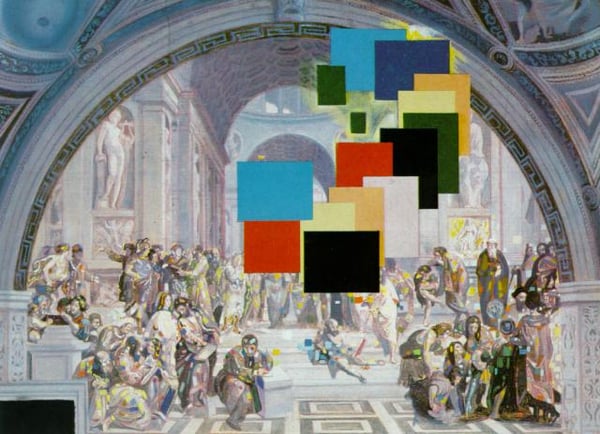
Expert Analysis of Athens Is Burning! The School of Athens and the Fire in the Borgo (Salvador Dalí, c. 1979–1980)
Style & Period Significance
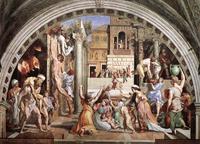
Executed during Dalí’s so-called “Classic Period” (1941–1989), this work demonstrates the artist’s late-career turn toward hyper-realist technique while retaining his Surrealist core. Dalí had moved away from the automatic, dream-like imagery of his earlier years, instead embracing meticulous, almost photographic precision—yet always subverting it with irrational, hallucinatory juxtapositions. Here, he fuses two iconic Renaissance frescos by Raphael—The School of Athens (1510) and The Fire in the Borgo (1514)—into a single, cataclysmic tableau. This hybridization is a hallmark of Dalí’s paranoid-critical method, where one image is violently merged with another to unlock subconscious associations.
Thematic Innovation
The painting collapses time and space: Raphael’s serene philosophical assembly (Plato, Aristotle, and other thinkers) is consumed by flames borrowed from the Fire in the Borgo, which originally depicted a miracle of Pope Leo IV extinguishing a fire. Dalí’s title—“Athens Is Burning!”—immediately announces a crisis of knowledge and culture. The School of Athens, symbol of rational Western thought, is engulfed by irrational destruction. This reflects Dalí’s post-war preoccupation with nuclear anxiety, the decay of classical ideals, and the tension between order and chaos—themes that dominate his Classic Period works like The Hallucinogenic Toreador (1970) and The Discovery of America by Christopher Columbus (1959).
Surrealist Recontextualization
As a Surrealist genre painting, the work overturns the traditional function of genre scenes (everyday life) by placing ordinary Renaissance figures into an extraordinary, apocalyptic event. The flames are rendered with Dalí’s signature luminous, melting forms, making the fire feel both real and fantastical—a “paranoid” version of Raphael’s clear, balanced compositions. The foreground includes Dalí’s recurring motifs: crutches (supporting fragile structures), elongated shadows, and a lone figure (perhaps Dalí himself) observing the destruction. This self-reflexive layer turns the viewer into a witness to art history’s own funeral pyre.
Why It Matters
- Mastery of Renaissance allusion: Dalí does not merely copy Raphael; he deconstructs his composition to reveal latent violence beneath classical harmony. The architecture collapses, the philosophers flee, and the serene arcades become a furnace.
- Bridge between past and modernity: The work exemplifies Dalí’s belief that Surrealism could revitalize old masters. It anticipates postmodern appropriation while remaining firmly within the hand-painted, realistic tradition he championed in his later years.
- Cultural prophecy: The burning of Athens—the cradle of democracy and philosophy—echoes 20th-century wars and the threat of nuclear annihilation. Dalí’s vision is both a homage to Raphael and a warning that civilization’s “fire” is never fully extinguished.
In essence, Athens Is Burning! is a surrealist history painting that asks: What if Raphael’s rational order met Dalí’s irrational fire? The answer is a masterwork of destruction—and a poignant meditation on the fragility of knowledge.
Visually similar
20 works with related composition and palette
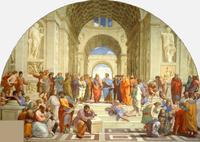
The School of Athens
Raphael
The School of Athens (after Raphael)
Anton Raphael Mengs
The Wedding Feast at Cana
Paolo Veronese
THE MARRIAGE AT CANA (AFTER VERONESE)
Nathaniel Hone the Younger
The Fire in the Borgo
Raphael
The Last Supper (detail)
Andrea del Sarto
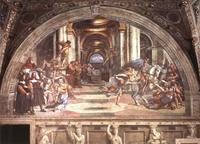
The Expulsion of Heliodorus from the Temple
Raphael
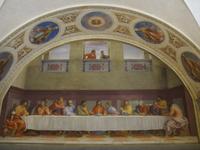
The Last Supper
Andrea del Sarto
Athens Is Burning! The School of Athens and the Fire in the Borgo
Salvador Dali
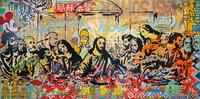
Happy Supper
Tadas Sokolovas
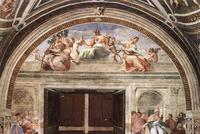
The Virtues
Raphael
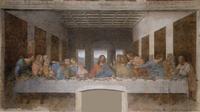
The Last Supper
Leonardo da Vinci
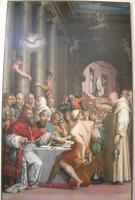
Dinner of St. Gregory the Great (Clement VII)
Giorgio Vasari
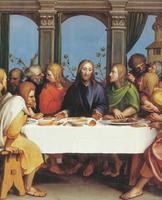
The Last Supper
Hans Holbein the Younger
Roman women offering their jewellery in defence of the state
Vincenzo Camuccini
Last Supper
Domenico Ghirlandaio
The Last Supper
Andy Warhol
The Last Supper
Vicente Juan Masip
The Last Supper
Vicente Juan Masip
The Last Supper
Andy Warhol