
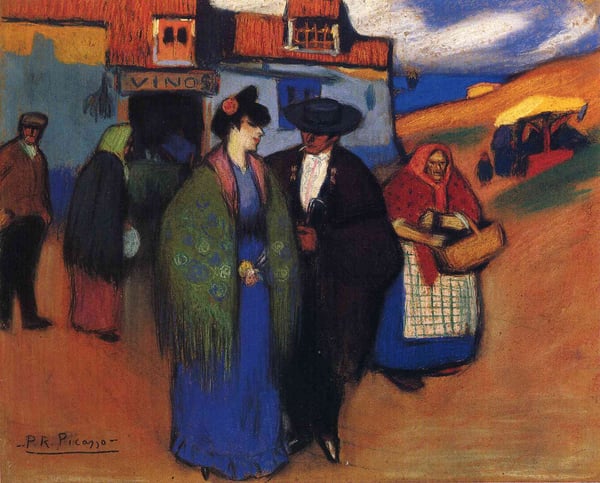
Deskundige analyse van A spanish couple in front of inn van Pablo Picasso
Stijl: Post-Impressionism · Genre: genre painting
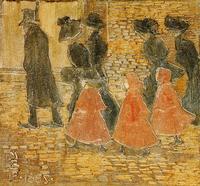
Expert Analysis: "A Spanish Couple in Front of an Inn" by Pablo Picasso
This work belongs to Picasso’s Early Years (roughly 1895–1900), a formative period when the young artist was absorbing and synthesizing various fin-de-siècle influences before developing his own revolutionary styles. Painted in a Post-Impressionist manner, the piece reflects Picasso’s engagement with the expressive color, bold outlines, and everyday subject matter championed by artists like van Gogh, Gauguin, and Toulouse-Lautrec.
Significance within Picasso’s Oeuvre
-
Bridge between Academic Training and Modernism – Executed when Picasso was still a teenager (or just out of his teens), this work demonstrates his technical proficiency in composition and figuration, but also his willingness to move beyond strict realism. The loose brushwork and slightly flattened space show his shift toward a more personal, emotional interpretation of reality—a key step toward his later Blue and Rose Periods.
-
Genre Painting as Social Observation – Choosing a “genre painting” (scenes of everyday life) allows Picasso to capture a slice of Spanish culture. The inn and the couple evoke the rustic, folkloric atmosphere of his native Spain, a theme he would return to throughout his career. The depiction of ordinary people in intimate, unglamorous moments hints at his lifelong interest in the human condition—a concern that became central in his Blue Period.
-
Post-Impressionist Techniques – The work is marked by strong outlines (reminiscent of Gauguin’s cloisonnism) and a vibrant, non-naturalistic palette. Colors are used expressively rather than descriptively: warm ochres, deep greens, and earthy reds create a sense of warmth and informality. The brushwork is visible and energetic, emphasizing the artist’s hand and emotional response to the scene.
-
Early Glimpse of Picasso’s Identity – Even at this early stage, Picasso was asserting a distinctly Spanish identity in his art, distancing himself from the academically favored subjects of Parisian salons. The couple’s posture—perhaps a moment of conversation, waiting, or courtship—feels both specific and universal, a quality that would define his best work.
Why This Work Matters
“A Spanish Couple in Front of an Inn” is significant not as a masterpiece of his mature style, but as a document of Picasso’s rapid evolution. It captures the moment when a gifted young artist was learning to break rules: rejecting hyper-realism for symbolic color, ignoring polished finish for lively texture, and preferring the authenticity of everyday people over mythological or historical figures.
For scholars and admirers, this painting offers a rare glimpse of Picasso before the masks, the Cubist fractures, or the political statements—just a young painter exploring the expressive power of paint, already fascinated by the drama of human interaction. It is a vital missing link in understanding how the most influential artist of the 20th century found his voice.
Museum / Gallery
Visueel vergelijkbaar
20 werken met verwante compositie en kleurenpalet
French Poet and His Mother
Istvan Farkas
Four Ages in Life
Edvard Munch
Egry József. Pár Az Erkélyen 1910
Egry József
Malays, Chiappini Street, Cape Town, 1976
Kenneth Baker
Snackbar in the open air
Pablo Picasso
Street, Dresden
Ernst Ludwig Kirchner
Bathers and Strollers
Maurice Prendergast
Province
Kazimir Malevich
Moulin De La Galette
Isaac Israels
Gypsy in front of Musca
Pablo Picasso
Fairground
Pablo Picasso
Egry József Munka Után 1911
Egry József
Public Garden
Pablo Picasso
The mother leading two children
Pablo Picasso
Walking Couple in Szentendre
Kmetty János
Spring Promenade
Maurice Prendergast
Untitled
Fikret Mualla Saygi
Flower seller
Pablo Picasso
Before a Café: Paris
John Duncan Fergusson
Three Little Girls in Red
Maurice Prendergast