
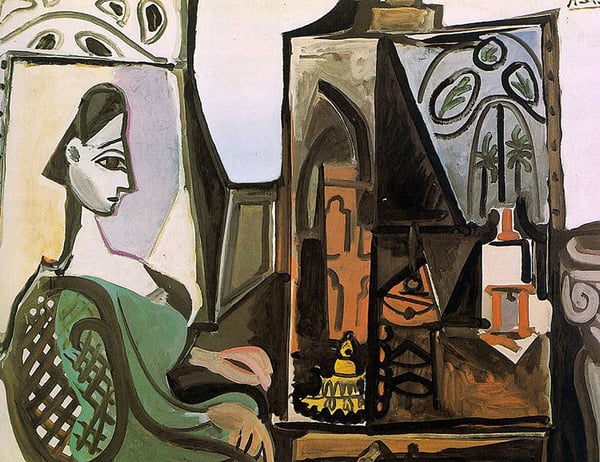
Expert analysis of Pablo Picasso’s Jacqueline at the studio
Style: Cubism, Surrealism · Genre: genre painting
Expert Analysis of Jacqueline at the Studio by Pablo Picasso
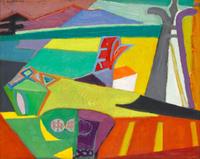
This work, created during Picasso’s Later Years, stands as a powerful synthesis of the two revolutionary styles that defined his career: Cubism and Surrealism. As a genre painting—depicting an intimate scene of daily life—it transforms a domestic moment into a complex meditation on perception, memory, and artistic identity.
Significance within Cubism:
Even in his later period, Picasso never abandoned Cubist principles. Here, Jacqueline’s figure is fractured into geometric planes, with her face shown simultaneously in profile and frontal view—a hallmark of Analytic Cubism. The studio setting collapses depth, forcing the viewer to navigate the canvas as a series of overlapping, translucent shapes. This extends Cubism’s original goal of representing multiple viewpoints at once, now applied to a personal, interior space rather than a still life or portrait.
Significance within Surrealism:
The Surrealist influence transforms the studio into a dreamlike realm. Jacqueline’s pose—relaxed yet enigmatic—hovers between concrete presence and psychological symbol. The distorted proportions, the floating objects, and the ambiguous spatial logic evoke the irrational, subconscious imagery championed by Surrealists. Unlike orthodox Surrealism’s automatism, Picasso harnesses these distortions with deliberate control, merging Surrealist freedom with Cubist structure.
Significance within Picasso’s Later Years:
This painting exemplifies the artist’s late-career tendency to revisit and fuse earlier styles. By the 1950s and 1960s, Picasso was less concerned with innovation than with synthesis. Jacqueline at the Studio is not merely a portrait of his second wife but a self-reflexive commentary on the act of painting itself. The studio—a recurring motif in his late work—becomes a stage where Picasso reenacts his own artistic history, blending the analytical dissection of Cubism with the emotive, uncanny aura of Surrealism. This makes the work a capstone of his lifelong exploration of how reality can be simultaneously deconstructed and reimagined.
Art-Historical Importance:
As a genre painting, it elevates a mundane scene (a woman in a studio) to a philosophical inquiry. It demonstrates that Cubism and Surrealism were not mutually exclusive but could be woven together to create a new visual language, one that remains deeply personal yet universally resonant. In Picasso’s oeuvre, it stands as a testament to his unyielding creativity, proving that even in old age, he could merge two of the 20th century’s most influential movements into a singular, hauntingly beautiful vision.
Visually similar
20 works with related composition and palette
Painter and his model
Pablo Picasso
Painter and his model
Pablo Picasso
Woman with the easel
Georges Braque
Untitled
Roman Selsky
Nude Still Life
Robert De Niro, Sr.
Painter and his model
Pablo Picasso
Scheiber Hugó, Bárban, ,.
Scheiber Hugó
Scheiber Hugó, Kávéházban
Scheiber Hugó
Bottle of black rum (Vive la France)
Pablo Picasso
Untitled
Dilek Demirci
The buffet of 'Catalan'
Pablo Picasso
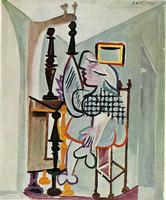
Woman by the dresser
Pablo Picasso
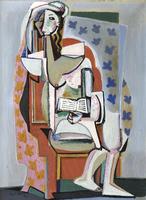
Žena v křesle s knihou
Emil Filla
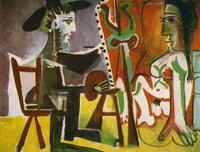
Painter and his model
Pablo Picasso
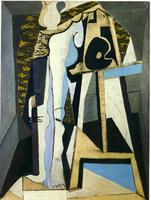
Interior with easel
Pablo Picasso
Still Life with Gourds
Henri Matisse
Rain
Louis Marcoussis
Still Life with Bottle and Glass
Juan Gris
An artist
Pablo Picasso
L’Atelier sur la terrasse de Mirmande
André Lhote