
Analisi esperta di Matador di Pablo Picasso
Stile: Cubism, Surrealism · Genere: portrait
Expert Analysis: Matador (1970) by Pablo Picasso
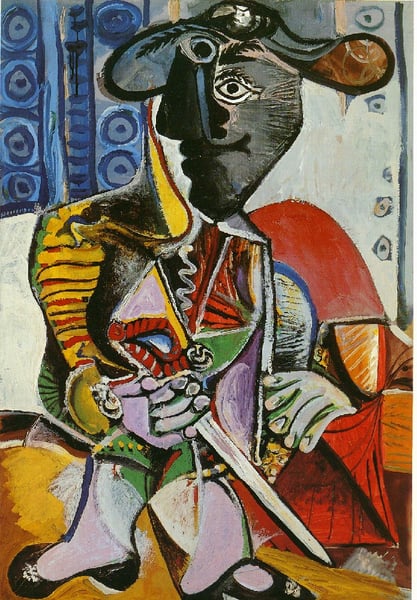
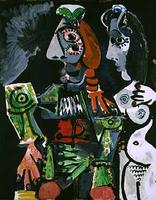
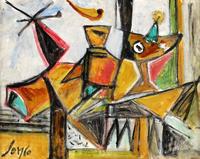
Pablo Picasso’s Matador stands as a powerful synthesis of two pivotal modernist movements—Cubism and Surrealism—executed during the artist’s Later Years (roughly the late 1960s to 1973). Painted when Picasso was nearly 90, this portrait of a bullfighter is not merely a depiction but a raw, psychological excavation of the artist’s lifelong obsession with the Spanish tradition of tauromachy.
Significance within its Style and Period
-
Cubist Inheritance: The painting retains Cubism’s fractured planes and faceted geometry, but here the distortion is looser and more gestural. The matador’s face is split into multiple viewpoints—profile and three-quarter view coexist—while his body is reduced to bold, angular blocks of color. This is not the analytical Cubism of 1910; rather, it is late-Cubist bravura, where form is aggressively simplified to emphasize the figure’s symbolic power rather than spatial logic.
-
Surrealist Imagination: The Surrealist influence manifests in the dreamlike, almost grotesque exaggeration of features. The matador’s eye is enlarged and staring, as if in a trance or fatal encounter. The hat and cape are rendered as biomorphic shapes that seem to merge with the figure rather than sit upon it—a hallmark of Surrealist “psychic automatism.” Picasso pushes the portrait into the realm of the subconscious, where the matador becomes an archetype of courage, mortality, and erotic tension.
-
Later Years Synthesis: In his final decade, Picasso often revisited themes from his Spanish heritage, blending them with a raw, urgent style that defied the refinement of his earlier periods. Matador is significant as a testament to the artist’s unbroken creative energy: the brushwork is rapid, almost violent, and the color palette ( heavy blacks, whites, and blood reds) evokes both the dust of the bullring and the brutality of old age. It is a portrait that refuses to be merely decorative; it confronts the viewer with the dualities of life and death, mask and self.
Why It Matters
Matador exemplifies how Picasso, at the end of his career, collapsed the distinctions between Cubism’s formal rigor and Surrealism’s psychological depth. It is a portrait that is both iconic and idiosyncratic—a final, defiant assertion that portraiture could still be a vehicle for myth, memory, and the raw material of the artist’s own psyche. In the context of his later years, it reveals a master who had internalized his own innovations and recombined them into a language that was more emotional, more direct, and utterly unforgettable.
Visivamente simili
20 opere con composizione e palette affini
The Man with a Pipe
Pablo Picasso
Musketeer with pipe
Pablo Picasso
Embrace
Pablo Picasso
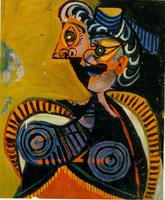
Untitled
Pablo Picasso
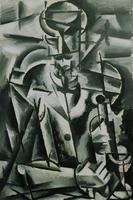
Blotter
Josef Capek
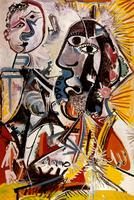
Big heads
Pablo Picasso
Untitled (Couple)
Charles Alston
Bust of a woman
Pablo Picasso
Figure avec Arbre
Sandro Chia
Crouching man
Pablo Picasso
Matador and female nude
Pablo Picasso
Sem título
Joaquim Rodrigo
Standing female nude and man with pipe
Pablo Picasso
Seated woman
Pablo Picasso
Bust of woman
Pablo Picasso
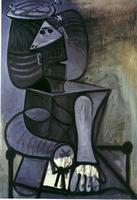
Seated woman with flat hat
Pablo Picasso
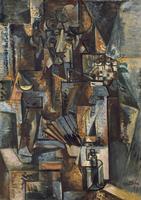
Žena S Vějířem
Emil Filla
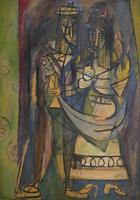
The Fiance
Wifredo Lam
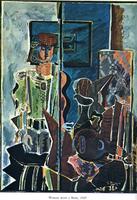
Woman with Book
Georges Braque
Still Life
Marcel Janco