
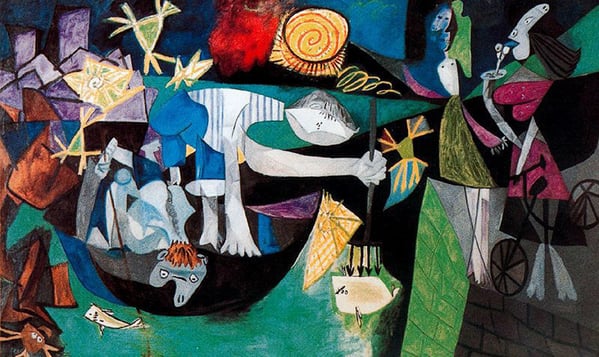
Night fishing at Antibes
詳細
Pablo Picasso の Night fishing at Antibes の専門的な分析
スタイル:Surrealism · ジャンル:genre painting
Expert Analysis of Night Fishing at Antibes (1939) by Pablo Picasso
Painted during a pivotal moment in Picasso’s career—his Neoclassicist & Surrealist Period—Night Fishing at Antibes stands as a vivid testament to the artist’s ability to fuse seemingly opposed stylistic impulses into a single, charged composition. The work is classified as a genre painting, but it transcends everyday scenes through the lens of Surrealism, transforming a simple night-fishing outing into a psychological and symbolic tableau.
What makes it significant:
-
Fusion of Neoclassical Order and Surrealist Disruption
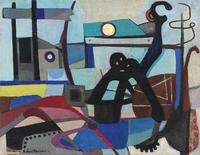
Although created during Picasso’s Neoclassicist & Surrealist Period, the painting deliberately pits classical stability against dreamlike distortion. The composition retains a structured, almost frieze-like arrangement reminiscent of classical reliefs—figures are placed across a shallow foreground space. Yet these figures are radically manipulated: the fishermen’s bodies are elongated, their faces seen in simultaneous profile and front view; a nude woman floats beside a small boat, her form fractured into elegant but impossible curves. The scene is grounded in the real location of Antibes, yet treated with the irrational logic of Surrealism. -
A Surrealist Genre Scene
As a genre painting, Night Fishing at Antibes depicts everyday life—local fishermen at work under the moon. But Picasso infuses this ordinary activity with dark, mysterious undercurrents. Two fishermen haul a net, while a bicyclist (a motif Picasso often used to suggest movement and modernity) speeds along the shore. The moon glows like an eye, casting an eerie, theatrical light. The inclusion of a small, gridded bathhouse on stilts and a floating figure (perhaps a bather or a mythological nymph) blurs the boundary between observed reality and subconscious vision. This tension between the mundane and the hallucinatory is a hallmark of Surrealist genre painting. -
Symbolic Complexity of Night and Water
The night setting allows Picasso to explore themes of isolation, labor, and the unconscious. The dark blue and violet palette, punctuated by the warm glow of lanterns and moon, creates a psychologically charged atmosphere. The fishermen’s struggle with the net becomes a metaphor for the creative act itself—hauling forms from the depths of the imagination. Meanwhile, the ghostly female bather echoes classical nereids, linking the work to Picasso’s neoclassical fascination with the Mediterranean heritage, yet her unnaturally large hand and staring face push the scene firmly into Surrealist territory. -
Transitional Masterpiece
Painted in 1939, on the eve of World War II, the work captures Picasso’s personal synthesis of two dominant modes. The Neoclassicist & Surrealist Period was a time when Picasso moved between rigorous draftsmanship and freewheeling fantasy. Night Fishing at Antibes is one of the era’s most successful integrations: it retains the monumental scale and compositional clarity of his neoclassical figures (e.g., the female bather recalls his early-1920s classical women), while the disjointed space, radical foreshortening, and absurd juxtapositions fully embrace Surrealism’s liberation from rational order. The result is a painting that feels both timeless and unnervingly immediate.
Conclusion
Night Fishing at Antibes is significant as a high point of Picasso’s Neoclassicist & Surrealist Period, demonstrating how he could bend Surrealist spontaneity into a structured genre painting without losing either the dreamlike strangeness or the classical sense of proportion. It is a work that captures the duality of its moment—caught between the stability of the past and the disruptive energies of the modern unconscious—and remains a haunting vision of the Mediterranean night, transformed by Picasso’s singular imagination.
Museum / Gallery
視覚的に類似
構図やパレットが近い作品 20 件
In Grey
Wassily Kandinsky
All Saints day II
Wassily Kandinsky
Blue-Red Composition
Sandor Bortnyik
Bees
Louis Marcoussis
The key
Jackson Pollock
Improvisation. Gorge
Wassily Kandinsky
Acrobats
Albert Gleizes
Vanity Box
Kazimir Malevich
A revolta - A revolta das bonecas
Eduardo Viana
Moderne Movie Theater
Olga Rozanova
Still Life
Marcel Janco
Bucolic Landscape
Heinrich Campendonk
Fruit Bowl, Pipe and Newspaper
Juan Gris
Smokers
Fernand Leger
Tetragramista II
Oswaldo Vigas
Ritmi di oggetti
Carlo Carra
Embrace
Pablo Picasso
Still life with harp and violin
Georges Braque
Composition IV
Wassily Kandinsky
Struttura marina
Giuseppe Santomaso