
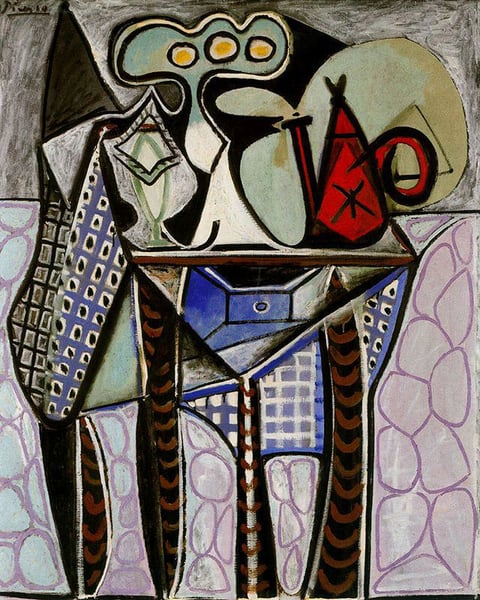
Still life on a table
Dettagli
Analisi esperta di Still life on a table di Pablo Picasso
Stile: Cubism, Surrealism · Genere: still life
Art Historical Analysis: Still Life on a Table by Pablo Picasso
Pablo Picasso’s Still Life on a Table is a compelling synthesis of two transformative movements—Cubism and Surrealism—created during his Neoclassicist & Surrealist Period (c. 1920s–1930s). In this work, Picasso pushes beyond the analytical fragmentation of early Cubism by infusing the still life genre with Surrealist dream logic and psychological weight.
Significance within Cubism:
The painting retains Cubism’s hallmark: the disassembly of objects into geometric planes and shifting perspectives. A bottle, fruit, and tabletop are rendered through angular facets and overlapping contours, challenging traditional notions of fixed viewpoint. However, unlike earlier Analytic Cubism (which often muted color to emphasize structure), here Picasso employs richer, more expressive hues. This coloristic boldness signals a transition toward a more synthetic, playful approach, where form is not merely analyzed but reassembled with emotional resonance.
Significance within Surrealism:
Picasso’s engagement with Surrealism is evident in the painting’s eerie, slightly dislocated reality. Objects seem to float or morph: a tabletop tilts vertiginously, a shadow defies logic, and spatial relationships become ambiguous. This destabilization of the familiar—a table as a domestic anchor—invites the viewer into a subconscious space, where everyday items are charged with uncanny life. The composition oscillates between order and chaos, mirroring the Surrealist interest in dream states and the irrational.
Bridge Between Movements and Period:
Still Life on a Table marks a crucial moment when Picasso reconciles Cubism’s intellectual rigor with Surrealism’s liberating irrationality. The Neoclassicist & Surrealist Period (a term often used by scholars to describe Picasso’s simultaneous embrace of classical figuration and avant-garde experimentation) is epitomized here: the subject is mundane, but its treatment is both analytical and fantastical. This duality makes the work significant as a record of Picasso’s refusal to be confined to a single style, instead forging a hybrid language that would influence generations of modernists.
In essence, Still Life on a Table is not merely a domestic arrangement but a laboratory where Cubist geometry meets Surrealist magic—a testament to Picasso’s ability to reinvent tradition while probing the limits of visual perception.
Visivamente simili
20 opere con composizione e palette affini
Great Still life on pedestal
Pablo Picasso
Two Women Seated by a Window
Albert Gleizes
Leeks, fish head, skull and pitcher
Pablo Picasso
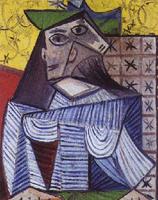
Female bust (Portrait de Dora Maar)
Pablo Picasso
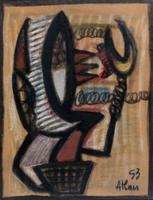
Untitled
Jean-Michel Atlan
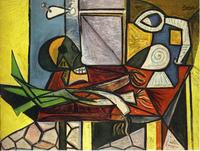
Skull and leeks
Pablo Picasso
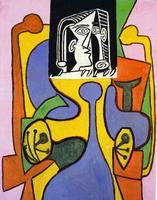
Woman sitting in an armchair
Pablo Picasso
Meditation of the Painter
Andre Masson
Breakfast
Pablo Picasso
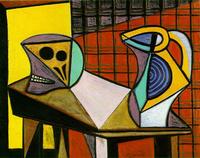
Crane and pitcher
Pablo Picasso
Seated woman with blue and red hat
Pablo Picasso
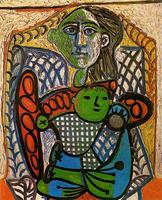
Claude in the arms of his mother
Pablo Picasso
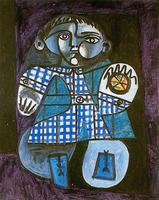
Claude with a ball
Pablo Picasso
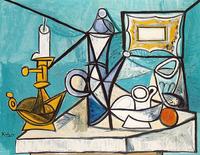
Still life with lamp
Pablo Picasso
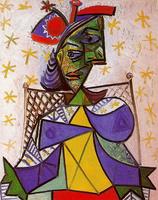
Woman sitting in an armchair
Pablo Picasso
Desertique
Bram van Velde
Untitled
Artin Demirci
Painting
Arshile Gorky
Bust of woman
Pablo Picasso
Woman sitting in an armchair
Pablo Picasso