
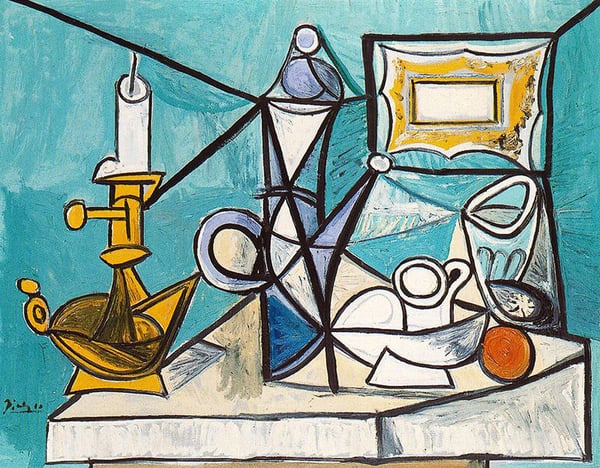
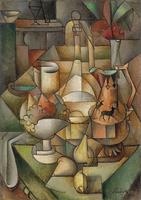
Still life with lamp
Dettagli
Analisi esperta di Still life with lamp di Pablo Picasso
Stile: Surrealism · Genere: still life
Expert Analysis: Still Life with Lamp by Pablo Picasso (Surrealist Period)
Context within Picasso’s Oeuvre
Pablo Picasso’s Still Life with Lamp belongs to his Neoclassicist & Surrealist Period (roughly 1920s–1930s), a phase marked by a dialectical tension between orderly, monumental forms (inherited from his post‑Cubist return to classicism) and the irrational, dream‑like distortions championed by the Surrealist movement. The work resides at the crossroads of these two impulses, making it a pivotal example of how Picasso synthesized—and subverted—both styles within the humble genre of still life.
Stylistic Significance
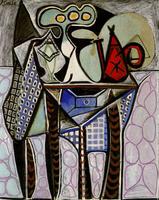
The painting is classified as Surrealist, yet its subject matter—a domestic lamp, table, and objects—reflects the quotidian roots of still life. Picasso subverts this tradition by deforming and dislocating the lamp into a biomorphic, almost organic shape. The lamp’s stem and shade might morph into a hybrid of plant, limb, or mechanical part, evoking the Surrealist fascination with the uncanny transformation of ordinary things. This aligns with André Breton’s definition of Surrealism as “pure psychic automatism,” yet Picasso’s disciplined handling of form (hinting at neoclassical solidity) reveals a conscious, controlled manipulation of reality rather than pure automatic expression.
Genre Innovation
As a still life, the work defies the genre’s usual goal of faithful representation. Instead, Picasso uses the lamp as a catalyst for exploring perspective, scale, and spatial ambiguity. The lamp’s light (implied rather than literal) becomes a metaphor for the unconscious mind illuminating the banality of the still‑life setup. This approach was radical in the 1920s: it transformed still life from a static arrangement into a psychological stage where objects seem to breathe, stretch, or dream.
Period Hybridity
The piece’s significance is heightened by its position within Picasso’s Neoclassicist & Surrealist Period. The neoclassicist leanings appear in the compositional stability and the volumetric handling of the lamp’s base, while Surrealist freedom emerges in the warped contours and ambiguous negative spaces. This synthesis demonstrates Picasso’s rejection of stylistic orthodoxy, proving that even within a single canvas, he could oscillate between order and chaos—a hallmark of his genius.
Legacy
Still Life with Lamp exemplifies how Picasso expanded still life beyond mere depiction, using the genre to investigate perception, memory, and the subconscious. It remains a key work for understanding the transition from Cubism to Surrealism, and for appreciating how Picasso could infuse a seemingly simple domestic object with the eerie, poetry‑laden energy of a dream.
Museum / Gallery
Visivamente simili
20 opere con composizione e palette affini
Untitled (Still life)
Paul Klee
The blue coffeemaker
Marcel Gromaire
Naturaleza Muerta Composicion
Maria Blanchard
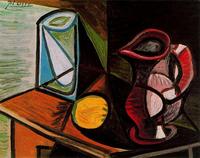
Glass and pitcher
Pablo Picasso
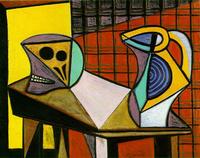
Crane and pitcher
Pablo Picasso
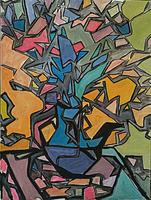
Vase bleu et fleurs
Cricorps
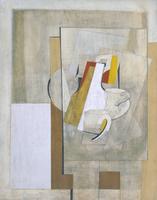
1945 (still life)
Ben Nicholson
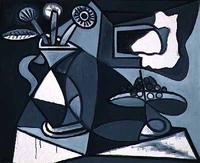
Vase with flowers
Pablo Picasso
Nature morte à la pipe
Serge Charchoune
Still Life
M. H. Maxy
Still Life with a Jug
Margit Selska
Still Life with White Tablecloth
Juan Gris
Jug, candle and enamel pan
Pablo Picasso
Still Life with Bottle and Glass
Juan Gris
Skull and leeks
Pablo Picasso
Still life on a table
Pablo Picasso
Bálint Endre, Asztali Csendélet 1947
Endre Balint
Composition with a Vase
Gustave Buchet
Still Life
Marcel Janco
Nature morte
Jean Metzinger