
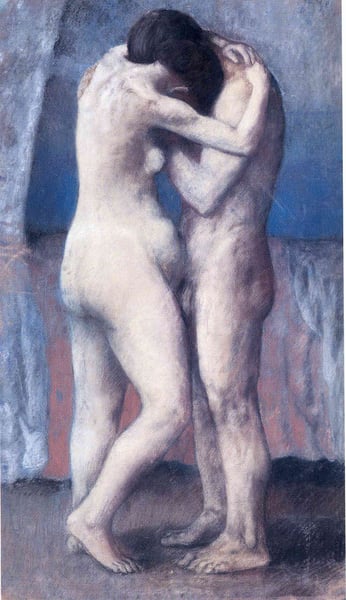
Analisi esperta di The Embrace di Pablo Picasso
Stile: Post-Impressionism · Genere: genre painting
Expert Analysis of "The Embrace" by Pablo Picasso
Pablo Picasso’s “The Embrace” (c. 1903) is a defining work of his Blue Period, executed within a Post-Impressionist framework and categorized as a genre painting—a scene of everyday life, here transformed into a profound meditation on human connection amid suffering.
Significance within the Blue Period
The Blue Period (1901–1904) marks Picasso’s shift toward a melancholic, monochromatic palette dominated by blues and blue-greens, reflecting themes of poverty, alienation, and emotional isolation. “The Embrace” exemplifies this focus: two figures locked in a tender yet somber embrace, their elongated forms and downward gazes evoking a sense of shared sorrow rather than romantic joy. The cool, nearly monochrome hues drain the scene of warmth, amplifying the emotional intensity—a hallmark of Picasso’s early Post-Impressionist influence.
Post-Impressionist Characteristics
While Post-Impressionism (led by Cézanne, Van Gogh, Gauguin) emphasized subjective emotion and symbolic content over naturalism, Picasso adapts these principles here. The brushwork is expressive, with visible strokes shaping the figures’ contours, and the composition prioritizes emotional resonance over anatomical precision. The awkward, almost sculptural embrace—heads pressed together, arms encircling—suggests a spiritual union born from shared hardship, aligning with the Post-Impressionist interest in conveying inner truth.
Genre Painting as Social Commentary
As a genre painting, “The Embrace” transcends mere depiction of a couple. In Picasso’s Blue Period, ordinary people—beggars, mothers, the destitute—become symbols of universal suffering. The figures’ simplified, mask-like faces recall Iberian sculpture and El Greco’s elongated saints, blending realism with a timeless, almost biblical quality. This elevates the intimate act of embracing into a statement on human resilience within poverty.
Legacy
“The Embrace” is pivotal because it crystallizes Picasso’s transition from decorative Post-Impressionism to a deeply personal, socially conscious style. It foreshadows his later Cubist deconstruction of form, yet here the emotional weight is carried entirely by color and line. The work stands as a testament to how the Blue Period’s stylistic constraints—limited palette, flattened space—intensified Picasso’s ability to convey empathy and existential solitude, cementing his role as a modern master.
Museum / Gallery
Visivamente simili
20 opere con composizione e palette affini
Untitled
Bruno Schulz
Standing female nude, her arms located in front of the chest
Paula Modersohn-Becker

Three Nudes
August Macke
The Three Graces
Edward Burne-Jones
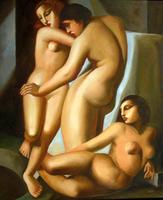
Women Bathing (detail)
Tamara de Lempicka
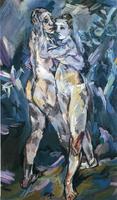
Two Nudes (Lovers)
Oskar Kokoschka
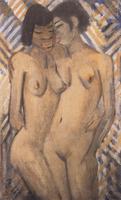
Zwei Negermädchen
Otto Mueller
[Nude Female] First Study for: Adoration of the Ages
James Taylor Harwood
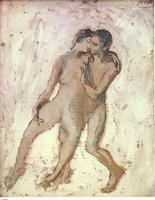
Nudes interlaces
Pablo Picasso
Adam and Eve
Edvard Munch
Two nude women
Pablo Picasso
Two nude women
Pablo Picasso
Standing Female Nude
Thomas Eakins
Life
Pablo Picasso
Zwei Mädchen
Otto Mueller
Standing Male and Seated Female Nudes
Vincent van Gogh

Old man and young girl
Dan Witz
Nude Woman Standing
Paul Cezanne
Untitled
Mark Rothko
Naked woman in the mirror
Federico Zandomeneghi