
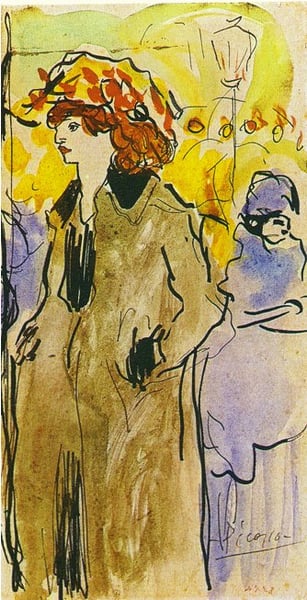
Expert analysis of Pablo Picasso’s Woman on the street
Style: Art Nouveau (Modern) · Genre: genre painting
Expert Analysis of Woman on the Street by Pablo Picasso (Early Years, Art Nouveau Style)
This early work by Picasso captures a fleeting, everyday moment—a woman walking along an urban thoroughfare—yet elevates it through the lens of Art Nouveau’s sinuous elegance. Painted during Picasso’s formative years, before his Blue and Rose periods, Woman on the Street exemplifies his youthful experimentation with modern currents while still rooted in traditional genre painting.
Significance within the Art Nouveau Style
Art Nouveau, with its organic, flowing lines and decorative sensuality, is typically associated with architecture, graphic arts, and design. Picasso’s application of its principles to a genre scene is significant because it demonstrates the style’s adaptability beyond pure ornament. Here, the woman’s silhouette is likely defined by a graceful, undulating contour—her dress, hair, or posture echoing the characteristic whiplash curves of Art Nouveau ironwork or poster art. The street itself becomes a stylized setting, where pavement lines, lampposts, or shop windows are simplified into rhythmic, linear patterns that flatten pictorial space, a hallmark of Modernist departure from academic perspective.
Significance within Picasso’s Early Period
During his early years (roughly 1895–1901), Picasso absorbed influences from Catalan Modernisme, Symbolism, and the bohemian life of Barcelona and Paris. Woman on the Street is notable for its shift away from the sentimental or religious subjects of his childhood training, toward the anonymous urban experience. This interest in the quotidian—a woman alone, absorbed in her own path—foreshadows his later fascination with figures in public spaces, such as the Harlequins of his Rose Period or the fragmented forms of Cubism. The painting also reveals Picasso’s growing command of mood over narrative: the woman’s isolation, the cool street, and the ornamental backdrop create a modern, almost cinematic tension.
Legacy as a Genre Painting
As a genre scene, Woman on the Street records a slice of modern life, a subject that nineteenth-century realists like Degas and Cassatt had made compelling. Picasso, however, injects a decorative, anti-naturalistic quality—the street becomes a pattern, the woman an emblem of urban anonymity. This fusion of high style with everyday reality marks an important step in Picasso’s development: he is no longer merely recording, but transforming the ordinary through a modern aesthetic lens. The work stands as a subtle bridge between the decorative fin-de-siècle and the radical formal inventions that would soon define the twentieth century.
Visually similar
20 works with related composition and palette
In Moulin Rouge
Henri de Toulouse-Lautrec
Street Scene with Green Cocotte
Ernst Ludwig Kirchner
Couple walking
Pablo Picasso
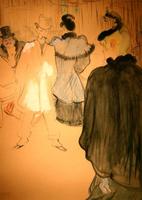
La Goulue and Paul Lescau
Henri de Toulouse-Lautrec
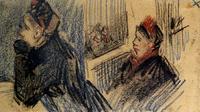
Two Women in a Balcony Box
Vincent van Gogh
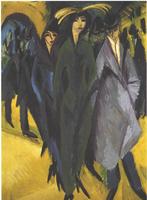
Women on the Street
Ernst Ludwig Kirchner
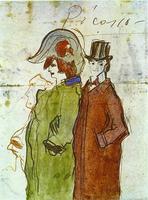
Picasso with partner
Pablo Picasso
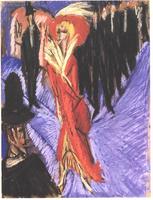
Red Cocotte
Ernst Ludwig Kirchner
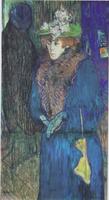
Jane Avril enter the Moulin Rouge
Henri de Toulouse-Lautrec
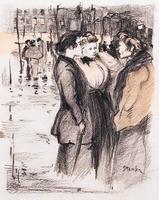
Craneuse - Original drawing
Theophile Steinlen
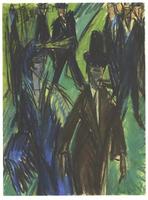
Street Scene
Ernst Ludwig Kirchner
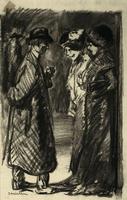
Le Rencontre
Theophile Steinlen
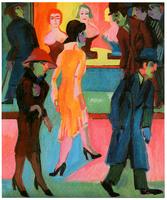
Street Scene in front of a Barbershop
Ernst Ludwig Kirchner
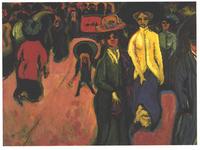
Street, Dresden
Ernst Ludwig Kirchner
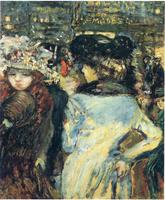
Two Elegant Ladies, Place de Clichy
Pierre Bonnard
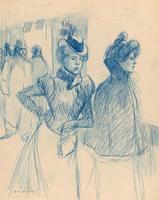
Two elegant women
Theophile Steinlen
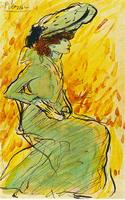
Seated woman in green
Pablo Picasso
Treport Beach (also known as A Very Sunny Day, Treport)
Maurice Prendergast
Afternoon in the Garden
August Macke
Organ player
Theophile Steinlen