
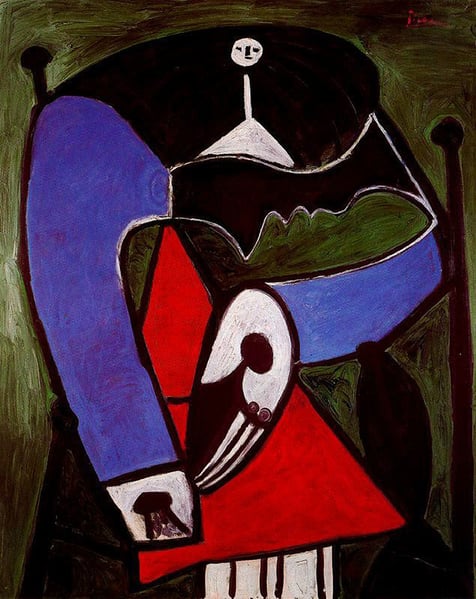
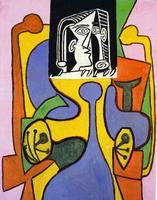
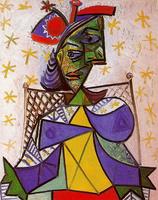
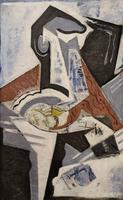
Woman sitting in an armchair
Dettagli
Analisi esperta di Woman sitting in an armchair di Pablo Picasso
Stile: Surrealism · Genere: portrait
Expert Analysis of "Woman Sitting in an Armchair" by Pablo Picasso
This portrait, executed during Picasso’s Neoclassicist & Surrealist Period, stands as a pivotal synthesis of two seemingly opposing aesthetic poles: the disciplined, monumental classicism of his early 1920s work and the dreamlike, psychologically charged distortions of Surrealism. While the subject—a woman in an armchair—recalls traditional seated portraiture, Picasso subverts convention through Surrealist reconfiguration of form and space.
Significance Within the Style and Period:
-
Surrealist Transformation of the Familiar – The armchair, a symbol of domestic stability, becomes a stage for irrational transformation. Picasso likely dislocates or multiplies the figure’s anatomy (common in his Surrealist portraits), merging the woman’s body with the chair’s structure to blur the boundary between human and object. This echoes the Surrealist goal of unlocking the subconscious by tampering with everyday reality.
-
Neoclassicist Underpinnings – Unlike the fully biomorphic distortions of later Surrealism, Picasso retains a sense of volumetric weight and simplified, sculptural lines inherited from his Neoclassical phase (e.g., the Women at the Well). The woman’s posture may suggest classical gravitas, yet her features are likely fragmented or reorganized, exposing the tension between ordered past and psychic rupture.
-
Transitional Artifact – Created at the height of the Surrealist movement (circa 1927–1932), this work represents Picasso’s personal negotiation with André Breton’s circle. It is significant for demonstrating how he refused complete surrender to Surrealist automatism, instead filtering its disruptive elements through his own cubist-derived logic and classical discipline. The armchair itself—a stable, familiar object—becomes a psychological armature on which anxiety and desire are projected.
Conclusion:
“Woman Sitting in an Armchair” is not merely a portrait but a compressed narrative of Picasso’s artistic journey. Its significance lies in how it uses Surrealist dislocation to liberate the portrait from naturalism while still grounding it in the structural harmony of his Neoclassicist period. The work encapsulates the modernity of the Surrealist Period: the familiar made strange, the human form made ambiguous, and the armchair transformed from a seat into a psychic theater.
Museum / Gallery
Visivamente simili
20 opere con composizione e palette affini
Seated woman with flat hat
Pablo Picasso
Femme au Fauteuil
Albert Gleizes
Seated Woman
Pablo Picasso
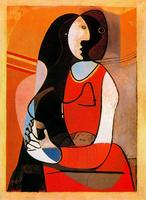
Seated woman
Pablo Picasso
Composition
Jean-Michel Atlan
Leeks, fish head, skull and pitcher
Pablo Picasso
Painting
Arshile Gorky
Woman sitting in an armchair
Pablo Picasso
Seated woman with blue and red hat
Pablo Picasso
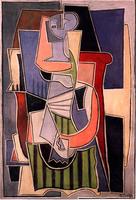
Woman sitting in an armchair
Pablo Picasso
Thursday Jeudi
Francis Picabia
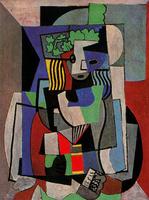
The student
Pablo Picasso
Untitled
Pablo Picasso
Lying female nude
Pablo Picasso
Skull and leeks
Pablo Picasso
1951
Karel Appel
Untitled
Jean-Michel Atlan
Woman sitting in an armchair
Pablo Picasso
Untitled
Jean-Michel Atlan
Composición
Maria Blanchard