Analisi esperta di Thursday Jeudi di Francis Picabia
Stile: Abstract Art · Genere: abstract
Expert Analysis of "Thursday Jeudi" by Francis Picabia
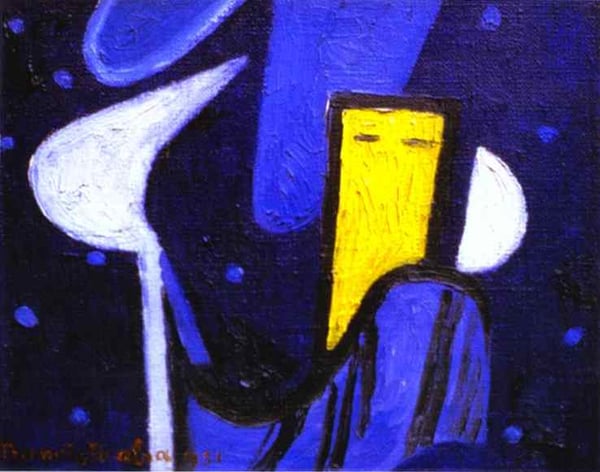
Francis Picabia’s "Thursday Jeudi" stands as a compelling example of early 20th‑century abstraction, a period in which the artist moved decisively away from representational forms toward pure visual language. Created within the broader context of Abstract Art, the work embodies the radical break from tradition that defined the avant‑garde.
Significance within Abstract Art
As an abstract composition, "Thursday Jeudi" refuses to depict recognizable objects, instead prioritizing color, line, and form as autonomous elements. Picabia’s abstraction was deeply influenced by his involvement with the Dada movement, where he embraced chance, irony, and a rejection of conventional meaning. The title itself—a bilingual repetition of “Thursday”—adds a layer of semantic play: it anchors the work in the mundane, yet the abstract treatment subverts any literal reading. This tension between language and visual abstraction is a hallmark of Picabia’s innovative approach.
Artistic Contribution
Picabia’s abstract works from this period were pivotal in expanding the boundaries of modern art. "Thursday Jeudi" demonstrates his mastery of dynamic composition, likely employing geometric or biomorphic shapes that interact with a sense of rhythm and spatial ambiguity. The painting’s significance lies in its assertion that art need not refer to the external world—instead, it can exist as an autonomous, self‑sufficient entity. This aligns with the broader Abstract Art movement’s goal of expressing pure emotion or intellectual ideas through non‑representational means.
Legacy
In the context of Picabia’s career, "Thursday Jeudi" represents a key moment of experimentation, where he oscillated between abstraction, mechanical imagery, and later figuration. Its existence underscores his restless creativity and his refusal to be confined by any single style. For art historians, the work is significant as a testament to the radical rethinking of artistic purpose that defined the early 20th century—a time when abstraction became a vehicle for questioning perception, reality, and the very nature of art itself.
Museum / Gallery
Genere
Stile
Visivamente simili
20 opere con composizione e palette affini
Femme au Fauteuil
Albert Gleizes
Naturaleza Muerta Con Tijeras
Maria Blanchard
Untitled
Jean-Michel Atlan
The arrival of the bird
Corneille
Calypso II
Jean-Michel Atlan
Composition
Jean-Michel Atlan
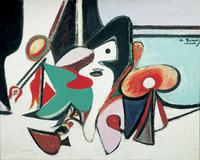
Painting
Arshile Gorky
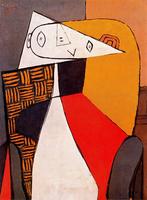
Seated Woman
Pablo Picasso
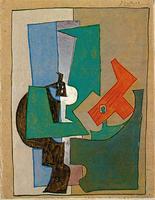
Pedestal
Pablo Picasso
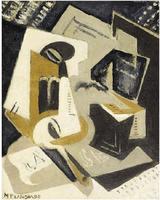
Composición
Maria Blanchard
Man with mandolin
Pablo Picasso
Couple at the seaside
Pablo Picasso
Composition, cubisme ornemental
Serge Charchoune
Composición
Maria Blanchard
Bodegón
Maria Blanchard
Seated woman with flat hat
Pablo Picasso
Woman sitting in an armchair
Pablo Picasso
Cuisinière
Mario Prassinos
Icône 3
Le Corbusier
Moon Woman
Jackson Pollock