
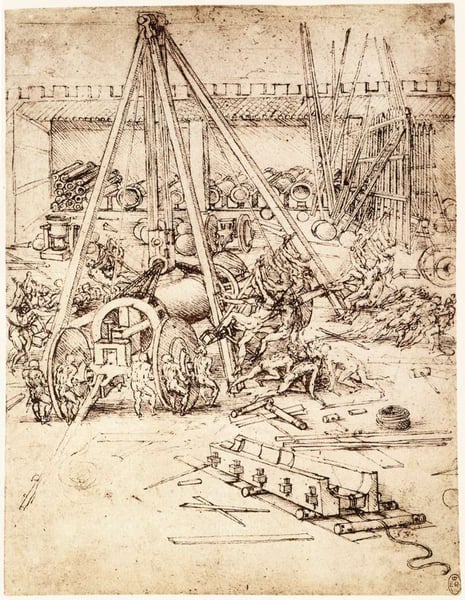
Expertenanalyse zu Leonardo da Vincis Cannon foundry
Stil: Early Renaissance · Genre: design
Expert Analysis of "Cannon Foundry" by Leonardo da Vinci
As an Early Renaissance design drawing, Leonardo da Vinci's "Cannon Foundry" exemplifies the period's revolutionary fusion of artistic precision with scientific inquiry. This work is significant for several reasons:
-
Bridging Art and Engineering: The piece is not merely a decorative sketch but a functional design study, showcasing da Vinci's unparalleled ability to translate mechanical concepts into highly detailed visual diagrams. During the Early Renaissance, artists increasingly examined the natural and built world through empirical observation; da Vinci's foundry drawing applies this same rigor to industrial processes, anticipating later technical illustration.
-
Innovation in Depiction of Machinery: The work captures the complex, multi-stage operation of casting cannons—from furnace design to molding and finishing. Da Vinci's analytical eye breaks down each component, using cross-sections and cutaway views that predate modern engineering blueprints. This demonstrates an early Renaissance understanding of perspective not just for spatial illusion, but for revealing internal mechanical functions.
-
Context of Military and Humanist Thought: The cannon foundry reflects the era's intersection of humanist learning and practical military needs. Da Vinci, working for patrons like Ludovico Sforza, often designed siege weapons and fortifications. This drawing is significant because it elevates a mundane industrial subject to the level of intellectual inquiry, treating the foundry as a system of forces, materials, and labor—a microcosm of Renaissance problem-solving.
-
Execution and Style: Despite being a design, the sheet displays da Vinci's characteristic delicate hatching and precise linework, typical of his silverpoint and ink studies. The composition balances chaos (workers, flames, machinery) with orderly notation, reflecting the Early Renaissance desire to harmonize nature with rational design.
In summary, "Cannon Foundry" stands as a landmark of the Early Renaissance because it embodies the artist-engineer ideal, using art as a tool for analysis and invention, and documents the technological ambition that defined the age.
Visuell ähnlich
20 Werke mit ähnlicher Komposition und Farbpalette
An Artillery Park
Leonardo da Vinci
The Crusaders' War Machinery
Gustave Dore
Ships
Johann Karl Schultz
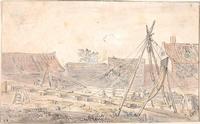
a Shipyard
Hendrick Avercamp
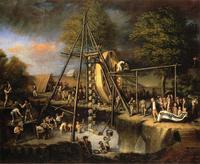
Exhumation of the Mastadon
Charles Willson Peale
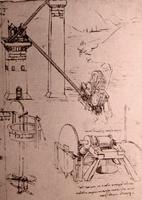
Drawings of machines
Leonardo da Vinci
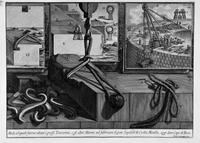
The Roman antiquities, t. 3, Plate LIV. Way in which they were raised big travertine, marble and other produce in the large tomb of Cecilia Metella.
Giovanni Battista Piranesi
The Rebuilding of the Temple Is Begun
Gustave Dore
Exlibris С. М.
Oleksandr Aksinin
Kondor Béla, Felkészülés a Forradalomra
Kondor Béla
Scissors Grinder
Adriaen van Ostade
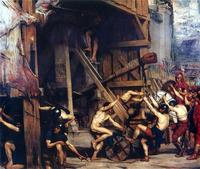
The Catapult
Edward Poynter
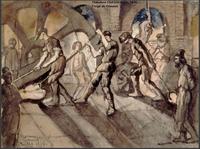
Forge du Creusot
Theodore Chasseriau
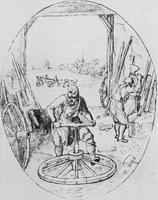
Bij De Wagenmaker. Tekening
Hendrick Avercamp
Don Quixote
Gustave Dore
Derricks
Martin Lewis
Drawings of Water Lifting Devices
Leonardo da Vinci
The Thin Kitchen
Pieter Bruegel the Elder
Don Quixote
Gustave Dore
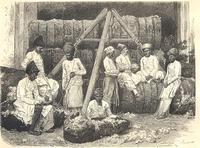
The cotton market
Émile Bayard