Analisi esperta di Bharagarh Fort di Nicholas Roerich
Stile: Symbolism · Genere: landscape
Expert Analysis of "Bharagarh Fort" by Nicholas Roerich
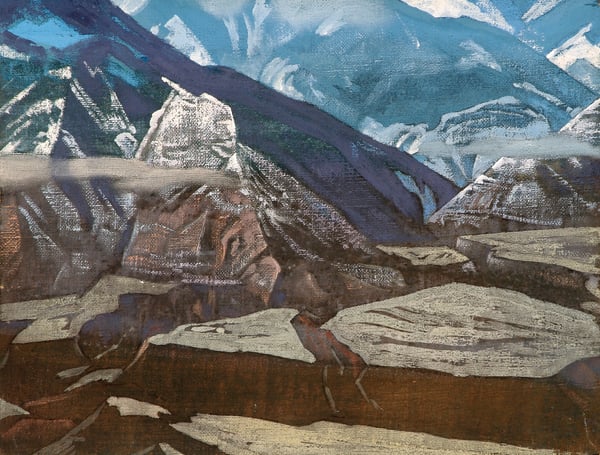
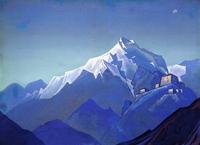
As a work firmly rooted in the Symbolist movement, Nicholas Roerich’s Bharagarh Fort transcends mere landscape depiction to become a meditation on the mystical and eternal. Roerich, known for his profound connection to the Himalayas and his role as a spiritual philosopher, transforms this fort—likely a historic structure in Rajasthan—into a symbol of resilience, timelessness, and the meeting of human ambition with the sublime forces of nature.
Significance within Symbolism and the Landscape Genre
-
Symbolist Vision: Roerich avoids realistic topographical detail. Instead, he uses the fort as a geometric anchor within a dreamlike, luminous atmosphere. The stark, often monochromatic or intensely colored skies (a hallmark of his palette) suggest a spiritual dimension—the fort becomes a silent witness to cosmic cycles, not merely a historical artifact. This aligns with Symbolism’s goal of expressing inner truths and abstract ideas through concrete forms.
-
Landscape as Metaphor: In Roerich’s hands, the landscape is never passive. The fort’s crenellations and massive walls, rendered in simplified, almost abstract shapes, echo the rocky terrain, blurring the line between human creation and natural geology. The painting invites contemplation on the transience of human power against the backdrop of enduring mountains (or desert, depending on the specific location). This is typical of Roerich’s later “Masters of the Himalayas” phase, where every peak and fortress becomes a spiritual beacon.
-
Color and Light: Roerich’s characteristic use of vivid, often unnatural blues, purples, and golds—reminiscent of Russian icon painting and Theosophical influences—imbues Bharagarh Fort with a quiet, sacred radiance. The fort may glow in the foreground or sit in shadow, but the light source is always metaphysical, suggesting an inner illumination that transcends physical time.
Conclusion: Bharagarh Fort is significant as a quintessential Roerichian landscape—a symbolist work that uses a historical site to speak to the eternal. It exemplifies how Roerich merged his archaeological fascination with a spiritual worldview, creating landscapes that are not just seen but felt as thresholds to higher realms. This piece stands as a testament to Symbolism’s power to imbue the natural world with profound, often esoteric meaning.
Museum / Gallery
Visivamente simili
20 opere con composizione e palette affini
Devita
Nicholas Roerich

Lahaul
Nicholas Roerich
Mount “M”
Nicholas Roerich
All ridge
Nicholas Roerich
Glaciers of Lahaul
Nicholas Roerich

Guru Guri Dhar
Nicholas Roerich
Mountains
Nicholas Roerich
Kuluta
Nicholas Roerich
Bell Mountain
Nicholas Roerich
Kuluta. Dobi Nulla.
Nicholas Roerich
Mount "M"
Nicholas Roerich
Study of mountains
Nicholas Roerich
Manasbal Lake
Nicholas Roerich
Everest
Nicholas Roerich
White Himalayas
Nicholas Roerich

Rohtang pass
Nicholas Roerich
Squad of Geser Khan
Nicholas Roerich

Himalayas
Nicholas Roerich

Himalayas. Chain of Kanchenjunga.
Nicholas Roerich
Himalayas. Blue mountains.
Nicholas Roerich