
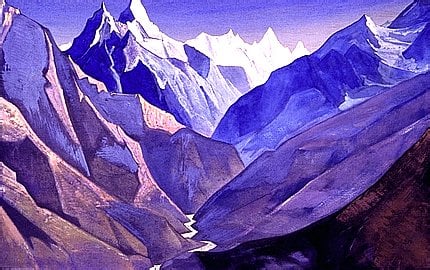
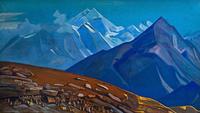
Mountains
Nicholas Roerich の Mountains の専門的な分析
スタイル:Symbolism · ジャンル:landscape
This analysis focuses on why "Mountains" by Nicholas Roerich is significant within the Symbolist movement and the artist’s broader spiritual vision.
Expert Art Historical Analysis: Mountains by Nicholas Roerich
Style & Context:
As a Symbolist landscape, Mountains does not aim for topographical accuracy. Instead, it uses the natural world as a vessel for metaphysical meaning. Symbolism, flourishing in the late 19th and early 20th centuries, rejected literal representation in favor of evoking inner states, dreams, and spiritual truths. Roerich, a Russian-born artist and mystic, was deeply influenced by Eastern philosophy, Theosophy, and his own expeditions to the Himalayas. His landscapes are meditations on the sublime—where matter and spirit meet.
Composition & Palette:
While the supplied facts give no specific visual details, Roerich’s characteristic treatment of mountains involves bold, simplified forms, luminous color harmonies (often deep blues, violets, and pinks), and a dramatic contrast between massive, silent peaks and a glowing sky. The mountains are not merely geological; they are thresholds—between earth and heaven, the mundane and the sacred. The lack of human figures or anecdotal detail forces the viewer into a contemplative encounter with the monumental.
Significance within Symbolism:
- Transcendence through Nature: Roerich’s mountains epitomize the Symbolist belief that landscape can express the inexpressible. Here, the peaks become archetypal symbols of aspiration, eternity, and spiritual enlightenment—a direct echo of the Himalayan reverence in Hindu and Buddhist traditions.
- Luminosity as Spirit: Roerich’s signature use of a radiant, almost inner light—often achieved by layering thin glazes—transforms a physical scene into a visionary experience. This aligns with the Symbolist goal of making the invisible visible.
- Cultural Synthesis: Roerich merged Russian Symbolism (with its roots in Orthodox icon painting and folk mysticism) with Eastern aesthetics. Mountains stands as a cross-cultural icon, linking the ethereal quality of Russian Symbolist painting to the meditative grandeur of Asian sacred landscapes.
Conclusion:
Mountains is significant not as a document of a place, but as a painted prayer. It demonstrates how Symbolist artists used landscape to explore the boundary between the material world and the cosmos—a boundary that Roerich, more than any other painter of his time, made feel tangible, vast, and holy.
視覚的に類似
構図やパレットが近い作品 20 件

Mount “M”
Nicholas Roerich
Mount "M"
Nicholas Roerich
Bell Mountain
Nicholas Roerich

Lahaul
Nicholas Roerich

Guru Guri Dhar
Nicholas Roerich

Himalayas
Nicholas Roerich
Himalayas
Nicholas Roerich
Study of Belukha
Nicholas Roerich
Himalayas. Blue mountains.
Nicholas Roerich
Himalayas
Nicholas Roerich

Himalayas
Nicholas Roerich

Teacher's order
Nicholas Roerich
Central Himalayas
Nicholas Roerich

Everest
Nicholas Roerich
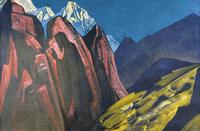
Shadow of the Teacher
Nicholas Roerich
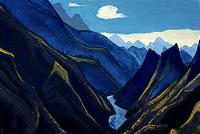
Himalayas
Nicholas Roerich
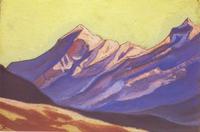
Himalayas
Nicholas Roerich

Nanda Devi
Nicholas Roerich
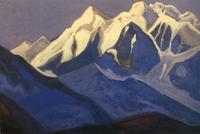
Snowy peaks
Nicholas Roerich
Vyas Kund
Nicholas Roerich