
Analisi esperta di Bridge of Glory di Nicholas Roerich
Stile: Symbolism · Genere: cloudscape
Expert Analysis: "Bridge of Glory" by Nicholas Roerich
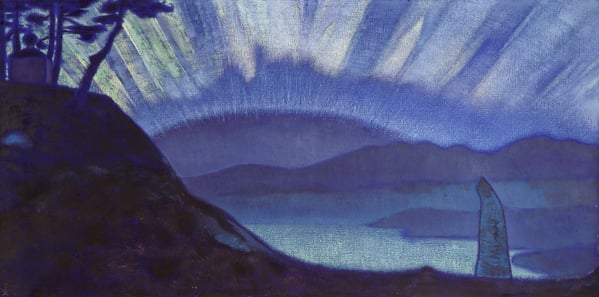
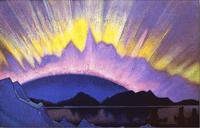
Nicholas Roerich’s “Bridge of Glory” is a quintessential work of Symbolist cloudscape painting, a genre that Roerich elevated from mere atmospheric study to a vehicle for metaphysical meaning. In this piece, the artist transforms a natural cloud formation into a luminous, arching bridge—a threshold between the earthly and the divine.
Significance within Symbolism and Roerich’s Oeuvre
-
Symbolic Transformation: The “bridge” motif is central to Roerich’s spiritual philosophy, representing the passage from the material world to higher planes of consciousness. By depicting clouds as a solid, radiant structure, Roerich blurs the line between natural phenomena and visionary architecture, embodying Symbolism’s rejection of literal representation in favor of inner truth.
-
Color and Mystical Light: Roerich’s palette—typically dominated by deep blues, golds, and iridescent whites—creates an otherworldly glow. The cloud-bridge acts as a focal point of unearthly radiance, suggesting glory not as human acclaim but as a divine, cosmic light. This treatment of light influences later Abstract and Spiritual art (e.g., Kandinsky).
-
Genre Innovation: Within the cloudscape genre, “Bridge of Glory” stands out for its narrative and symbolic density. Unlike Romantic cloud studies that emphasize transient beauty, Roerich’s clouds are eternal, structural, and intentional. The work anticipates the modernist fascination with the sublime, while remaining deeply rooted in Symbolist mysticism.
Conclusion: The significance of “Bridge of Glory” lies in its ability to synthesize observable nature with abstract spiritual longing. It exemplifies how Symbolist artists used landscape elements (here, clouds) as metaphors for transcendence, affirming Roerich’s role as a visionary bridge between late-19th-century Symbolism and 20th-century explorations of the unconscious and the cosmic.
Museum / Gallery
Visivamente simili
20 opere con composizione e palette affini

Beda the Preacher
Nicholas Roerich
Monhegan (Shining of night)
Nicholas Roerich
Spring Evening During the Ice Break
Hugo Simberg
The Language of the Forest
Nicholas Roerich
Star light
Konstantin Bogaevsky

Treasure
Nicholas Roerich
Egry József, Isola Bella
Egry József
Chalice of Christ
Nicholas Roerich
Paysage du Midi
Georges Ribemont-Dessaignes

Ice and Clouds
Arthur Dove
Himalayas
Nicholas Roerich
My road (I)
Mikalojus Konstantinas Ciurlionis
Violet Landscape
Janos Mattis-Teutsch

Night rider
Nicholas Roerich

Eclipse
Nicholas Roerich
Kuluta. Mountains before the sunset.
Nicholas Roerich

Study of mountains
Nicholas Roerich
At midnight. Light of the Shambhala.
Nicholas Roerich
The setting sun
Konstantin Bogaevsky
Sunset
Mikalojus Konstantinas Ciurlionis