
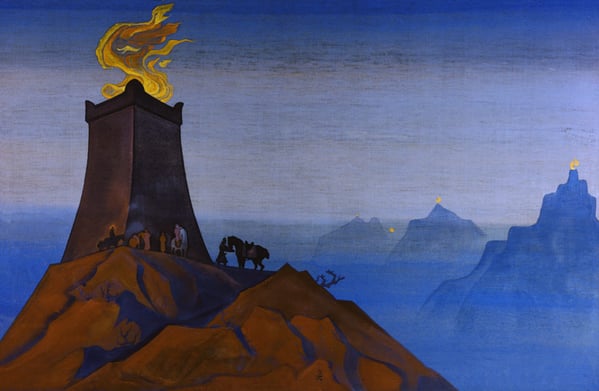
Analisi esperta di Flowers of Timur (The Lights of Victory) di Nicholas Roerich
Stile: Symbolism · Genere: landscape
Expert Analysis of Flowers of Timur (The Lights of Victory) by Nicholas Roerich
As a Symbolist landscape, this work transcends mere topography to become a vessel for metaphysical and historical meaning. Roerich, a master of Symbolism, uses the natural world not as an end in itself but as a conduit for spiritual and epic narratives.
Significance within Symbolism:
- The title itself—Flowers of Timur (The Lights of Victory)—anchors the landscape in the legacy of Timur (Tamerlane), the 14th-century conqueror. In Symbolist fashion, Roerich does not depict battles or portraits; instead, he evokes victory through nature. "Flowers" become the silent, enduring monuments of conquest, while "Lights of Victory" suggests a transcendent, almost divine radiance emanating from the land.
- The landscape genre here is elevated to a symbolic stage: the rugged mountains, vast plains, or stark horizons typical of Roerich’s work are not mere backdrops but active participants in the narrative. The “flowers” may be literal blooms or metaphorical bursts of light and color across the terrain, representing the spirit of triumph that outlasts war.
- Roerich’s palette—often rich in deep blues, purples, and golden ambers—creates a mystical atmosphere. The landscape is both earthly and ethereal, aligning with Symbolism’s rejection of literal representation in favor of evoking inner truths, myths, and the sublime.
Artistic and Historical Significance:
- Roerich was deeply influenced by Eastern philosophy, Central Asian travel, and theosophy. Flowers of Timur encapsulates his fascination with the Silk Road and the forgotten empires that shaped it. By framing a historical victory through the lens of a symbolic landscape, he invites viewers to contemplate how nature reclaims and memorializes human ambition.
- The work exemplifies the artist’s signature synthesis of Russian Symbolism with Asian motifs—a fusion that distinguishes him from his European contemporaries. The “victory” here is not glorified violence but a spiritual conquest, where light and flowers suggest peace transcending conflict.
- This painting is a testament to how Symbolist landscapes can carry layered meanings: the “Timur” reference implies a specific cultural memory, while the universal imagery of lights and flowers speaks to eternal cycles of glory, decay, and rebirth.
Conclusion:
Flowers of Timur (The Lights of Victory) is a landmark Symbolist landscape because it translates historical epic into an atmospheric, meditative vision. Roerich uses nature as a silent recorder of human drama, proving that within Symbolism, a mountain range or a field of flowers can speak louder than any battle scene. The work’s significance lies in its ability to make landscape itself the bearer of myth, memory, and the transcendent “lights” of victory.
Museum / Gallery
Visivamente simili
20 opere con composizione e palette affini
Fires of victory (Sentinel lights on the towers in Gobi)
Nicholas Roerich

Flowers of Timur (The Lights of Victory)
Nicholas Roerich
Himalayas. Monastery.
Nicholas Roerich
Mekheski - Moon People
Nicholas Roerich
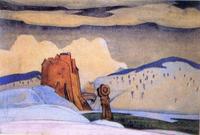
Winter
Nicholas Roerich

Gateway to Hell
Alfred Kubin

Gompa
Nicholas Roerich
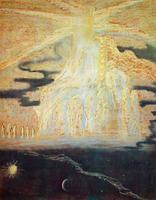
Hymn (II)
Mikalojus Konstantinas Ciurlionis

Silhouette
Nicholas Roerich

Zarathustra
Nicholas Roerich

Spell. New moon.
Nicholas Roerich
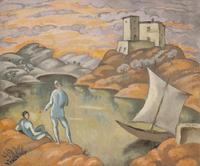
Landscape with Seafarers
Eugeniusz Zak

Lago Monti
Xul Solar

King Gesar
Nicholas Roerich

Defender. Cloud-archer.
Nicholas Roerich
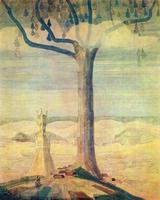
Andante (Sonata of the Summer)
Mikalojus Konstantinas Ciurlionis

Armageddon
Nicholas Roerich

Message from Shambhala
Nicholas Roerich
The Way of the Cross II
Marianne von Werefkin
Eastern altar
Konstantin Bogaevsky