Expertenanalyse zu Nicholas Roerichs Fires of victory (Sentinel lights on the towers in Gobi)
Stil: Symbolism · Genre: genre painting
Artwork Analysis: "Fires of Victory (Sentinel Lights on the Towers in Gobi)" by Nicholas Roerich
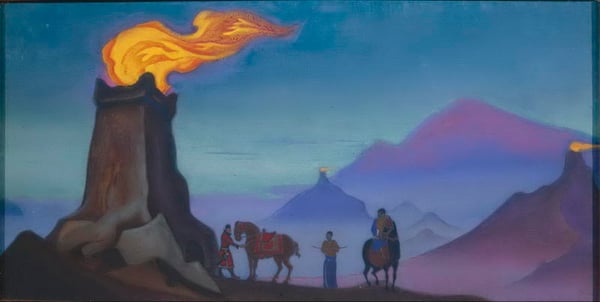
As a work of Symbolism, Nicholas Roerich’s painting transcends its genre painting label (depicting daily life or a specific scene) by imbuing a seemingly ordinary subject—beacon fires on watchtowers in the Gobi Desert—with profound metaphysical weight. The significance of this piece within Roerich’s oeuvre and the Symbolist movement lies in its fusion of the earthly and the spiritual, the ancient and the eternal.
Symbolist Context
Symbolism rejected mere realism, seeking instead to evoke inner emotion, myth, and the unseen. Roerich, deeply influenced by Theosophy, Eastern philosophy, and his own archaeological expeditions, often used the stark landscapes of Central Asia as a stage for cosmic drama. Here, the sentinel lights are not merely practical signal fires; they are beacons of spiritual vigilance and triumph. The title—“Fires of Victory”—suggests that the lights represent an inner conquest, perhaps over the vast, primal forces of the desert or over human ignorance. The Gobi, a place of harsh emptiness, becomes a liminal space where the material world meets the divine.
Aesthetic and Symbolic Significance
- Color and Light: Roerich’s characteristic palette—intense blues, deep purples, and fiery oranges—creates a twilight atmosphere where the flames glow with an almost supernatural intensity. This contrast between the cool, dark sky and the warm, radiant fires heightens the emotional impact: the lights are fragile yet defiant, ephemeral yet eternal.
- Form and Composition: The towers are simplified, almost geometric, echoing ancient stupas or meditation structures. They anchor the composition while the fires draw the eye upward, suggesting a journey from the physical to the spiritual. The vast, empty desert surrounding them emphasizes solitude and the monumental scale of human spiritual striving.
- Narrative vs. Symbol: Although a genre painting (a scene of daily watchman duty), Roerich strips away anecdotal detail. No figures are visible; the towers themselves become sentinels. The “victory” is not military but mystical—a triumph of consciousness over the void.
Significance within Symbolism and Roerich’s Career
- Cross-Cultural Synthesis: Roerich uniquely blended Russian Symbolist aesthetics with the spiritual iconography of the East. Here, the Gobi towers recall both Buddhist chortens and Siberian shamanic pillars, creating a universal symbol of enlightenment.
- Themes of Light and Darkness: Like other Symbolists (e.g., Gustave Moreau, Odilon Redon), Roerich used light to symbolize the soul’s awakening. The “sentinel lights” are guards against the spiritual darkness of materialism—a recurring theme in his series on the Gobi and the Himalayas.
- Legacy: This painting exemplifies Roerich’s vision of art as a vehicle for higher consciousness, a core tenet of the Symbolist movement’s later, more esoteric phase. It stands as a key work in his Pictures of Asia and The Flowers of the Gobi series, demonstrating how a simple genre scene can become a meditative icon.
In summary, Fires of Victory is significant because it transforms a mundane act—lighting beacons in the desert—into a rich symbol of spiritual resilience, perfectly embodying Symbolism’s quest to see beyond the visible into the realm of the eternal.
Visuell ähnlich
20 Werke mit ähnlicher Komposition und Farbpalette
Flowers of Timur (The Lights of Victory)
Nicholas Roerich
Flowers of Timur (The Lights of Victory)
Nicholas Roerich

Mother of Genghis Khan
Nicholas Roerich

Marvelous miracle (To the feat)
Nicholas Roerich
Hystaspes. Shahnameh.
Nicholas Roerich
Order of Rigden Jyepo
Nicholas Roerich

Voice of Mongolia
Nicholas Roerich
A depiction of the Cintamani being carried by the Lung Ta (Wind Horse)
Nicholas Roerich
Genghis Khan
Nicholas Roerich
Mongolian horseman
Nicholas Roerich

Oirot Messenger of the White Burkhant
Nicholas Roerich
Nastasia Mikulichna
Nicholas Roerich
Order of Rigden Jyepo
Nicholas Roerich

King Gesar
Nicholas Roerich
Prince Igor Campaign
Nicholas Roerich

Song of Shambhala
Nicholas Roerich
Chenrezig
Nicholas Roerich
Himalayas. Monastery.
Nicholas Roerich
M'han Pres La Cartera (Poema De Joan Brossa)
Joan Ponc

Mohammed the Prophet
Nicholas Roerich