Expert analysis of Alfred Kubin’s Gateway to Hell
Style: Symbolism · Genre: symbolic painting
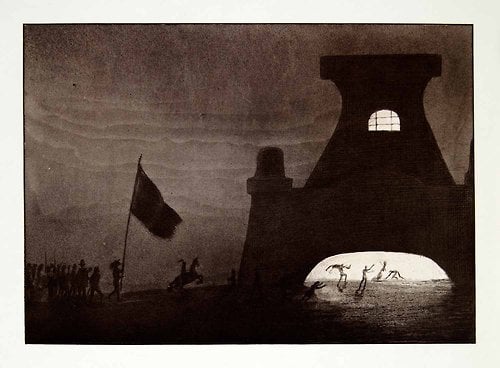
Analysis of "Gateway to Hell" by Alfred Kubin
Alfred Kubin’s "Gateway to Hell" stands as a quintessential example of Symbolist painting, a movement that prized subjective emotion, the macabre, and the visionary over naturalistic depiction. Created in the early 20th century, this work is significant for its powerful fusion of Symbolist allegory with a pre-Expressionist intensity, marking a transitional moment in modern art.
Stylistic and Thematic Significance
As a symbolic painting, "Gateway to Hell" operates not as a literal depiction of a mythological underworld, but as a psychological landscape. Kubin, deeply influenced by the works of Odilon Redon and James Ensor, uses dense, fluid lines and a monochromatic palette (characteristic of his preferred pen-and-ink technique) to evoke a sense of dread and entrapment. The "gateway" itself is often rendered as an architectural or organic threshold—half-crumbling stone, half-animalistic orifice—blurring the boundary between the real and the fantastical. This ambiguity is central to Symbolism: the viewer is not shown hell, but the feeling of approaching it.
Art-Historical Context
Kubin’s work foreshadows the darker currents of German Expressionism and the dream-logic of Surrealism. "Gateway to Hell" is especially significant because it exemplifies Kubin’s ability to translate personal anxiety and apocalyptic visions into a visual language that resonates universally. The intricate, often chaotic draftsmanship—spiders, chimeras, skeletal figures, and abyssal voids—creates a dense web of symbolism that resists a single interpretation, inviting endless psychological projection.
Legacy
Within Kubin’s oeuvre, "Gateway to Hell" is a key piece that showcases his mastery of the symbolic grotesque. It is not merely a frightening image but a sophisticated meditation on mortality, taboo, and the subconscious. The work’s lasting significance lies in its ability to evoke profound unease through pure line and shadow, establishing Kubin as a crucial link between the Symbolist fascination with the occult and the later 20th-century exploration of the irrational.
Visually similar
20 works with related composition and palette
Flowers of Timur (The Lights of Victory)
Nicholas Roerich
Fires of victory (Sentinel lights on the towers in Gobi)
Nicholas Roerich
Silhouette
Nicholas Roerich
Fortress (Fortress Fairy Tale)
Mikalojus Konstantinas Ciurlionis
Flowers of Timur (The Lights of Victory)
Nicholas Roerich
Age of Reason
Alphonse Mucha
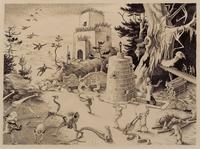
Fanciful Ink Drawing II
Franz Sedlacek
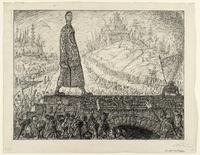
The Emperor of China
Alfred Kubin
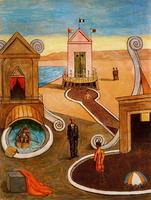
The Mysterious Bath
Giorgio de Chirico
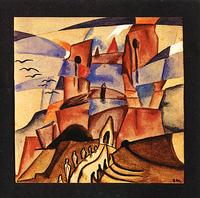
Penitentes
Xul Solar
Study of the Interior of Glass House
Joseph Wright
The key is here, the gate elsewhere
Victor Hugo
Searching for the Fourth Dimension
Salvador Dali
Mekheski - Moon People
Nicholas Roerich
Tombs in the desert
Nicholas Roerich
The Sawhorse
Giovanni Battista Piranesi
Madonna Laboris
Nicholas Roerich
Flying Bomb Depot (recto)
Graham Sutherland
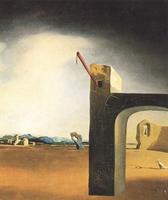
Morphological Echo'
Salvador Dali
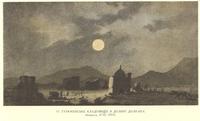
Turkmen cemetery in Dolnapa valley
Taras Shevchenko