Expert analysis of Nicholas Roerich’s Glow
Style: Symbolism · Genre: cityscape
Expert Analysis of “Glow” by Nicholas Roerich
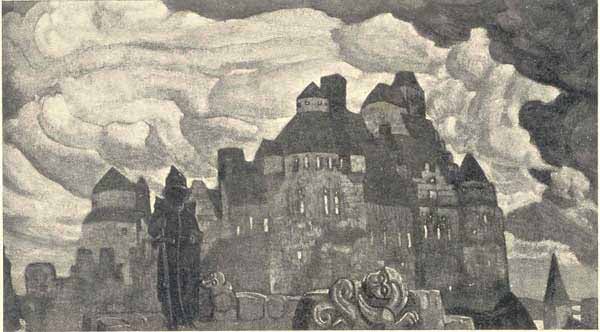
Nicholas Roerich’s Glow is a compelling example of Symbolist cityscape painting, a genre the artist used to transcend mere topographical representation and instead evoke metaphysical or spiritual dimensions. Within the Symbolist tradition, the city is rarely a literal, bustling metropolis; rather, it becomes a luminous cipher for inner vision, cosmic order, or the meeting of earthly and celestial realms.
What makes Glow significant within both Symbolism and Roerich’s oeuvre is its masterful manipulation of light and atmosphere. The title itself—“Glow”—signals that the painting’s primary subject is not the architectural forms themselves, but the ethereal radiance that suffuses them. In typical Symbolist fashion, color and light carry psychological and spiritual weight. Roerich bathes the city in a warm, golden or amber luminescence, transforming stone and tower into translucent, almost otherworldly shapes. This glow does not function as naturalistic daylight or sunset; it is an inner illumination, suggesting a sacred or utopian vision—a city of the soul rather than of maps.
The composition likely emphasizes verticality or a distant, panoramic view (common in Roerich’s cityscapes), directing the viewer’s gaze upward or into a hazy, glowing distance. This aligns with Symbolism’s rejection of detailed realism in favor of mood, suggestion, and allegory. The buildings may appear simplified, almost like silhouettes or stage flats, allowing the glow to dominate and unify the scene. Such treatment invites contemplation: the city becomes a threshold between the material world and a transcendent state of harmony or enlightenment.
Roerich’s genius in Glow lies in the seamless fusion of genre and style. The cityscape—often a modern, industrial subject—is here infused with ancient, mythic qualities. The glow can be read as a beacon of spiritual aspiration, a motif that recurs in Symbolist art to convey hope, revelation, or the eternal within the ephemeral. For viewers, the painting serves as a visual meditation, where the physical city dissolves into a vision of luminous unity. This ability to elevate a familiar genre into a realm of symbolic suggestion is what secures Glow a distinctive place in early 20th-century symbolic painting.
Visually similar
20 works with related composition and palette
Glow
Nicholas Roerich
Glow
Nicholas Roerich
St Anthony at the City
Albrecht Durer
Castle. The Doomed City.
Nicholas Roerich
Fairy-Land
Edmund Dulac
Viking's tomb
Nicholas Roerich
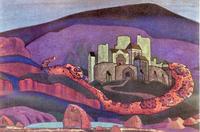
The Doomed City
Nicholas Roerich
Untitled
Nicholas Roerich
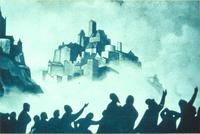
Armageddon
Nicholas Roerich
Rostov Veliky. Kremlin.
Nicholas Roerich
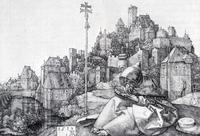
St. Anthony
Albrecht Durer
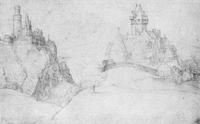
Two Castles
Albrecht Durer
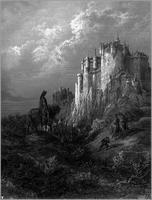
Idylls of the King
Gustave Dore
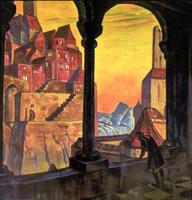
Cor Ardens
Nicholas Roerich
Tristan's castle
Nicholas Roerich
Ominous
Nicholas Roerich
Puss in Boots
Maxfield Parrish
City
Nicholas Roerich
Study of decoration
Nicholas Roerich
Castle with a certificate
Jacek Yerka