
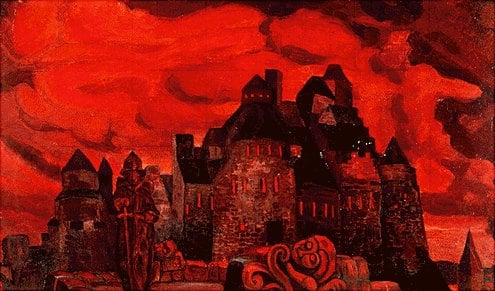
Analisi esperta di Glow di Nicholas Roerich
Stile: Symbolism · Genere: cityscape
Expert Analysis of "Glow" by Nicholas Roerich
Nicholas Roerich’s “Glow” stands as a quintessential example of Symbolist cityscape painting, where the artist transcends mere topographical representation to evoke a spiritual, almost metaphysical experience of the urban environment. Within the Symbolist tradition, Roerich prioritizes inner vision and emotional resonance over realistic depiction, and this work exemplifies that ethos through its treatment of light, color, and architectural form.
The title itself, “Glow,” points to the central device: an ethereal radiance that seems to emanate from within the city’s structures, as if the buildings themselves are animated by a sacred or cosmic energy. Roerich’s use of luminous, often otherworldly hues—deep blues, ambers, and golds—creates a dreamlike atmosphere where the boundary between the physical and the spiritual dissolves. The cityscape is not a specific, identifiable place but a symbolic archetype—perhaps a “city of the future” or a celestial Jerusalem—that invites contemplation of humanity’s higher aspirations.
Significant within Roerich’s broader oeuvre, “Glow” reflects his deep interest in Theosophy, Eastern philosophy, and the unity of human creativity with natural and divine forces. Unlike conventional cityscapes that celebrate human industry or civic pride, Roerich’s work subverts that genre by using the city as a metaphor for spiritual awakening. The glowing light functions as a symbol of enlightenment, hope, or a transcendent truth that lies just beyond ordinary perception.
In the context of Symbolism, “Glow” is notable for its rejection of Impressionist ephemerality in favor of a more durable, visionary stillness. Roerich’s bold, flat planes of color and simplified, almost medieval architectural forms lend the scene a timeless, iconic quality. The painting does not describe a moment but suggests a state of being—a quiet, luminous revelation. This is what makes “Glow” significant: it transforms a mundane subject (the city) into a vessel for the sublime, aligning perfectly with the Symbolist aim to “clothe the idea in sensible form.”
Visivamente simili
20 opere con composizione e palette affini
Glow
Nicholas Roerich
Glow
Nicholas Roerich
Fairy-Land
Edmund Dulac
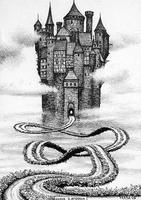
Castle with a certificate
Jacek Yerka
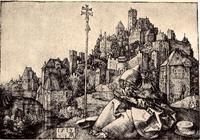
St Anthony at the City
Albrecht Durer
Untitled
Nicholas Roerich
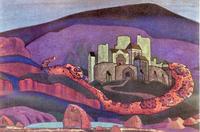
The Doomed City
Nicholas Roerich
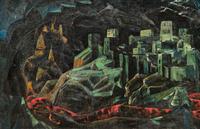
The Dead City
Nicholas Roerich
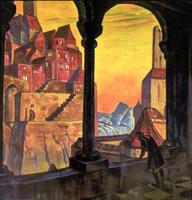
Cor Ardens
Nicholas Roerich
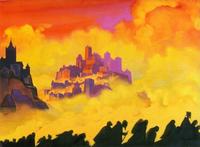
Armageddon
Nicholas Roerich
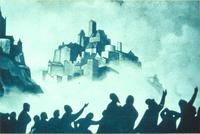
Armageddon
Nicholas Roerich
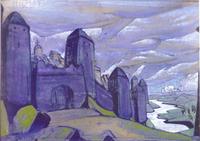
Yaroslavna's Lament
Nicholas Roerich
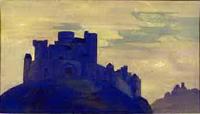
Castle. The Doomed City.
Nicholas Roerich
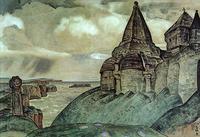
Viking's tomb
Nicholas Roerich
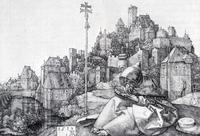
St. Anthony
Albrecht Durer
Two Castles
Albrecht Durer
City
Nicholas Roerich
Study of decoration
Nicholas Roerich
Ominous
Nicholas Roerich
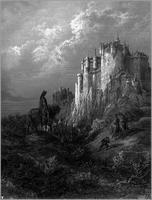
Idylls of the King
Gustave Dore