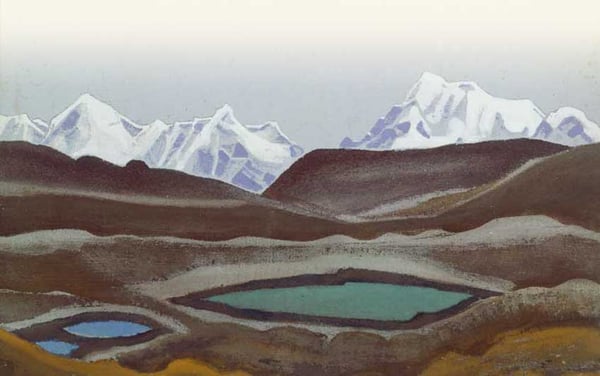
Expert analysis of Nicholas Roerich’s Kangchenjunga. Mountain lakes.
Style: Symbolism · Genre: landscape
Expert Analysis of "Kangchenjunga. Mountain lakes." by Nicholas Roerich
Within Nicholas Roerich’s Symbolist oeuvre, Kangchenjunga. Mountain lakes stands as a quintessential meditation on the sublime and the spiritual—key concerns of the Symbolist movement. The work transcends mere landscape depiction, using the Himalayan peaks and still waters as conduits for metaphysical reflection.
Symbolist Significance
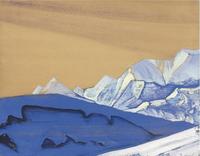
Roerich transforms the specific geography of Kangchenjunga (the world’s third-highest peak, sacred in Tibetan Buddhism) into a universal symbol of transcendence. The mountain lakes, rendered in luminous blues and tranquil reflections, serve as mirrors between the earthly and the divine. Symbolism here is not allegorical but direct: the lake’s stillness suggests meditative clarity, while the jagged, snow-clad peak embodies the unattainable ideal of spiritual ascent. Color is paramount—cool tones of celestial blue and lavender against stark whites evoke a sense of eternal silence, a hallmark of Roerich’s Symbolist vocabulary.
Artistic Techniques
Roerich employs a flattened perspective and simplified, almost abstract forms to emphasize essence over topographical accuracy. The composition is anchored by the vertical thrust of the mountain, countered by the horizontal expanse of the lake—a visual tension that echoes the Symbolist interest in bridging opposites (earth/sky, matter/spirit). His characteristic use of layered, translucent washes creates a diffuse, glowing light that seems to emanate from within the canvas, suggesting an inner radiance rather than external illumination.
Cultural and Historical Context
Painted during Roerich’s Central Asian expeditions (1923–1928), this work reflects his deep engagement with Theosophy and Eastern philosophy. For Roherich, the Himalayas were not just a landscape but a “living temple” of ancient wisdom. Kangchenjunga. Mountain lakes thus becomes a visual mantra—a serene, hypnotic icon that invites the viewer to move beyond the material world into a state of contemplative union.
Significance within Roerich’s Career
This painting exemplifies Roerich’s mature style, where he synthesizes Russian Symbolist traditions (from Vrubel and the World of Art group) with Buddhist iconography. It is significant for its restrained emotional power: while many landscape Symbolists rely on dramatic chiaroscuro or mystical figures, Roerich achieves spiritual intensity through pure, austere nature—a feat that aligns him with later abstract Expressionists while remaining distinct in his harmonious, ethereal palette.
In sum, Kangchenjunga. Mountain lakes is a masterwork of Symbolist landscape, where geography becomes a threshold to the infinite, and the artist’s brush transforms a real location into a threshold for the viewer’s own inner journey.
Visually similar
20 works with related composition and palette
Himalayas. Chain of Kanchenjunga.
Nicholas Roerich
Himalayas
Nicholas Roerich
Sacred Himalayas
Nicholas Roerich

Pass
Nicholas Roerich
Himalayas. Ridge Kanchendganga.
Nicholas Roerich
Sacred Himalayas
Nicholas Roerich
Sacred Himalayas
Nicholas Roerich
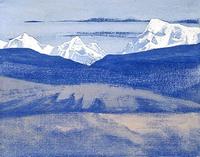
Himalayas
Nicholas Roerich
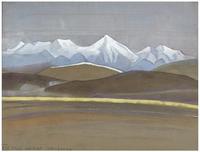
Ak-Tagh. Lenin's Mountain.
Nicholas Roerich
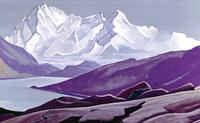
Sacred Himalayas
Nicholas Roerich

Himalayas
Nicholas Roerich

Everest
Nicholas Roerich

The Greatest and Holiest of Tangla
Nicholas Roerich
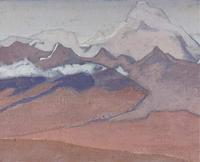
On the way to Shekar Dzong
Nicholas Roerich
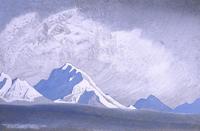
Himalayas
Nicholas Roerich
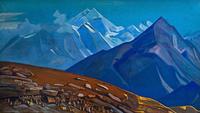
Vyas Kund
Nicholas Roerich
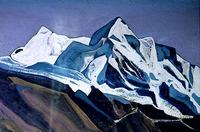
Tibet
Nicholas Roerich
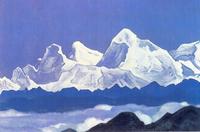
Everest
Nicholas Roerich

The Holiest Thang La
Nicholas Roerich
Tibet
Nicholas Roerich