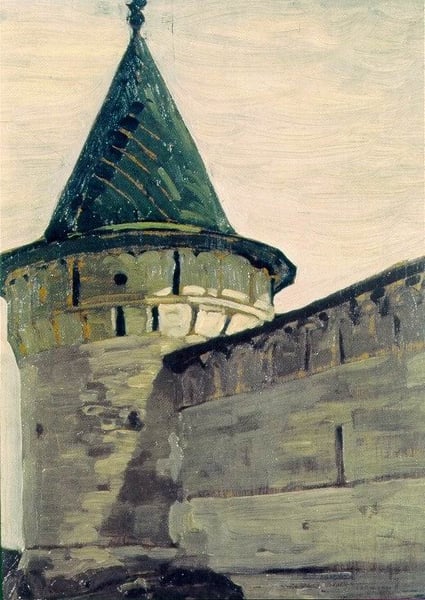
Kostroma. Belfry of Ipatievsky monastery.
Dettagli
Analisi esperta di Kostroma. Belfry of Ipatievsky monastery. di Nicholas Roerich
Stile: Art Nouveau (Modern) · Genere: cityscape
Expert Analysis: Nicholas Roerich’s "Kostroma. Belfry of Ipatievsky monastery"
Style & Period Significance:
Though Nicholas Roerich is often associated with Symbolism and later metaphysical themes, this cityscape is squarely within the Art Nouveau (Modern) idiom. Art Nouveau’s hallmark is the synthesis of organic, flowing lines with a decorative, anti-historicist approach to architecture and nature. Here, Roerich applies that sensibility not to a typical Parisian or Viennese subject, but to a distinctly Russian Orthodox monument—the belfry of the Ipatievsky Monastery in Kostroma.
What Makes This Work Significant:
-
Fusion of National Identity with International Modernism – Roerich elevates a centuries-old religious structure (the belfry, part of a monastery linked to the Romanov dynasty) by rendering it through Art Nouveau’s sinuous, rhythmic lines. The verticality of the belfry is emphasized, its domes and arches softened into almost floral, organic forms. This creates a dialogue between traditional Russian sacred architecture and the pan-European desire for a “new” visual language at the turn of the 20th century.
-
Cityscape as a Spiritual Landscape – Typical Art Nouveau cityscapes often celebrated modern urban life or picturesque medieval towns. Roerich instead treats the monastery belfry as a visionary symbol—anchoring the cityscape in spiritual tradition rather than secular modernity. The bell tower appears less as a literal structure and more as an icon, its silhouette echoing the upward-aspiring motifs common in Art Nouveau (e.g., gothic-revival tendrils, whiplash curves).
-
Color and Atmosphere – Roerich’s palette (inferred from his known works) likely uses muted, earthy tones with sudden accents—characteristic of his later, more mystical style—applied here to create a hushed, contemplative mood. The interplay of light and shadow on the belfry transforms a documentary cityscape into a meditative scene, aligning with Art Nouveau’s aim to blur the boundaries between fine art, decoration, and spiritual expression.
Conclusion:
“Kostroma. Belfry of Ipatievsky monastery” is significant because it exemplifies how Art Nouveau could be adapted to Russian cultural heritage without losing its modern decorative vigor. Roerich takes a localized, historic subject and frames it within a universal, modern aesthetic—making the work a bridge between national tradition and the international Art Nouveau movement.
Visivamente simili
20 opere con composizione e palette affini
Monastery gate and wall
Isaac Levitan
Monastery gate and wall
Isaac Levitan
Pskov
Konstantin Gorbatov
Suzdal. Walls of Saviour-Euthimius Monastery
Nicholas Roerich
Rostov Veliky. Attics of princely houses.
Nicholas Roerich
Terem of Yaroslavna. By the monastery wall.
Nicholas Roerich
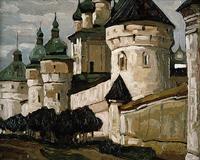
Rostov the Great
Nicholas Roerich
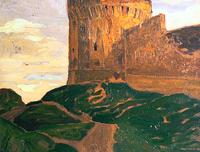
Smolensk. Tower.
Nicholas Roerich
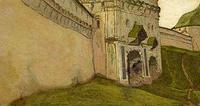
Zvenigorod. Holy Gate.
Nicholas Roerich
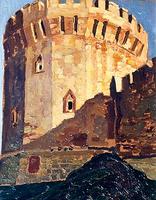
Smolensk. Tower.
Nicholas Roerich
The Blue Day. Rostov The Great
Konstantin Yuon
Barbara's Gate
Konstantin Yuon
Tower of Novgorod Kremlin
Nicholas Roerich
The Rostov Kremlin
Konstantin Yuon
Russian Monastery in Winter
Konstantin Gorbatov
Illustration for Alexander Pushkin's 'Fairytale of the Tsar Saltan'
Ivan Bilibin
Rostov the Great
Nicholas Roerich
Izborsk. Towers.
Nicholas Roerich
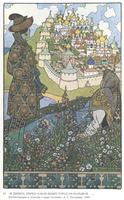
Illustration for Alexander Pushkin's 'Fairytale of the Tsar Saltan'
Ivan Bilibin
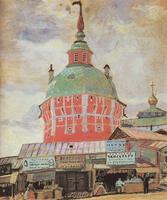
Red Tower of Troitse-Sergeevsky Lavra
Boris Kustodiev