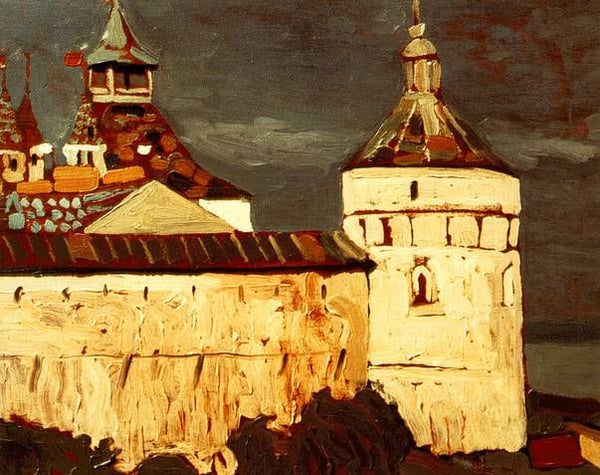
Rostov Veliky. Attics of princely houses.
Dettagli
Analisi esperta di Rostov Veliky. Attics of princely houses. di Nicholas Roerich
Stile: Art Nouveau (Modern) · Genere: cityscape
Expert Analysis of "Rostov Veliky. Attics of princely houses." by Nicholas Roerich
Style & Context:
Created in the Art Nouveau (Modern) style, this cityscape by Nicholas Roerich exemplifies the movement’s emphasis on decorative harmony, organic lines, and spiritual symbolism—adapted here to a distinctly Russian architectural subject. Art Nouveau often sought to integrate art into everyday life, and Roerich achieves this by elevating the humble "attics of princely houses" into a vision of historical and mystical grandeur.
Significance within the Style/Period:
- Fusion of National Heritage with Modern Aesthetics: Roerich’s work is significant for grounding Art Nouveau’s flowing, ornamental sensibility in the vernacular of Old Russian architecture. The attics, with their intricate rooflines, colorful eaves, and decorative wooden carvings, are rendered not as mere historical records but as living, rhythmic forms that pulse with the organic curves typical of the style. This reflects a broader Art Nouveau interest in regional folklore and craftsmanship.
- Spiritual and Symbolic Depth: Unlike many urban cityscapes of the period focused on modernity and industry, Roerich’s attics evoke a timeless, almost sacred atmosphere. The composition emphasizes verticality and layered patterns, drawing the viewer’s eye upward—a nod to the spiritual aspiration that runs through much of Roerich’s oeuvre and resonates with Art Nouveau’s fascination with the unseen and the transcendent.
- Decorative yet Architectural Precision: The painting showcases Art Nouveau’s characteristic flatness and decorative detail—roofs, chimneys, and facades are treated as interconnected, flowing panels of color and line rather than strict perspectival renderings. This treatment makes the attics appear both solid and ethereal, grounding the modern style in a deeply Russian sense of place.
Conclusion:
"Rostov Veliky. Attics of princely houses." stands as a unique synthesis of Art Nouveau’s global decorative language and Russia’s architectural identity. It demonstrates how the style could be adapted to celebrate national heritage while still pushing toward a modern, spiritually charged visual language. The work remains a compelling example of how cityscape painting within Art Nouveau could transcend mere representation to become a vehicle for cultural and mystical expression.
Museum / Gallery
Visivamente simili
20 opere con composizione e palette affini
Rostov the Great
Nicholas Roerich
The Rostov Kremlin
Konstantin Yuon
Kostroma. Belfry of Ipatievsky monastery.
Nicholas Roerich
The Blue Day. Rostov The Great
Konstantin Yuon
Spring Evening. Rostov The Great
Konstantin Yuon
Terem of Yaroslavna. By the monastery wall.
Nicholas Roerich
Russian Monastery in Winter
Konstantin Gorbatov
Pskov
Konstantin Gorbatov
Monastery gate and wall
Isaac Levitan
Rostov Veliky. Entrance to Kremlin.
Nicholas Roerich
Illustration for Alexander Pushkin's 'Fairytale of the Tsar Saltan'
Ivan Bilibin
Rostov the Great
Nicholas Roerich
Sergiyev Posad
Konstantin Yuon
The Rostov's Kremlin Gates
Konstantin Yuon
Churches
Aristarkh Lentulov
Monastery gate and wall
Isaac Levitan
View of a Monastery
Konstantin Gorbatov
Suzdal. Walls of Saviour-Euthimius Monastery
Nicholas Roerich
Troitse-Sergiev Posad
Konstantin Gorbatov
Zvenigorod. Holy Gate.
Nicholas Roerich