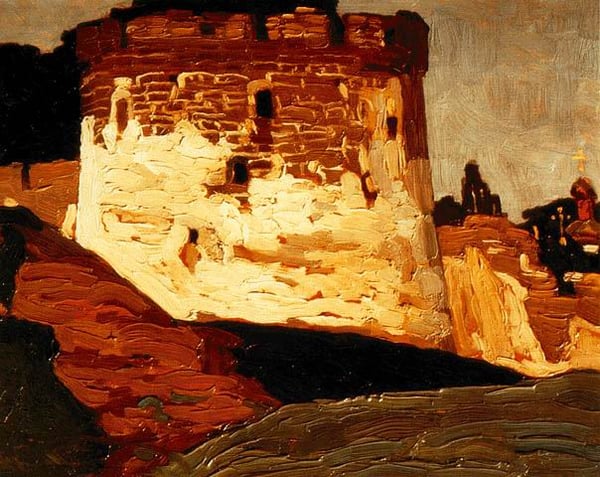
Pechora. Monastery walls and towers.
Dettagli
Analisi esperta di Pechora. Monastery walls and towers. di Nicholas Roerich
Stile: Art Nouveau (Modern) · Genere: cityscape
Expert Analysis of "Pechora. Monastery walls and towers." by Nicholas Roerich
Nicholas Roerich’s Pechora. Monastery walls and towers. stands as a compelling example of Art Nouveau’s adaptation to spiritual and architectural subjects. Though traditionally associated with flowing, organic forms, Art Nouveau here is channeled through Roerich’s distinct mystical lens—transforming a cityscape into a meditative study of structure and atmosphere.
Significance within Art Nouveau and its Period:
- Architectural Spirituality: Roerich elevates the monastery’s walls and towers beyond mere architectural record. The composition likely emphasizes verticality and rhythmic repetition of forms—key Art Nouveau strategies—to evoke a sense of sacred ascent and timelessness. This aligns with the movement’s interest in uniting art with spiritual or symbolic meaning.
- Integration of Decorative Line: The depiction of the monastery’s contours, from wall outlines to tower silhouettes, would have employed Art Nouveau’s characteristic sinuous, decorative lines. Roerich softens the harshness of medieval fortifications, imbuing them with a lyrical, almost organic quality that merges human construction with the natural landscape.
- Modernist Cityscape: As a cityscape, this work breaks from traditional naturalistic views. Instead, Roerich presents a stylized, symbolic vision—a hallmark of Art Nouveau’s modernism. The monastery becomes a motif of cultural heritage and spiritual aspiration, resonating with contemporary searches for identity and transcendence in an era of rapid industrialization.
What Makes It Significant:
This artwork demonstrates how Art Nouveau could transcend its usual domestic and decorative applications to address monumental, historical subjects. Roerich’s treatment of the Pechora monastery—with its emphasis on line, mood, and spiritual geography—marks a critical intersection of Slavic architectural tradition and pan-European modernist aesthetics. The piece thus stands as a singular synthesis: a modern, decorative treatment of an ancient sacred precinct, embodying Art Nouveau’s quest to infuse everyday life with beauty and deeper meaning.
Museum / Gallery
Visivamente simili
20 opere con composizione e palette affini
Izborsk. Towers.
Nicholas Roerich
Pskov towers
Nicholas Roerich
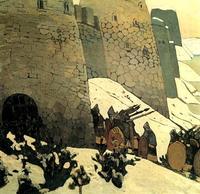
Patrol
Nicholas Roerich
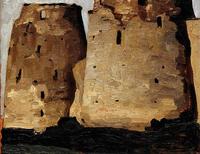
Izborsk. Towers.
Nicholas Roerich
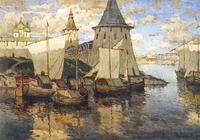
Pskov
Konstantin Gorbatov
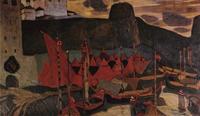
Old Pskov
Nicholas Roerich
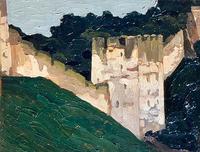
Pechora. Monastery walls and towers.
Nicholas Roerich
Russian Monastery in Winter
Konstantin Gorbatov
Feodosia at winter
Konstantin Bogaevsky
Late Winter in Gherla
Rudolf Schweitzer-Cumpana
Smolensk. Tower.
Nicholas Roerich
Tower of Novgorod Kremlin
Nicholas Roerich
Pechersky Monastery
Nikolay Bogdanov-Belsky
Porhov. Belfry on fortress tower.
Nicholas Roerich
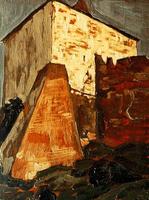
Kremlin tower in Novgorod
Nicholas Roerich
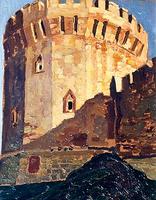
Smolensk. Tower.
Nicholas Roerich
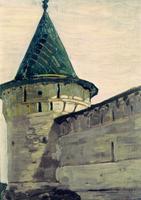
Kostroma. Belfry of Ipatievsky monastery.
Nicholas Roerich
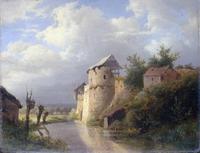
The Old Fortress
Louwrens Hanedoes
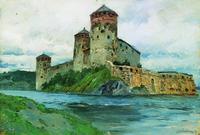
Fortress. Finland.
Isaac Levitan
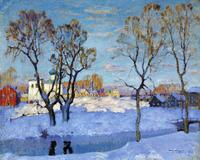
Early Spring in Pskov
Konstantin Gorbatov