Analisi esperta di Street in front of castle di Nicholas Roerich
Stile: Art Nouveau (Modern) · Genere: design
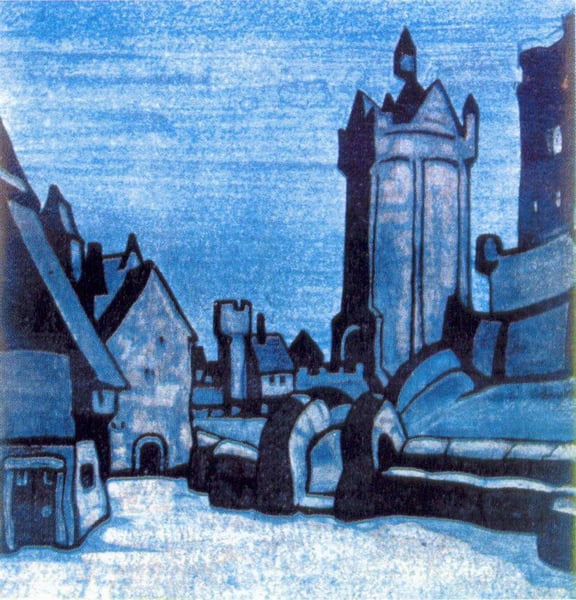
Expert Analysis: "Street in front of castle" by Nicholas Roerich
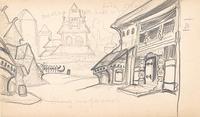
Nicholas Roerich’s “Street in front of castle” is a significant work within the Art Nouveau (Modern) movement, specifically through the lens of design. As a piece categorized as design—likely a stage set, decorative panel, or architectural proposal—it exemplifies Art Nouveau’s core ambition to dissolve boundaries between fine art and applied arts, creating a total work of art (Gesamtkunstwerk).
What makes this artwork significant:
-
Synthesis of Architecture and Nature – Art Nouveau prized organic, flowing lines and an integration of natural forms into built environments. In this street scene, Roerich likely uses sinuous, stylized contours to blend the castle’s rigid medieval silhouette with the organic curves of foliage, cobblestones, or archways. The emphasis on a unified, rhythmic surface—flattened perspective and decorative patterning—transforms an ordinary street into a symbolic, dreamlike stage.
-
Symbolist Undertones – Roerich was deeply influenced by Russian Symbolism and Theosophical spirituality. Although designated as “design,” the work transcends mere decoration. The castle, a recurring motif in Roerich’s oeuvre, suggests a gateway to ancient, mystical realms. The street may represent a liminal space between the earthly and the sacred, a hallmark of his artistic philosophy. This spiritual dimension elevates the design from utilitarian craft to a meditative vision.
-
Influence on Theatrical Design – Roerich’s most celebrated contributions were his stage designs for Diaghilev’s Ballets Russes (e.g., The Rite of Spring, Prince Igor). “Street in front of castle” likely manifests his mastery of atmospheric space: a flat, patterned foreground leading the eye toward a monumental, stylized castle. Such compositions were pivotal in shaping modern stagecraft, where color, line, and symbolic architecture replaced naturalistic backdrop.
-
Innovation in Color and Tone – Roerich employed a distinctive, jewel-like palette (earthy ochres, deep blues, and muted greens) that evokes ancient frescoes or Tibetan thangkas. In this design, the contrast between the cool, monumental castle and the warm, animated street would create a rhythmic visual tension—a technique that influenced later modernist approaches to abstracted landscape.
In summary, “Street in front of castle” is significant as a paradigmatic Art Nouveau design that fuses spiritual symbolism, decorative harmony, and architectural fantasy, showcasing Roerich’s unique ability to transform a mundane street into a threshold of eternal beauty and mystical depth.
Museum / Gallery
Visivamente simili
20 opere con composizione e palette affini
Vignette for book "N. K. Roerich"
Nicholas Roerich
Jerusalem
Nicholas Roerich

Untitled
Nicholas Roerich
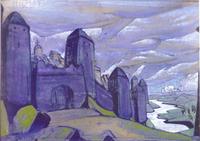
Yaroslavna's Lament
Nicholas Roerich
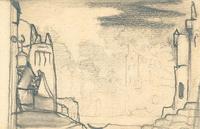
Scenery sketch for Mussorgsky's opera "Khovanshchina"
Nicholas Roerich
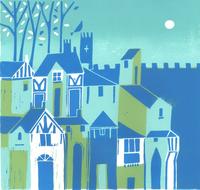
City Walls
Giuliana Lazzerini
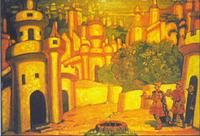
Gifts
Nicholas Roerich
Les Petit Maisons (drypoint)
Chaim Goldberg
Light night
Nicholas Roerich
City
Nicholas Roerich
Glow
Nicholas Roerich
Landscape at Beaulieu
Juan Gris
City wall
Nicholas Roerich
City on the Mountain (Stadt auf dem Berge)
Lyonel Feininger
Study of decoration
Nicholas Roerich

Close this window
Jacek Yerka
Tmutarakan
Nicholas Roerich
Licht und Kraft liefert Elektrizitätswerk Strassburg
Léo Schnug
Tristan's castle
Nicholas Roerich
Vignette for book "N. K. Roerich"
Nicholas Roerich