Analisi esperta di Mnemosyne di Dante Gabriel Rossetti
Stile: Romanticism · Genere: mythological painting
Expert Analysis of "Mnemosyne" by Dante Gabriel Rossetti
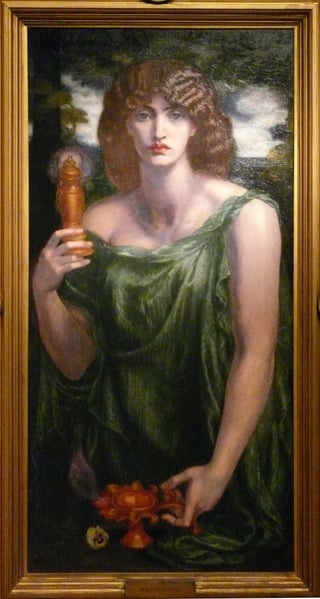
Dante Gabriel Rossetti’s Mnemosyne (also titled The Lamp of Memory) stands as a quintessential example of late Romanticism, specifically channeling the Pre-Raphaelite Brotherhood’s ideals. Though the given style is Romanticism, Rossetti was a founding figure of the Pre-Raphaelite movement, which sought to revive the vivid color, intricate detail, and spiritual intensity of early Renaissance art within a Romantic framework. Here, he elevates the mythological subject—the Greek Titaness of memory and mother of the Muses—into a profound meditation on inspiration, loss, and the act of artistic creation.
Significance within Romanticism and the Pre-Raphaelite Ethos
-
Symbolist Complexity & Emotional Depth:
The painting is dense with symbolic meaning, typical of Rossetti’s mature work. Mnemosyne holds a lamp (the “lamp of memory”) that illuminates her face and a sprig of poppies, alluding to both sleep and the preserving power of recollection. The somber, introspective expression of the model—often identified as Jane Morris, Rossetti’s muse and later wife—imbues the work with a haunting, almost melancholic dignity. This fusion of classical allegory with personal emotional resonance is a hallmark of Rossetti’s Romantic approach: mythology becomes a vehicle for exploring the artist’s own inner world. -
Aesthetic and Technical Virtuosity:
Rossetti employs the Pre-Raphaelite technique of luminous, layered glazes and intense, jewel-like colors. The deep greens and golds of the background, the rich auburn hair, and the pale, porcelain skin of Mnemosyne create a near-hallucinatory realism that is both idealized and intensely physical. The composition is tightly focused on the figure, with minimal background detail, drawing the viewer’s gaze to the symbolic objects and the woman’s penetrating eyes. This inward, contemplative structure reflects the Romantic fascination with the subjective, the mystical, and the timeless. -
Role of the Female Muse:
Mnemosyne is a key work in Rossetti’s series of “stunners” (his term for his idealized female portraits). Here, the goddess Memory is embodied by Jane Morris, whose strong, angular features became an icon of Pre-Raphaelite beauty. Rossetti’s treatment transforms her from a real woman into a timeless symbol of the creative impulse—memory as the mother of the arts. This conflation of the personal (his love for Jane) and the mythological (the Titaness) gives the painting its poignant, almost autobiographical gravity. -
Place in Romantic Mythological Painting:
Unlike the heroic or dramatic mythological scenes of earlier Romanticists (e.g., Delacroix or Turner), Rossetti’s mythology is static, inward, and psychological. Mnemosyne does not narrate an action but rather embodies a state of being. This aligns with the later Romantic and Symbolist interest in the evocation of mood over plot, making Rossetti a bridge between Romanticism and the Symbolist movement of the late 19th century.
Conclusion:
Mnemosyne is significant because it condenses the core preoccupations of Rossetti’s art—the sacred power of memory, the idealization of the muse, and the fusion of personal emotion with classical myth—into a single, arresting image. It exemplifies how Romanticism, through the Pre-Raphaelite lens, could transform a mythological figure into a deeply modern icon of introspection and artistic devotion.
Museum / Gallery
Visivamente simili
20 opere con composizione e palette affini
The Wife of Pygmalion
George Frederick Watts
The Magdalene
Correggio
Allegoria dell’estate
Constantijn Netscher
Pandora
Dante Gabriel Rossetti
Astarte Syriaca
Dante Gabriel Rossetti
Portrait of Anna Pitt as Hebe
Louise Elisabeth Vigee Le Brun
Ophelia
Joan Brull
Portrait of Young Woman
Wilhelm Kotarbinski
A Vision of Fiammetta
Dante Gabriel Rossetti
Portrait of a Woman
Abbott Handerson Thayer
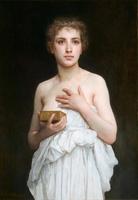
Pandora
William-Adolphe Bouguereau
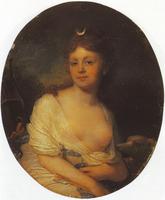
Countess Ekaterina Riboper
Vladimir Borovikovsky
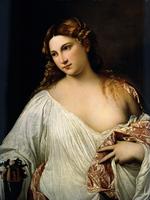
Flora
Titian
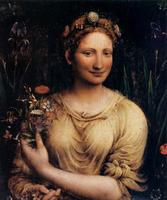
Flora
Francesco Melzi

Nymph followed by Apollo
Maurice Quentin de La Tour
Portrait de Madame Regnaud de Saint-Jean-d'Angély, née Laure Guesnon de Bonneuil (1776-1857)
François Gérard
Finestra
Dante Gabriel Rossetti
Anne Morice of Wirrington
John Riley
Pandora
Alexandre Cabanel
Lady Elizabeth Howard
John Hoppner