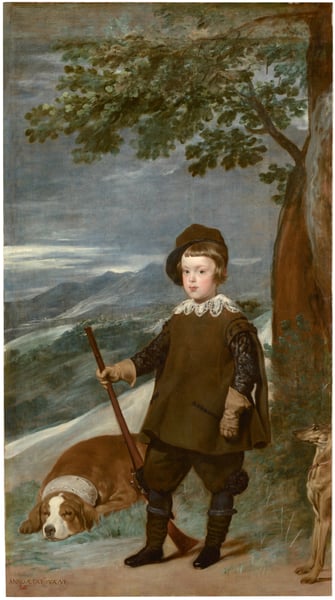
Prince Balthasar Carlos dressed as a Hunter
Details
Expert analysis of Diego Velazquez’s Prince Balthasar Carlos dressed as a Hunter
Style: Baroque · Genre: portrait
Expert Analysis of Prince Balthasar Carlos Dressed as a Hunter by Diego Velázquez
As a portrait executed in the Baroque style, this work exemplifies Velázquez’s extraordinary ability to merge courtly representation with the naturalism and dynamic energy characteristic of the period. The subject—the young prince—is presented not in static, formal regalia but in the guise of a hunter, a choice that carries deep symbolic and political weight.
Significance within Baroque portraiture:
Baroque portraiture often sought to convey the power, vitality, and human complexity of its sitters. Velázquez, as court painter to Philip IV, mastered this by blending psychological insight with theatrical presentation. Here, the prince’s casual athletic stance, the outdoor setting, and his hunting attire (complete with gun and dog) signal strength, readiness, and a noble connection to the land—virtues essential for a future monarch. The use of chiaroscuro (strong contrasts of light and shadow) models the prince’s face and clothing with a sculptural three-dimensionality, while the sweeping brushwork in the landscape and foliage adds a sense of movement, a hallmark of Baroque dynamism.
Genre and innovation:
As a portrait, the work transcends mere likeness. It belongs to a tradition of caza (hunting) portraits that celebrated the Habsburg dynasty’s martial prowess and aristocratic leisure. Yet Velázquez’s treatment is strikingly natural: the prince’s gaze is direct yet slightly softened, his pose relaxed but alert. The dog, a faithful companion, reinforces themes of loyalty and the hunt as a metaphor for governance. Unlike earlier stiff court portraits, this painting captures a fleeting moment—the boy’s arrested motion as he pauses, gun in hand—that feels both intimate and monumental.
Placement in Velázquez’s oeuvre:
This work sits among Velázquez’s most celebrated portrayals of the ill-fated prince, who died young. Here, the artist avoids idealization, rendering the child’s pale complexion, delicate features, and slightly awkward posture with unflinching honesty. The result is a poignant blend of royal propaganda and tender human observation—a signature of Velázquez’s genius that would influence later generations of portraitists, from Goya to Manet.
In summary, Prince Balthasar Carlos Dressed as a Hunter is significant as a Baroque portrait that elevates courtly symbolism through naturalistic execution, dynamic composition, and psychological depth, embodying the era’s fusion of power, nature, and human vulnerability.
Museum / Gallery
Visually similar
20 works with related composition and palette
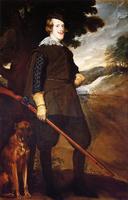
Philip IV King of Spain
Diego Velazquez
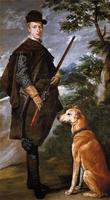
Portrait of Cardinal Infante Ferdinand of Austria with Gun and Dog
Diego Velazquez
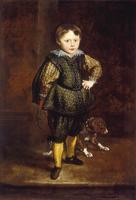
Portrait of Filippo Cattaneo, Son of Marchesa Elena Grimaldi
Anthony van Dyck
Portrait of a couple in a landscape
Gerrit Dou
Hunter`s Companions
Alexandre Thomas Francia
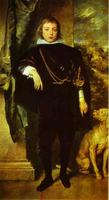
Prince Rupert von der Pfalz
Anthony van Dyck
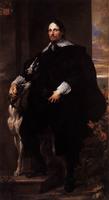
Philippe Le Roy
Anthony van Dyck
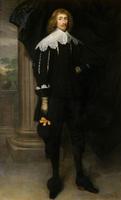
Thomas Bruce (1599–1663), 1st Earl of Elgin
Cornelius Johnson
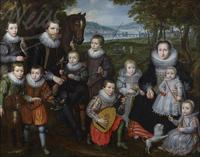
An unknown Flemish Family
Otto van Veen
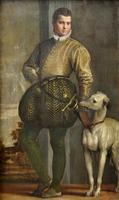
Boy with a Greyhound
Paolo Veronese
Three Children with a Goat Cart
Frans Hals
Albert and Nicolaas Rubens
Peter Paul Rubens
Portrait of the Duke of Pastrana
Juan Carreno de Miranda
The Court Dwarf, Don Franciso Lezcano called 'El Nino de Vallecas'
Diego Velazquez
Nicolaes van der Borght, Merchant of Antwerp
Anthony van Dyck
Man Standing Up
Rembrandt
Portrait Of Maerten Soolmans
Rembrandt
Willem Van Heythuyzen
Frans Hals
A Young Boy with His Dog
Nicolaes Maes
Marriage Portrait of Isaac Massa and Beatrix van der Laen
Frans Hals