Expert analysis of Bartolome Esteban Murillo’s Children Eating a Pie
Style: Baroque · Genre: genre painting
Expert Art Historical Analysis of "Children Eating a Pie" by Bartolomé Esteban Murillo
Style and Context
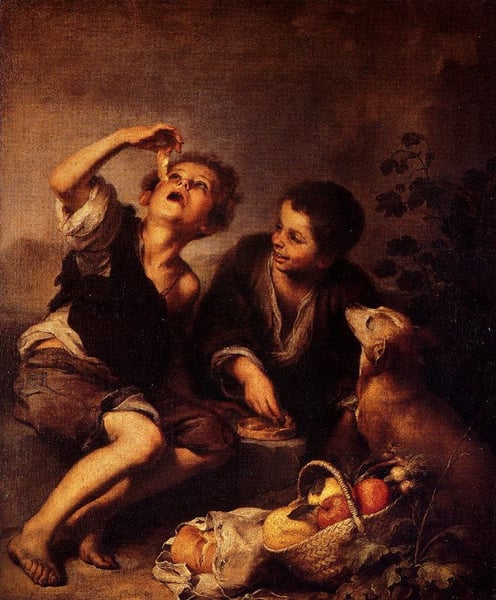
As a work of the Spanish Baroque, "Children Eating a Pie" exemplifies Murillo’s signature departure from the dramatic chiaroscuro and religious severity of contemporaries like Zurbarán. Instead, Murillo infused the Baroque interest in naturalism with a gentle, accessible charm. The painting belongs to his celebrated series of genre paintings depicting the street children of Seville—urchins who, despite their ragged clothes, are shown with dignity, joy, and a sense of fleeting innocence.
Significance within the Baroque and Genre Traditions
Murillo’s genre scenes were revolutionary for their time. While Baroque art often served religious or royal propaganda, Murillo turned his attention to the everyday lives of the poor, offering a humanizing, almost idealizing view. In "Children Eating a Pie," the children’s rapt focus on their shared meal transforms a humble act into a moment of pure childhood delight. The composition is balanced and intimate, with soft, diffused light (a hallmark of Murillo’s style) that glows on their faces and hands, focusing the viewer’s empathy on their simple pleasure.
Why This Painting Matters
-
Humanization of the Marginalized – At a time when poverty was often depicted for moralizing or pathetic effect, Murillo presents these children as playful, resourceful, and endearing. This approach influenced later European genre painters, from Chardin to the Victorians.
-
Mastery of Light and Texture – Murillo’s brushwork renders the wrinkled clothing, the sticky hands, and the crumbling pie with remarkable realism, yet the overall effect is poetic rather than gritty. This balance between natural observation and idealized tenderness is a distinctive achievement of the Spanish Baroque.
-
Cultural Mirror – The painting reflects 17th-century Seville’s bustling street life, where orphaned and impoverished children fended for themselves. By capturing a moment of shared food and laughter, Murillo offers a quiet commentary on resilience and community.
In sum, "Children Eating a Pie" is not merely a charming snapshot—it is a foundational work in the history of genre painting, demonstrating how Baroque emotional depth and technical skill can elevate the everyday into the timeless.
Museum / Gallery
Visually similar
20 works with related composition and palette
Boys Playing Dice
Bartolome Esteban Murillo
Two boys playing dice
Bartolome Esteban Murillo
Two Peasant Boys and a Negro Boy
Bartolome Esteban Murillo
Joseph Telling his Dreams
Bernardo Strozzi
Two Peasant Boys
Bartolome Esteban Murillo
George Henry Hall after Bartolomé Esteban Murillo Boys Eating Grapes and Melon (copy)
George Henry Hall
The Little Fruit-Seller
Bartolome Esteban Murillo
Return of the prodigal son
Jan Steen
Peasant Woman and a Boy
Bartolome Esteban Murillo
Prophet Elijah and the Widow of Sarepta
Bernardo Strozzi
A Persistent Cavalier (genre scene)
Giuseppe Maria Crespi
Two Boys Eating a Melon and Grapes
Bartolome Esteban Murillo
Boy with a Dog
Bartolome Esteban Murillo
LABAN SEARCHING FOR THE HOUSEHOLD IDOLS
Simone Pignoni
Italian Fisher Children
Henry Campotosto
Children with a bird's nest and flowers
Angelica Kauffman
Zwei Kinder Bei Der Mahlzeit
Jan Miense Molenaer
JUNGER MANN, DER EINE KÖCHIN BEDRÄNGT
Jacob Toorenvliet
Lot and His Daughters
Artemisia Gentileschi
Hagar Assisted by the Angel
Giovanni Battista Tiepolo