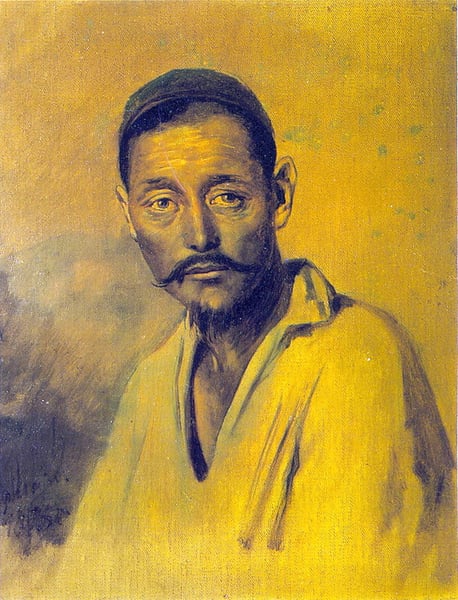
Head of a Kirghiz. Study for 'The Court Pugachev'
Expert analysis of Vasily Perov’s Head of a Kirghiz. Study for 'The Court Pugachev'
Style: Realism · Genre: portrait
Expert Analysis of "Head of a Kirghiz. Study for 'The Court Pugachev'" by Vasily Perov
This work is a striking example of Russian Realism, a movement that sought to depict the truths of everyday life and historical events with unflinching accuracy and human empathy. As a study for Perov’s larger historical canvas, The Court of Pugachev, this portrait is significant for several reasons.
Ethnographic Authenticity and Human Dignity
Perov’s decision to focus on a single figure—a Kirghiz (Kyrgyz) man—demonstrates the Realist commitment to representing the diverse ethnic makeup of the Russian Empire. Far from being a generic "Eastern" type, the study emphasizes individual character through careful observation of facial structure, weathered skin, and the subtle play of light. The subject’s expression is neither romanticized nor demonized; instead, it conveys a quiet, dignified presence. This aligns with Realism’s goal of portraying people from all walks of life with respect and verisimilitude.
Preparatory Mastery and Historical Insight
As a study for a major historical painting, Head of a Kirghiz offers rare insight into Perov’s working method. The focus on a single head reveals his dedication to capturing authentic facial types, costumes, and psychological depth—essential for lending credibility to the larger narrative of Pugachev’s rebellion. The loose, confident brushwork and restrained palette typical of oil studies highlight the artist’s skill in rendering texture and flesh tones without over-polishing, a hallmark of Realist technique.
Social and Political Underpinnings
Perov’s Realism often carried critical social commentary. By including a Kirghiz figure—a member of a nomadic group often marginalized in Russian art—alongside Cossacks and peasants in the final composition, Perov subtly underscores the multi-ethnic nature of Pugachev’s uprising. This study thus functions not only as a preparatory tool but as a testament to the Realist pursuit of historical truth, giving voice to those typically omitted from official histories.
In summary, Head of a Kirghiz is significant as a model of Realist portraiture that blends ethnographic accuracy, technical skill, and narrative purpose. It enriches our understanding of Perov’s artistic process and the social breadth of one of Russia’s most important historical paintings.
Visually similar
20 works with related composition and palette
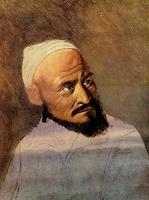
Head of a Kirghiz. Sketch
Vasily Perov
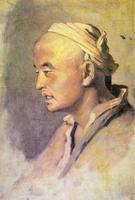
Head of a Kirghiz. Sketch
Vasily Perov
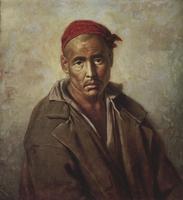
Head of a Kirgiz-convict
Vasily Perov
Head of fisherman
Vincenzo Caprile
Turk
Constantin Artachino
Turk
Constantin Artachino
Johann Georg Prillinger
Richard Gerstl
Cossack with red shirt
Vasily Surikov
The old fisherman
Pablo Picasso
Portrait of a young fisherman
Zinaida Serebriakova
Self-portrait
Michele Cammarano
Self portrait with spectacles
Paul Gauguin
Lully (Gypsy)
Vasily Vereshchagin
Portrait S.D. Mstislavsky
Kuzma Petrov-Vodkin
Portrait of a fisherman
Ernst Meyer
Portrait of Aimé Morot
Émile Friant
Kazakh with his national headdress
Vasily Vereshchagin
Richard Hughes
Augustus John
Portrait of a man
Michele Cammarano
Ivan Lipoveanul
Octav Angheluta