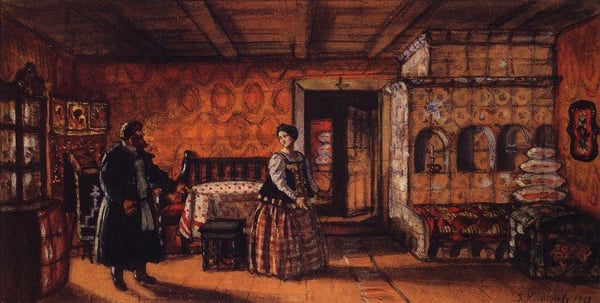
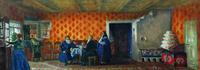
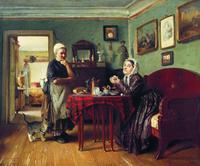
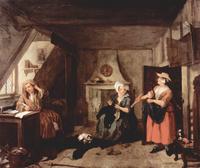
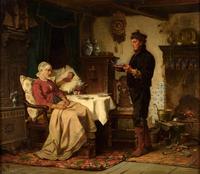
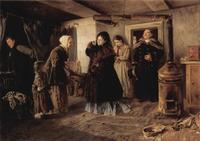
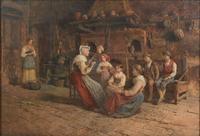
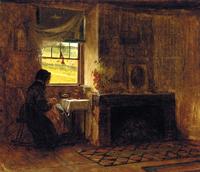
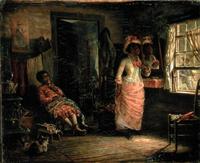
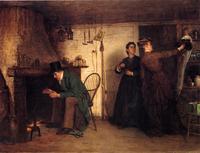
"Room in the house of Prokofy Pazukhin" by Boris Kustodiev stands as a masterful example of literary painting within the Realist tradition. The work is significant for its dual role: it is both a faithful illustration of a specific literary source—most likely Mikhail Saltykov-Shchedrin’s satirical play The Death of Pazukhin—and a vivid genre scene that encapsulates the material culture and social tensions of late 19th-century Russian merchant life.
Kustodiev’s Realism here is not merely documentary; it is a vehicle for narrative and psychological depth. Every object in the cramped, cluttered interior—the heavy draperies, the kitsch religious icons, the overstuffed furniture—serves as a silent clue to the character of Prokofy Pazukhin, a venal and hypocritical merchant. The meticulous rendering of textures and patterns, typical of Kustodiev’s early Realist phase, brings the room to life as a stage set for literary drama. The painting’s significance lies in how it uses the conventions of Realism (detailed observation, truth to material reality) to heighten the literary narrative’s social commentary. The suffocating opulence of the room mirrors the moral decay of its inhabitant, making the space itself a character. Kustodiev later moved toward a more decorative, folk-infused style, but this work anchors his reputation as a keen observer of Russian society, capable of turning a novelist’s written world into a thoroughly convincing, tactile environment.