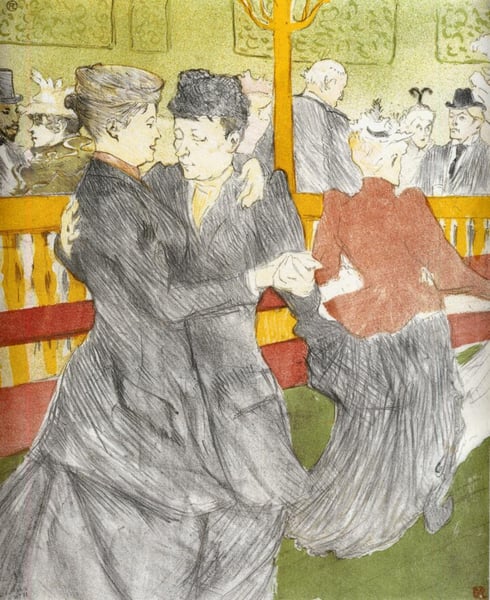
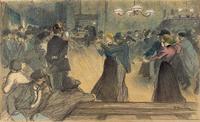
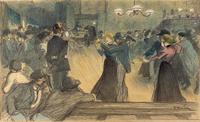
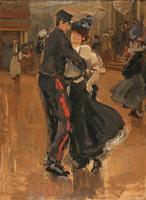
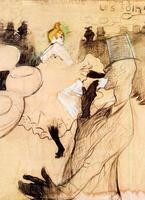
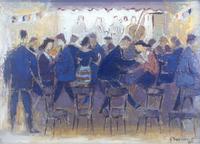
As an expert art historian, I will analyze Dancing at the Moulin Rouge by Henri de Toulouse-Lautrec using only the provided facts: it belongs to the Art Nouveau (Modern) style and is a genre painting.
Significance within Style and Period:
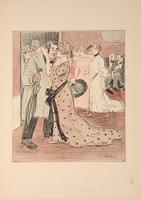
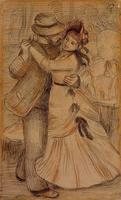
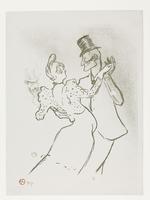
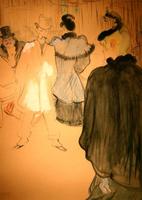
This work is a landmark of Art Nouveau's modern sensibility applied to genre painting. Toulouse-Lautrec captures the vibrant, decadent nightlife of Paris, a hallmark of modernity, while employing the decorative flatness, sinuous lines, and bold silhouettes characteristic of Art Nouveau. Rather than idealized historical or mythological scenes (as in Academic art), he elevates contemporary popular entertainment—dancers, performers, and spectators—to the level of high art. The composition’s dynamic, cropped angles and emphasis on rhythmic pattern over realistic depth reflect Art Nouveau’s fusion of fine art with graphic design, notably the influence of Japanese prints and poster aesthetics. By placing this genre scene within the Art Nouveau idiom, Toulouse-Lautrec redefines genre painting as a vehicle for capturing the fleeting energy of modern urban life, making the work a crucial bridge between Impressionism’s social observation and the decorative boldness of early modernism.