
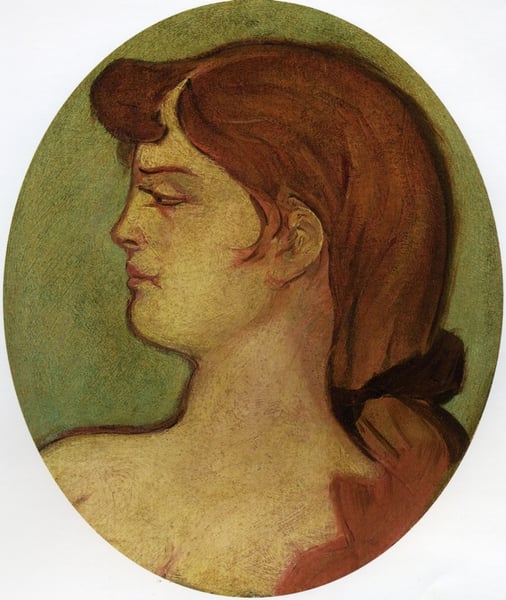
Expert analysis of Henri de Toulouse-Lautrec’s Portrait of a Woman of the House on the Rue d Amboise
Style: Post-Impressionism · Genre: portrait
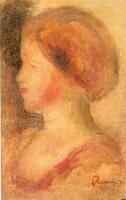
Henri de Toulouse-Lautrec’s Portrait of a Woman of the House on the Rue d’Amboise is a striking example of Post-Impressionist portraiture that reveals the artist’s unflinching commitment to depicting the unvarnished realities of modern urban life. Painted during his immersion in the demimonde of fin-de-siècle Paris, the work belongs to a remarkable series of portraits he created of the women who worked at the famous brothel on the Rue d’Amboise—a subject that was then considered scandalous but which Toulouse-Lautrec treated with rare dignity and psychological acuity.
Stylistically, the portrait epitomizes key Post-Impressionist innovations: flattened spatial depth, bold outlines, and a palette that is both vivid and intentionally discordant. Toulouse-Lautrec’s debt to Japanese ukiyo‑e woodblock prints is evident in the asymmetrical cropping and the emphasis on two-dimensional pattern, yet he subverts decorative elegance with a raw, almost confrontational intimacy. The woman is neither idealized nor moralized; her expression is guarded, her posture slightly slack, suggesting the fatigue of a life bounded by commerce and routine. This refusal to sentimentalize his sitters marks a significant departure from both Impressionist charm and academic portraiture.
What makes the work particularly significant is its role in expanding the portrait genre beyond the privileged classes. Toulouse-Lautrec documented the anonymous women of the maisons closes—figures who were typically invisible in high art except as allegories of vice. By granting them a quiet, individualized presence, he asserted their humanity and, in doing so, challenged the social hierarchies that governed portraiture. Within the broader Post-Impressionist movement, which prioritized subjective expression and modern themes, this painting stands as a bold assertion that authenticity and empathy could be found in the margins of society. It remains a testament to Toulouse-Lautrec’s unique ability to fuse formal experimentation with compassionate observation, making the ordinary extraordinary and the marginalized unforgettable.
Museum / Gallery
Visually similar
20 works with related composition and palette
Study of a Young Girl (Mademoiselle Murer)
Pierre-Auguste Renoir
Portrait of Elizabeth Siddal
Dante Gabriel Rossetti
Profile
Edmund Charles Tarbell
Fernande's Head
Pablo Picasso
Woman's Head in Profile
Amedeo Modigliani
The Artist
Ion Theodorescu-Sion
Head of a woman
Pierre-Auguste Renoir
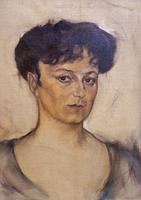
Marianne von Meixner
Christian Schad
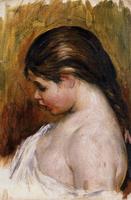
Young Girl Reading
Pierre-Auguste Renoir
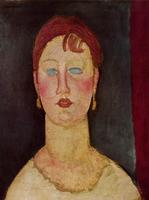
The Singer from Nice
Amedeo Modigliani
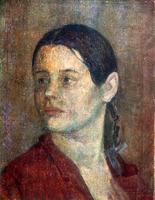
Portrait of a Young Woman
Volodymyr Bondarenko
Head of a Young Woman
Pierre-Auguste Renoir
Self portrait
Paula Modersohn-Becker
Portrait of a Woman
Károly Lotz
Head of a Young Woman
Pierre-Auguste Renoir
Head Study of Maria Zambaco (The Wine of Circe)
Edward Burne-Jones
Giulia Leonardi
Ferdinand Hodler
The Venus That was Never Finished
John Duncan
Portrait of a Young Woman
Pierre-Auguste Renoir
Portrait of a Young Girl
Pierre-Auguste Renoir