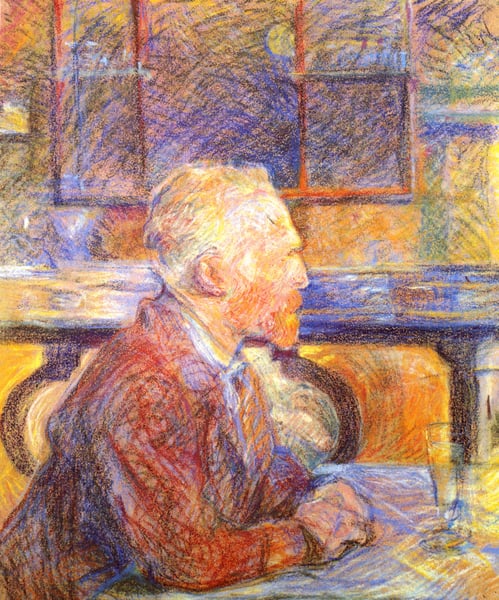
"Portrait of Vincent van Gogh" by Henri de Toulouse-Lautrec is a masterful example of Post-Impressionist portraiture, notable for its intimate psychological insight and technical bravura. Created in 1887, the work captures van Gogh in profile, rendered with swift, energetic pastel strokes on cardboard—a medium that emphasizes immediacy and raw emotion.
Significance within Post-Impressionism lies in Toulouse-Lautrec's departure from naturalism. He distills van Gogh's features into bold outlines and vivid, non-descriptive patches of color: the fiery orange hair, green-tinged complexion, and sharp, black-tipped nose. This expressive distortion conveys van Gogh's intense, restless character, while the shallow space and cropped composition focus solely on his face, eliminating any narrative context.
The portrait also documents a brief but important friendship between two giants of modern art. Toulouse-Lautrec, known for his acerbic depictions of Parisian nightlife, here treats his fellow painter with unusual sympathy. The work reveals how both artists shared a commitment to conveying inner life through exaggerated color and line—a hallmark of Post-Impressionism. This piece thus stands as a dual testament: a personal homage and a vivid manifesto of a style that pushed beyond Impressionism's optical concerns toward subjective expression.