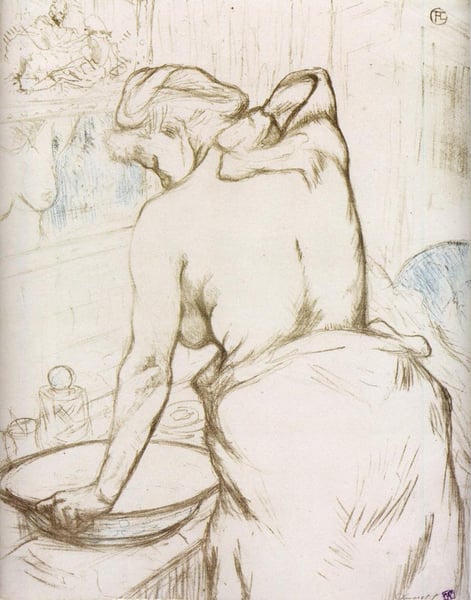
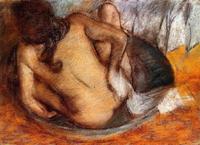
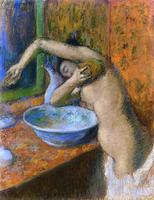
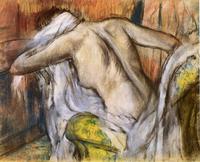
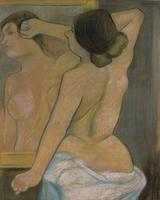
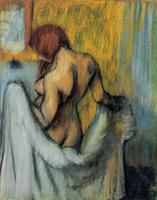
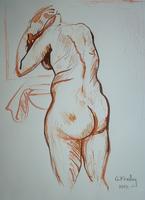
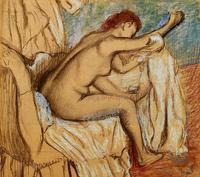
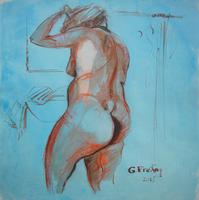
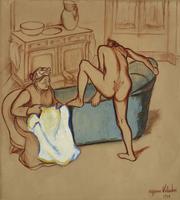
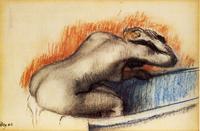
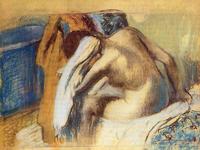
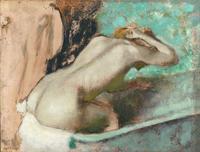
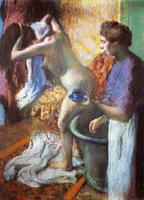
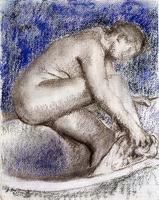
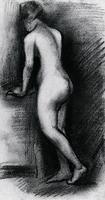
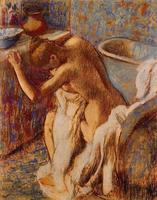
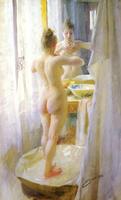
This artwork, a sketch and study titled Woman at Her Toilette them, Washing Herself by Henri de Toulouse-Lautrec, is a quintessential example of the artist’s unflinching, intimate approach to the human figure within the Post-Impressionist movement. Its significance lies in how it deliberately subverts the traditional, idealized portrayal of the female nude.
Created as a rapid study—evident in the loose, unfinished lines—the work captures a private, unposed moment. Toulouse-Lautrec was deeply influenced by Japanese ukiyo-e prints, which encouraged a flattening of space and bold cropping; here, the woman’s body fills the frame with an almost snapshot-like immediacy. The artist’s characteristic use of expressive, broken contours and minimal shading prioritizes the raw movement of washing over anatomical perfection. Unlike the polished nudes of academic painting or even the more romanticized figures of contemporaries like Renoir, this sketch offers a candid, almost voyeuristic glimpse into the daily life of a modern woman—a prostitute or a working-class figure from the Montmartre demimonde. In doing so, Toulouse-Lautrec redefines the “sketch and study” genre, elevating it from a mere preparatory exercise to a finished statement about authenticity, spontaneity, and the unglamorous truth of the female experience in fin-de-siècle Paris.