
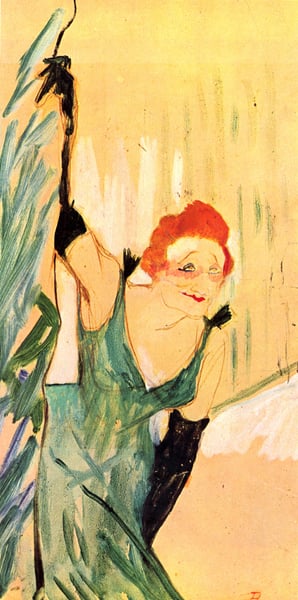
Expert analysis of Henri de Toulouse-Lautrec’s Yvette Guilbert
Style: Art Nouveau (Modern) · Genre: portrait
Expert Analysis: "Yvette Guilbert" by Henri de Toulouse-Lautrec
Henri de Toulouse-Lautrec’s portrait of the celebrated cabaret singer Yvette Guilbert stands as a landmark work within the Art Nouveau movement and modern portraiture. Executed in the artist’s signature graphic style, this piece captures the essence of fin-de-siècle Parisian nightlife while pushing the boundaries of how a performer could be represented in fine art.
Significance in Style and Period
Toulouse-Lautrec was a pivotal figure in the transition from Impressionism to Art Nouveau. In this portrait, he employs the characteristic sinuous, flowing lines and flat areas of color that define Art Nouveau’s decorative aesthetic. Yet unlike many purely ornamental works of the period, Toulouse-Lautrec infuses his subject with psychological depth and social commentary. Yvette Guilbert is not idealized; instead, her distinctive features—the long, black gloves, the sharp profile, the famously thin, almost skeletal frame—are exaggerated with a caricaturist’s eye. This approach reflects the influence of Japanese ukiyo-e woodblock prints, particularly in the bold outlines and asymmetrical composition, which Toulouse-Lautrec admired and collected.
Why It Matters in Modern Portraiture
For a “portrait” genre, Toulouse-Lautrec subverts traditional expectations. Rather than a formal, static likeness, he presents Guilbert mid-performance, her mouth slightly open and hands gesturing, as if caught in a moment of song. This dynamism aligns with the modern fascination with capturing fleeting modern life, akin to Degas’ ballet dancers but even more raw and immediate. The work’s significance also lies in its role as one of the first artistic representations of a celebrity from popular culture—a precursor to modern pop art. Guilbert was a star of the Moulin Rouge, and Toulouse-Lautrec’s portraits (often created as lithograph posters) helped elevate commercial art to high-art status, a hallmark of Art Nouveau’s blurring of fine and applied arts.
Technical and Cultural Impact
The composition emphasizes negative space and silhouette, with Guilbert’s black dress and gloves set against a pale, almost abstract background. This reduction to essentials—line, shape, and stark contrast—is a radical departure from the painterly traditions of the 19th century and a direct forerunner of 20th-century modernism. Artistically, it demonstrates Toulouse-Lautrec’s mastery of lithography, a medium that allowed him to produce affordable, vibrant prints while maintaining the spontaneity of drawing. Culturally, the portrait immortalizes Guilbert as an icon of the Belle Époque, embodying the wit, decadence, and theatricality of Montmartre.
In summary, Yvette Guilbert is significant because it synthesizes Art Nouveau’s elegant linearity with a modern, unflinching portrait of a real, eccentric personality. It challenges the distinction between poster and painting, performer and subject, and remains a testament to Toulouse-Lautrec’s ability to capture the soul of an era through the face of its star.
Museum / Gallery
Visually similar
20 works with related composition and palette
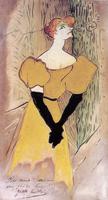
Yvette Guilbert
Henri de Toulouse-Lautrec
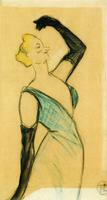
Yvette Guilbert
Henri de Toulouse-Lautrec
l'Ecuyère
Kees van Dongen
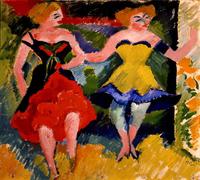
Ballet Dancers
Max Pechstein
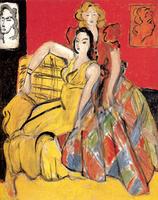
Two Girls
Henri Matisse
Yvette Guilbert
Henri de Toulouse-Lautrec
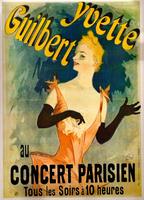
Yvette Guilbert
Jules Cheret
Dancer In Blue Tutu
Henri Matisse
Woman with Green Stockings
Kees van Dongen
Madame Gautreau
John Singer Sargent
El Burdel
Víctor Humareda
Fernanda de Castro
Anita Malfatti
Seated woman in green
Pablo Picasso
Singer with a glove
Edgar Degas
Concert Stage
Everett Shinn
Jeanne Dubinsky
John French Sloan
Portrait of Quappi in pink and purple
Max Beckmann
Portrait of Gertrud Muller
Ferdinand Hodler
Lady in Red Coat
Giovanni Boldini
Dancer Seated on a Table
Henri Matisse