Analyse experte de Woman Holding a Balance de Johannes Vermeer
Style : Baroque · Genre : genre painting
As an expert art historian, I will analyze "Woman Holding a Balance" by Johannes Vermeer, focusing on its significance within the Baroque style and the genre painting tradition.
Expert Analysis: "Woman Holding a Balance" by Johannes Vermeer
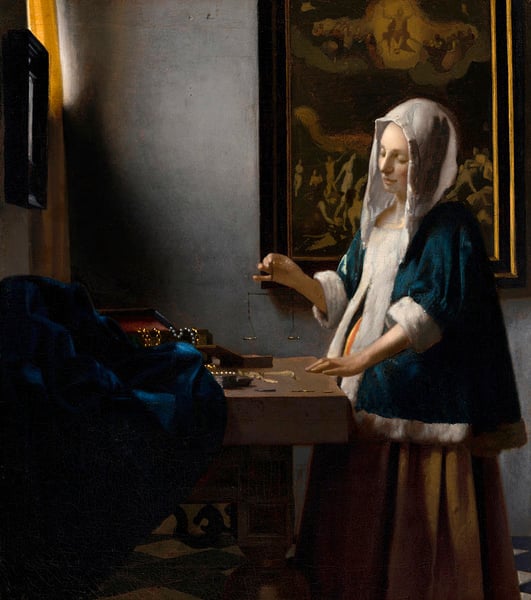
Johannes Vermeer’s Woman Holding a Balance (c. 1664) stands as a masterful synthesis of the Baroque fascination with light, texture, and moral allegory, while also exemplifying the intimate domesticity of genre painting. What makes this work profoundly significant is its serene equilibrium between the physical and the spiritual, captured through Vermeer’s unparalleled handling of light and composition.
Visual and Technical Mastery
At first glance, the painting depicts a quiet, everyday moment: a woman in a blue-edged jacket and a white cap stands before a table, holding an empty balance. The light, a hallmark of the Baroque, streams from the left, softly modeling her face, the folds of her costume, and the polished surface of the balance. Vermeer’s signature use of sfumato—a delicate blending of tones—creates a luminous, almost tactile surface. The mirror on the wall, the pearls, and the gold of the balance reflect light in precise, jewel-like highlights, demonstrating the artist’s obsessive attention to optical truth.
Symbolism and Moral Significance
This painting is not merely a snapshot of 17th-century Dutch life; it is a meditation on transience and judgment. Above the woman’s hand hangs a painting of the Last Judgment—a motif of divine weighing of souls—which creates a direct visual and thematic dialogue with the woman’s own scales. Her balance is empty, held perfectly level, suggesting a moment of pause, reflection, and equilibrium. She is not weighing gold or jewels but is herself a figure of discernment, embodying the virtue of temperance and the idea that earthly possessions (the pearls, the gold) are ultimately subject to a higher, spiritual reckoning.
Significance Within Baroque and Genre Painting
In the context of Baroque art—known for its dramatic tenebrism, dynamic movement, and emotional intensity—Vermeer offers a startlingly quiet alternative. His work is often called “the inner Baroque” for its stillness and psychological depth. Unlike the theatrical gestures of Caravaggio or the opulent flourishes of Rubens, Vermeer achieves grandeur through reflection, not action.
As a genre painting, this work elevates the domestic scene to the level of profound allegory. While many Dutch contemporaries (such as Pieter de Hooch or Gerard ter Borch) also painted women in interiors, Vermeer’s composition is uniquely balanced—literally and figuratively. The vertical lines of the woman’s figure, the rectangular mirror, and the painting within the painting create a rigorous structure that echoes the scales themselves. This formal harmony reinforces the thematic message: a life of moderation and introspection brings spiritual equilibrium.
Conclusion
Woman Holding a Balance is significant because it epitomizes Vermeer’s ability to marry the mundane with the eternal. It is a quiet masterpiece of the Baroque, proving that the most profound art can be found in a woman’s pause, a beam of light, and an empty scale. The painting remains a timeless symbol of the search for balance in all things—material, moral, and spiritual.
Museum / Gallery
Visuellement similaire
20 œuvres à la composition et à la palette proches
Lady Writing a Letter with Her Maid
Johannes Vermeer
Girl interrupted at her music
Johannes Vermeer
A lady writing
Johannes Vermeer
The Milkmaid
Johannes Vermeer
Brothel Scene
Frans van Mieris the Elder
Woman hands over money to her servant
Pieter de Hooch
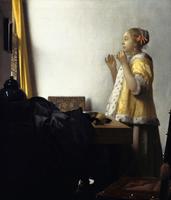
Young Woman with a Pearl Necklace
Johannes Vermeer
Lady at Her Toilet
Frans van Mieris the Elder
Dissolute Household
Jan Steen
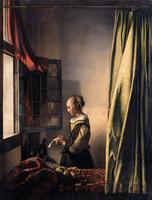
Girl Reading a Letter at an Open Window
Johannes Vermeer
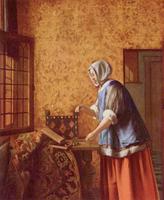
Woman weighing gold coins
Pieter de Hooch
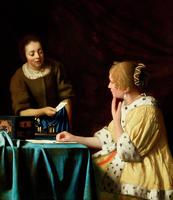
Mistress and Maid (Lady with Her Maidservant Holding a Letter )
Johannes Vermeer
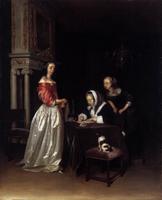
Curiosity
Gerard Terborch
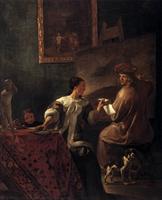
The Drawing Lesson
Jacob Ochtervelt
The Oyster Meal
Jacob Ochtervelt
Woman reading a letter (Woman in Blue Reading a Letter)
Johannes Vermeer
A Lady and Two Gentlemen
Johannes Vermeer
A Young Woman Sewing
Nicolaes Maes
The glass of wine
Johannes Vermeer
Breakfast
Gabriel Metsu