Analyse experte de The Ambassadors de Hans Holbein the Younger
Style : Northern Renaissance · Genre : portrait
Expert Analysis: "The Ambassadors" by Hans Holbein the Younger
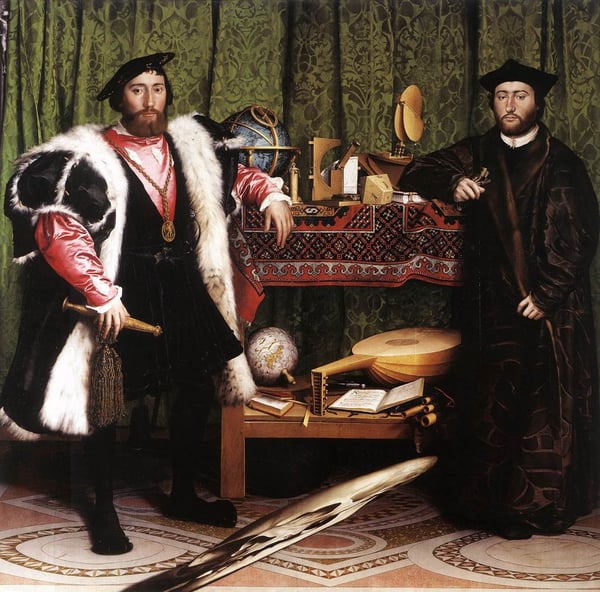
Hans Holbein the Younger’s The Ambassadors (1533) stands as a pinnacle of the Northern Renaissance portrait, a masterful fusion of meticulous naturalism, complex symbolism, and intellectual ambition. Painted during a period of religious upheaval and burgeoning global exploration, this double portrait of French envoys Jean de Dinteville and Georges de Selve is far more than a simple likeness—it is a richly layered meditation on power, knowledge, and mortality.
Significance within the Northern Renaissance
The painting epitomizes the Northern Renaissance’s hallmark: astonishing detail and symbolic density. Every object on the two-tiered shelf—from the celestial globe and astrolabe (representing the heavens) to the lute, arithmetic book, and terrestrial globe (representing earthly pursuits)—reflects the humanist ideals of learning, science, and the arts. Holbein’s precise rendering of textures, from velvet to metal to wood, demonstrates the Flemish-influenced technique of oil glazing that Northern artists perfected, creating a luminous, almost tangible surface.
Yet the work’s most radical feature is its anamorphic skull—a distorted form stretching diagonally across the foreground. When viewed from a sharp angle (or in certain mirrored reproductions), it snaps into focus, a memento mori that intrudes on the ambassadors’ worldly confidence. This optical illusion is not just a technical tour de force; it embodies the Northern Renaissance’s preoccupation with the transience of life and the limits of human perception. The skull disrupts the viewer’s static gaze, forcing a shift in perspective—literally and philosophically—from earthly vanities to the inevitability of death.
Genre and Innovation
As a portrait, The Ambassadors transcends simple representation by embedding its subjects within a web of political and scholarly allusion. Dinteville’s dagger bears his age (29), de Selve’s book shows his (25), while the broken lute string and the clash between the two globes hint at discord—perhaps the looming rift between Catholic and Protestant factions. Holbein merges the tradition of the donor portrait with the vanitas still life, creating a hybrid that declares: knowledge and power are fleeting.
Its significance also lies in its monumental scale (almost life-size) and its international scope—Holbein, a German-born painter working in England, depicted French diplomats with objects from craftsmen across Europe. This global perspective, combined with the anamorphic device, cements The Ambassadors as a touchstone of Northern Renaissance portraiture: a work where realism serves not just to capture likeness, but to question the very nature of reality and mortality.
Museum / Gallery
Visuellement similaire
20 œuvres à la composition et à la palette proches
The Ambassadors (after Holbein)
Paul Wunderlich
Malatesta Baglioni
Parmigianino
Alfonso d'Este
Dosso Dossi
Portrait of Fabrizio Salvaresio
Titian
Portrait of Jacopo Strada
Titian
Charles De Solier, Sieur De Morette
Hans Holbein the Younger
Nicolò Molino, Venetian Ambassador
Daniel Mytens the Elder
Unknown gentleman with music books and lute
Hans Holbein the Younger
Portrait of Charles de Solier
Hans Holbein the Younger
Portrait of Francesco I De' Medici
Alessandro Allori
Faust on Easter Morning
Johann Peter Krafft
Portrait of Charles
Anthony van Dyck
Alfonso I d'Este, Duke of Ferrara
Peter Paul Rubens
Knight of Malta with a watch
Titian
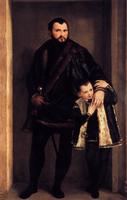
Iseppo and Adriano da Porto
Paolo Veronese
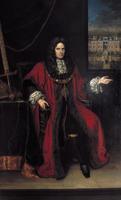
Portrait of Sir Robert Clayton (1629–1707)
Laureys a Castro
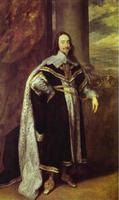
Charles I, King of England
Anthony van Dyck
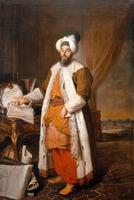
Portrait of Mehemet Said Pacha, Bey of Rumelia, special ambassador of the ottoman Sultan Mahmoud II
Jacques Aved
Twenty Five Year Old Youth with Fur Lined Coat
Tintoretto
Sir Henry Savile (1549–1622)
Marcus Gheeraerts the Younger