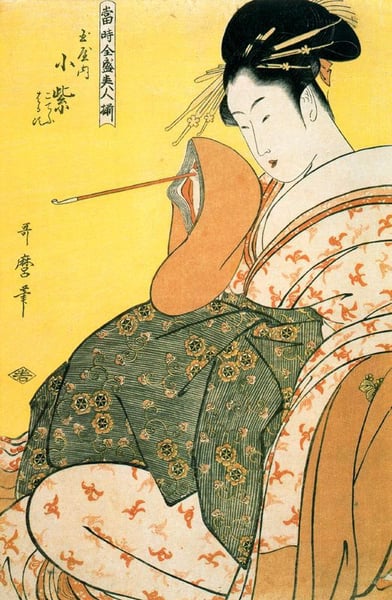
Analisi esperta di Komurasaki of the Tamaya with pipe in hand di Kitagawa Utamaro
Stile: Ukiyo-e · Genere: portrait
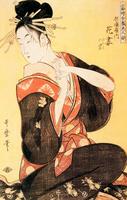
Expert Analysis: "Komurasaki of the Tamaya with pipe in hand" by Kitagawa Utamaro
This portrait, executed in the Ukiyo-e style, exemplifies Kitagawa Utamaro's revolutionary approach to the bijin-ga (pictures of beautiful women) genre during the late 18th century. What makes the work significant is Utamaro’s profound shift from idealized, generic depictions of courtesans to intimate, psychologically nuanced individual portraits.
Technical and Stylistic Significance Utamaro was a master of the ōkubi-e (large-head picture) format, which he pioneered to focus on the sitter’s face and upper torso, eliminating background distraction. Here, the composition isolates Komurasaki—a celebrated courtesan of the Tamaya house—with a simple, elegant line that emphasizes her refined features and the texture of her kimono. The pipe in her hand is not merely a prop but a symbol of relaxed, post-service leisure, inviting the viewer into a private moment. Utamaro’s use of subtle color gradations (bokashi) and delicate, flowing brushwork in the hair and fabric creates a sense of airy grace, while the slight turn of her head and half-lidded gaze suggest introspection or gentle amusement.
Period Context and Legacy In the floating world (ukiyo) of Edo-period Japan, courtesans were often portrayed as remote, idealized icons. Utamaro broke this convention by emphasizing individuality: Komurasaki is recognizable as a specific person, not a type. This portrait, part of his series Seirō Jūni Toko (Twelve Hours in the Yoshiwara), contributes to Utamaro’s reputation for capturing the "inner life" of his subjects—a radical humanization that elevated Ukiyo-e from mere decorative art to a subtle psychological study. His influence extended to European Impressionists, who admired his cropping, asymmetry, and emphasis on fleeting expression.
Significance within Ukiyo-e The artwork stands as a pinnacle of the genre's maturity, where printmaking technique (woodblock) and artistic vision merged to produce a work of quiet sophistication. Utamaro’s ability to convey character through minimal means—a glance, a hand gesture, a pipe—marks this portrait as a masterclass in restraint and emotional depth, solidifying his status as the supreme painter of the floating world’s most celebrated women.
Museum / Gallery
Visivamente simili
20 opere con composizione e palette affini
Reading a letter
Kitagawa Utamaro
Untitled
Uemura Shoen
Actor Segawa Tomisaburo II as the Geisha Asaka
Tōshūsai Sharaku
Courtesan writing a letter
Kitagawa Utamaro
The Hour of the Ramin
Kitagawa Utamaro
Untitled
Uemura Shoen
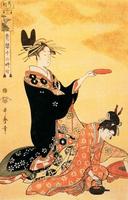
The Hour of the Boar
Kitagawa Utamaro
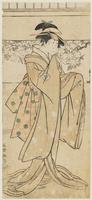
Kabuki Actor Iwai Kumesaburō I as the Geisha Kumekichi
Tōshūsai Sharaku
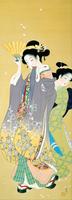
Cherry Blossom Viewing
Uemura Shoen
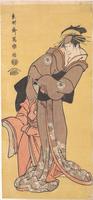
Actor Segawa Tomisaburo II as the Courtesan Toyama and Actor Ichikawa Kurizo as Higashiyama Yoshiwakamaru
Tōshūsai Sharaku
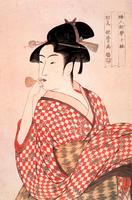
Girl blowing Vidro
Kitagawa Utamaro
Kabuki Actors Sawamura Sōjūrō III as Nagoya Sanza, and Segawa Kikunojō Iii as the Courtesan Katsuragi
Tōshūsai Sharaku
Segawa Kikunojō III as the Courtesan Katsuragi
Tōshūsai Sharaku
Iwai Hanshirō IV as Otoma, Daughter of Ohina from Inamuragasaki in Kamakura, actually Kikusui, the wife of Kusunoki Masashige
Tōshūsai Sharaku
Courting Komachi
Utagawa Toyokuni
The Hour of the Oxx
Kitagawa Utamaro
The Hour of the Horse
Kitagawa Utamaro
The four virtues
Kitagawa Utamaro
A scene on the bridge and beld
Kitagawa Utamaro
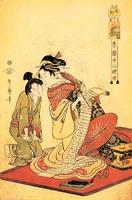
The Hour of the Dragon
Kitagawa Utamaro