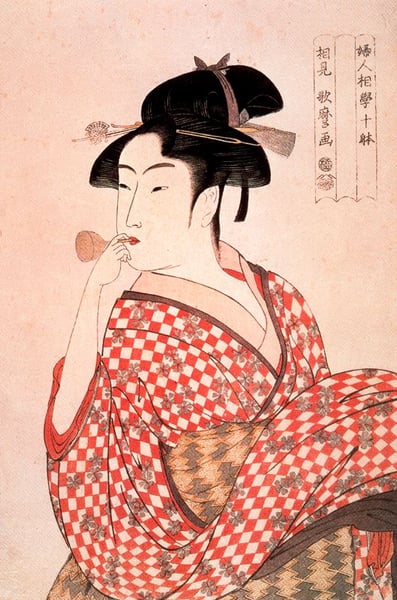
Girl blowing Vidro
Analisi esperta di Girl blowing Vidro di Kitagawa Utamaro
Stile: Ukiyo-e · Genere: portrait
Expert Analysis of "Girl blowing Vidro" by Kitagawa Utamaro
Kitagawa Utamaro’s "Girl blowing Vidro" is a masterful example of late 18th-century Ukiyo-e portraiture, specifically within the bijin-ga (pictures of beautiful women) subgenre. The work’s significance lies in Utamaro’s revolutionary approach to capturing fleeting, intimate moments—a departure from the more formal, static depictions of earlier Ukiyo-e artists.
What makes this work stand out:
-
Domestic intimacy and psychological depth: Utamaro elevates a simple, everyday action—a young woman blowing into a glass object (a vidro, likely a Dutch-imported glass pipe or toy)—into a study of absorbed concentration. Her slightly parted lips, soft gaze, and relaxed posture convey a moment of quiet playfulness, not idealized performance. This shift from theatrical courtesan portraits to genuine private life was a hallmark of Utamaro’s later career.
-
Innovative composition and cropping: The close-up framing, with the figure filling much of the picture plane, was a daring choice in Edo-period Ukiyo-e. By cropping the figure at the shoulders and focusing on her hands and face, Utamaro creates an unprecedented sense of immediacy and psychological proximity, inviting the viewer into her personal space.
-
Subtle fusion of Japanese and Western elements: The vidro itself is a telling detail: glassware was introduced to Japan by Dutch traders during the isolationist Edo period. Utamaro’s inclusion of this foreign object not only documents contemporary material culture but also signals a modern sensibility. His use of delicate, flowing lines (Japanese bokashi and kappazuri techniques) contrasts with the angular, transparent object, creating a visual dialogue between native tradition and imported novelty.
-
Refined handling of line and color: True to Ukiyo-e’s aesthetic, Utamaro employs a sinuous, expressive fude (brush line) to define the woman’s kimono folds and hair, while the face is rendered with remarkable subtlety—a soft kubi (neck) elongation and small, almond-shaped eyes that suggest individuality rather than a generic type. The restricted palette (likely pale flesh tones, muted kimono patterns, and the clear, light blue of the glass) emphasizes the purity of the moment.
In the broader context of Ukiyo-e, "Girl blowing Vidro" exemplifies Utamaro’s genius for transforming ordinary life into something extraordinary—a quiet, luminous portrait that balances intimacy, technical virtuosity, and a subtle nod to Japan’s changing world. It remains a touchstone for why Utamaro is celebrated as the master of the inner life of Edo’s women.
Visivamente simili
20 opere con composizione e palette affini
The geisha kamekichi
Kitagawa Utamaro
Looking thirsty - The Appearance of a Town Geisha, a Bargirl in the Ansei Era
Tsukioka Yoshitoshi
The Hour of the Oxx
Kitagawa Utamaro
Portrait of Naniwaya Okita
Kitagawa Utamaro
Woman playing a poppin
Kitagawa Utamaro
The Hour of the Ramin
Kitagawa Utamaro
Three Beauties of the Present Day
Kitagawa Utamaro
Looking eager to meet someone - The appearance of a courtesan of the Kaei period
Tsukioka Yoshitoshi
Courtesan writing a letter
Kitagawa Utamaro
Bijin holding a flower pot
Toyohara Chikanobu
Bijin - Light Snowfall
Kiyokata Kaburagi
Looking shy - The appearance of a young girl of the Meiji era
Tsukioka Yoshitoshi
The Hour of the Tiger
Kitagawa Utamaro
Looking Disagreeable - The Appearance of a Young Lady from Nagoya During the Ansei era
Tsukioka Yoshitoshi
Desire
Tsukioka Yoshitoshi
Wishing to remove makeup
Utagawa Kuniyoshi
Iwai Hanshirō IV as San, the maid servant of Ukiyonosuke, actually Saeda, the younger sister of Sabanosuke
Tōshūsai Sharaku
Kabuki Actors Sawamura Sōjūrō III as Nagoya Sanza, and Segawa Kikunojō Iii as the Courtesan Katsuragi
Tōshūsai Sharaku
Bijin
Keisai Eisen
Komurasaki of the Tamaya with pipe in hand
Kitagawa Utamaro