Expert analysis of Kitagawa Utamaro’s Women making dresses
Style: Ukiyo-e · Genre: genre painting
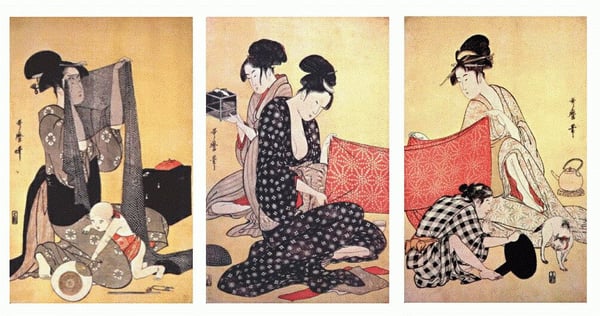
An expert analysis of "Women making dresses" by Kitagawa Utamaro must begin by situating the work within the Ukiyo-e tradition—specifically the subgenre of bijin-ga (pictures of beautiful women)—while also acknowledging its status as a genre painting that elevates a domestic, everyday scene to the level of fine art.
Significance within Ukiyo-e and Utamaro’s oeuvre:
Utamaro is celebrated for his revolutionary approach to depicting women, moving away from static, idealized portraits toward more natural, intimate, and psychologically nuanced compositions. In Women making dresses, he captures a moment of quiet, focused collaboration—two or more women engaged in the meticulous craft of textile work (likely a kimono or traditional garment). This subject matter is significant because it shifts the viewer’s attention away from the pleasure quarters (where many Ukiyo-e artists focused) and onto the skilled labor and domestic artistry of women in Edo-period Japan.
Formal and stylistic achievements:
- Composition and perspective: Utamaro often employed a close-up, cropped framing that suggests the viewer is an unseen witness to the scene. The figures are arranged in a balanced, flowing diagonal, guiding the eye across their hands and the fabric, emphasizing process over pose.
- Line and color: The delicate, fluid kakemono-e (hanging scroll-like) outlines are characteristic of Utamaro’s mature style. He uses subtle gradations of color—pale blues, muted pinks, and warm whites—to evoke the softness of silk and the intimate atmosphere of the workspace. The absence of heavy shadow keeps the scene buoyant and airy.
- Expressive detail: Utamaro excels in rendering the posture and gesture of hands, a notoriously difficult element in Ukiyo-e. Here, the women’s fingers are shown sewing, pinning, or adjusting the fabric with a precision that conveys both expertise and serene concentration. Their downward gazes and relaxed shoulders create a mood of dignified absorption, not servility.
Cultural and art-historical importance:
This work exemplifies how Ukiyo-e could serve as both a record of daily life and an investigation into the beauty of routine. By focusing on dressmaking—a profession that combined creativity with craftsmanship—Utamaro elevates the role of women as artisans. The print also reflects the Edo-period fascination with seasonal fashion and textile design, but it avoids mere documentation; instead, it transforms a functional task into a moment of poised, graceful humanity.
In summary, Women making dresses is significant for its intimate realism, its subtle social commentary on women’s labor, and its masterful use of Ukiyo-e conventions to capture the quiet dignity of a shared creative process. It stands as a testament to Utamaro’s ability to find profound beauty in the ordinary, a hallmark of the finest genre painting in the woodblock tradition.
Visually similar
20 works with related composition and palette
Women making dresses
Kitagawa Utamaro
Women making dresses
Kitagawa Utamaro
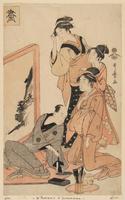
The four virtues
Kitagawa Utamaro
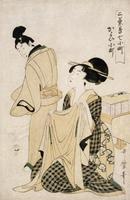
A Geisha in her Lover`s Room
Kitagawa Utamaro
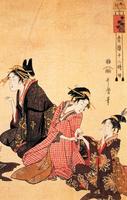
A scene on the bridge and beld
Kitagawa Utamaro
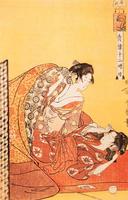
The Hour of the Dragon
Kitagawa Utamaro
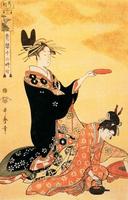
The Hour of the Boar
Kitagawa Utamaro
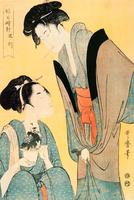
The Hour of the Hare
Kitagawa Utamaro
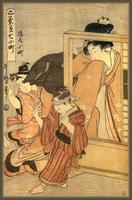
A Woman Watches Two Children
Kitagawa Utamaro
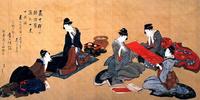
Portrait of Chino Hyogo seated at his writing desk
Katsushika Hokusai
Courting Komachi
Utagawa Toyokuni
Kabuki Actors Sawamura Sōjūrō III as Nagoya Sanza, and Segawa Kikunojō Iii as the Courtesan Katsuragi
Tōshūsai Sharaku
Courtesans Strolling Beneath Cherry Trees Before the Daiko
Kitagawa Utamaro
In circle, figure piece, (Outdoor)
Hiroshige
Upper Class
Kitagawa Utamaro
Hour of the Snake
Kitagawa Utamaro
The Hour of the Dog
Kitagawa Utamaro
Three Seated Ladies with Lanterns
Kitagawa Utamaro
The Hour of the Horse
Kitagawa Utamaro
All night under mosquito net
Kitagawa Utamaro