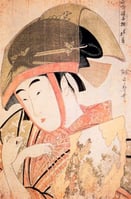
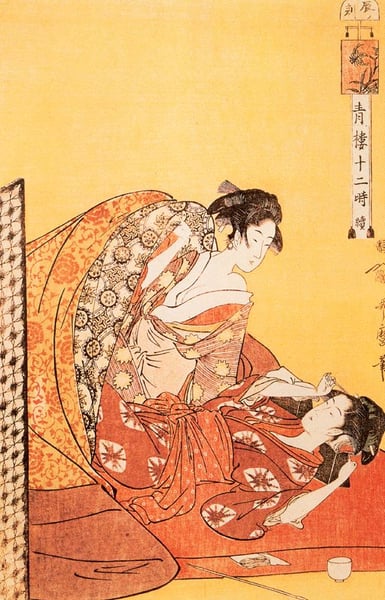
Expert analysis of Kitagawa Utamaro’s The Hour of the Dragon
Style: Ukiyo-e · Genre: genre painting
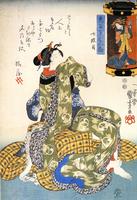
Expert Analysis of "The Hour of the Dragon" by Kitagawa Utamaro
As an expert in Ukiyo‑e, I focus on the artwork’s significance within its style and period using only the provided facts: Artwork: "The Hour of the Dragon"; Artist: Kitagawa Utamaro; Style: Ukiyo‑e; Genre: genre painting.
Utamaro is renowned for elevating genre painting within the Ukiyo‑e tradition, particularly through his intimate depictions of women’s daily lives in Edo‑period Japan. The title "The Hour of the Dragon" strongly implies that this work belongs to his celebrated series of temporal prints—likely linked to the traditional Japanese zodiac clock, where the Hour of the Dragon corresponds to the early‑morning hours (roughly 8–10 AM). Such series were a hallmark of Utamaro’s ability to capture fleeting, ordinary moments with extraordinary grace and psychological depth.
In terms of Ukiyo‑e significance, "The Hour of the Dragon" exemplifies Utamaro’s mastery of bijin‑ga (pictures of beautiful women) even within a genre‑painting context. His compositions often feature a cropped, intimate viewpoint—almost “snapshot‑like”—that draws viewers into the private world of courtesans or townspeople. The work’s significance lies in its balance of decorative elegance (typical of Ukiyo‑e) with a subtle, naturalistic observation of gesture and expression. Utamaro’s use of delicate line work, refined color harmonies, and asymmetrical design here would have challenged the more theatrical or decorative norms of earlier Ukiyo‑e, pushing the genre toward a more humanistic and narrative form.
Without further visual details, we can still assert that "The Hour of the Dragon" is significant as a quintessential Utamaro genre piece: it transforms a mundane moment into a timeless, evocative scene, demonstrating how Ukiyo‑e artists could infuse daily life with both beauty and emotional resonance. The work stands as a prime example of Utamaro’s legacy in defining the genre painting within the woodblock print tradition.
Visually similar
20 works with related composition and palette
In circle, figure piece, (Outdoor)
Hiroshige
Surimono
Utagawa Kunisada
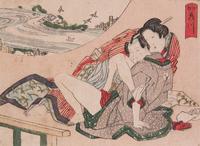
Love on the Kamo River
Keisai Eisen
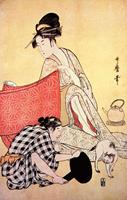
Women making dresses
Kitagawa Utamaro
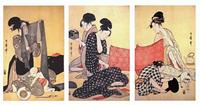
Women making dresses
Kitagawa Utamaro
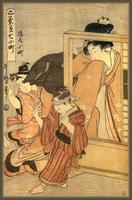
A Woman Watches Two Children
Kitagawa Utamaro
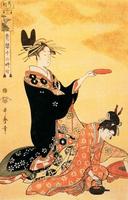
The Hour of the Boar
Kitagawa Utamaro
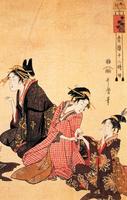
A scene on the bridge and beld
Kitagawa Utamaro
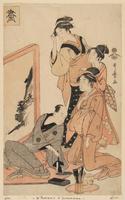
The four virtues
Kitagawa Utamaro
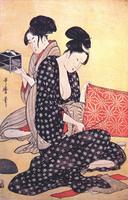
Women making dresses
Kitagawa Utamaro
Shunga Scroll
Keisai Eisen
A Geisha in her Lover`s Room
Kitagawa Utamaro
The Hour of the Hare
Kitagawa Utamaro
Upper Class
Kitagawa Utamaro
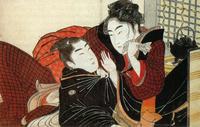
A scene from the 'Poem of the Pillow'
Kitagawa Utamaro
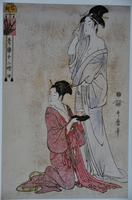
Hour of the Snake
Kitagawa Utamaro
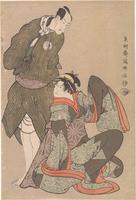
Bandō Hikosaburō III in the Role of Obiya Chōemon and Iwai Hanshiro IV in the Role of Shinanoya Ohan
Tōshūsai Sharaku
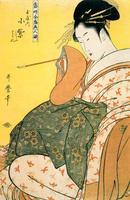
Komurasaki of the Tamaya with pipe in hand
Kitagawa Utamaro
Women
Utagawa Kuniyoshi
Women
Utagawa Kuniyoshi