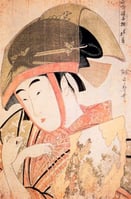
Expert analysis of Kitagawa Utamaro’s Hour of the Snake
Style: Ukiyo-e · Genre: genre painting
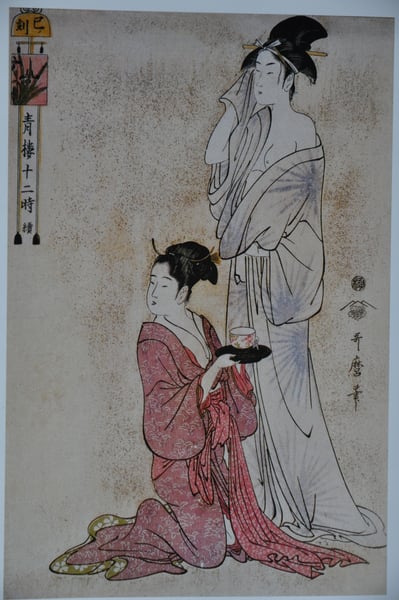
Expert Analysis of "Hour of the Snake" by Kitagawa Utamaro
Kitagawa Utamaro’s “Hour of the Snake” stands as a masterful example of Ukiyo-e’s bijin-ga (pictures of beautiful women) genre, and a pivotal work within his celebrated series “Twelve Hours of the Yoshiwara” (or “Seirō Jūniji”). The piece gains its significance from Utamaro’s revolutionary approach to portraiture within the floating world—an artistic shift that moved Ukiyo-e away from idealized, static courtly figures and toward intimate, psychologically nuanced glimpses of real women in candid, everyday moments.
Composition and Technique The print depicts a courtesan or high-ranking oiran during the “Hour of the Snake” (approximately 10 a.m. in traditional Japanese timekeeping), a period associated with morning leisure and preparation. Utamaro employs a daringly close, upper-body ōkubi-e (large-head picture) composition—a format he pioneered. The woman is shown in three-quarter profile, her face softly turned as she adjusts her hair or gazes pensively. This tight cropping eliminates background context, forcing the viewer’s attention entirely on her expression, costume, and subtle gesture. Utamaro’s linework is exquisitely precise: flowing, calligraphic contours trace the fall of her layered kimono, the curve of her neck, and the intricate structure of her elaborate shimada hairstyle. Delicate, almost invisible kebori (hair-line engraving) gives texture to her black tresses, while the palette—dominated by subtle grays, muted indigos, and a touch of red in her under-kimono—creates a quiet, domestic intimacy that contrasts sharply with the expected gaiety of the pleasure district.
Psychological Depth and Innovation What elevates “Hour of the Snake” beyond mere decorative beauty is Utamaro’s ability to capture a private, unguarded moment. The woman’s slightly downcast eyes and relaxed mouth suggest introspection or even a hint of melancholy—a mood rarely admitted in earlier Ukiyo-e, which often emphasized surface glamour. Utamaro was a meticulous observer of female anatomy, posture, and emotion; here he rejects idealized symmetry in favor of a naturalist asymmetry: the hair slightly askew, one shoulder subtly higher than the other. This psychological realism was groundbreaking. As art historian Tadashi Kobayashi notes, Utamaro’s ōkubi-e “transformed the courtesan from a type into a person, granting her an inner life that resonated with contemporary audiences.”
Significance within Ukiyo-e and Utamaro’s Career Works like “Hour of the Snake” cemented Utamaro’s reputation in the 1790s as the preeminent painter of women in Edo-period Japan. The series itself was innovative in its temporal conceit—mapping the daily rhythms of Yoshiwara courtesans onto the traditional twelve-hour clock, thereby humanizing and memorializing their structured lives. Utamaro’s influence extended to later artists such as Hokusai and Kuniyoshi, and his close-up portraits directly anticipated the modern shin-hanga and sōsaku-hanga movements. Moreover, this print’s subtle eroticism—suggested through diaphanous fabric and the exposed nape of the neck (a conventionalized fetish)—exemplifies Ukiyo-e’s sophisticated interplay between concealment and revelation, a hallmark of the genre’s enduring appeal.
In sum, “Hour of the Snake” is significant because it redefined the female portrait in Ukiyo-e: prioritizing psychological interiority over ornamental surface, and elevating a routine morning ritual into a timeless, poignant icon of the floating world.
Visually similar
20 works with related composition and palette
The Hour of the Oxx
Kitagawa Utamaro
The Hour of the Hare
Kitagawa Utamaro
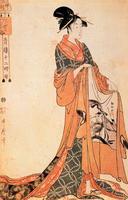
The Hour of the Horse
Kitagawa Utamaro
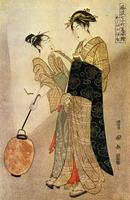
Courting Komachi
Utagawa Toyokuni
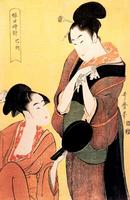
The Hour of the Tiger
Kitagawa Utamaro
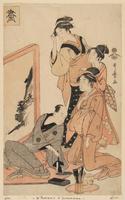
The four virtues
Kitagawa Utamaro
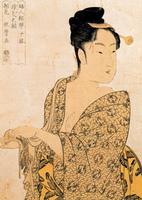
The Hour of the Cock
Kitagawa Utamaro
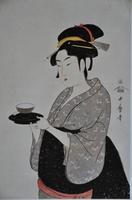
Portrait of Naniwaya Okita
Kitagawa Utamaro
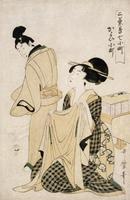
A Geisha in her Lover`s Room
Kitagawa Utamaro
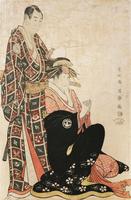
Kabuki Actors Sawamura Sōjūrō III as Nagoya Sanza, and Segawa Kikunojō Iii as the Courtesan Katsuragi
Tōshūsai Sharaku
Segawa Kikunojō III as the Courtesan Katsuragi
Tōshūsai Sharaku
Sagawa Kikunojo III as the Courtesan Katsuragi,and Sawamura Sojuro
Tōshūsai Sharaku
The Hour of the Boar
Kitagawa Utamaro
Kabuki Actor Segawa Kikunojō III as the Shirabyōshi Hisakata of Miyako Kujō
Tōshūsai Sharaku
A Woman Watches Two Children
Kitagawa Utamaro
Women making dresses
Kitagawa Utamaro
Bandō Hikosaburō III in the Role of Obiya Chōemon and Iwai Hanshiro IV in the Role of Shinanoya Ohan
Tōshūsai Sharaku
A scene on the bridge and beld
Kitagawa Utamaro
Beauty in Long Undergarment
Goyo Hashiguchi
The Hour of the Dragon
Kitagawa Utamaro