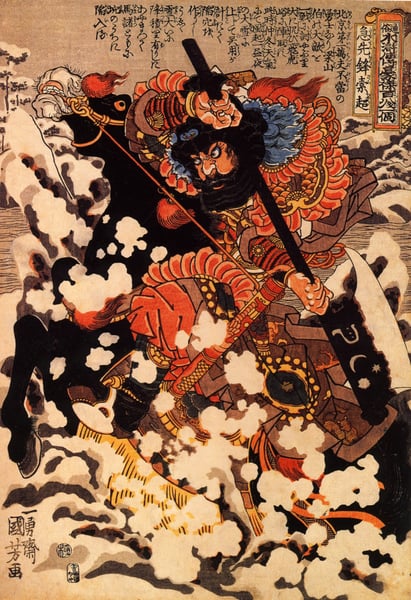
Kyusenpo Sacucho charging throught the snow on a black stallion
Expert analysis of Utagawa Kuniyoshi’s Kyusenpo Sacucho charging throught the snow on a black stallion
Style: Ukiyo-e · Genre: battle painting
This woodblock print by Utagawa Kuniyoshi, Kyusenpo Sacucho Charging Through the Snow on a Black Stallion, exemplifies the artist’s virtuosity within the Ukiyo-e tradition—specifically the battle painting genre known as musha‑e. Kuniyoshi was a master of dynamic composition and dramatic narrative, and this work stands out for its innovative fusion of action, weather, and symbolic contrast.
Significance within Ukiyo‑e and the Battle Genre:
-
Dynamic Motion and Spatial Tension – The charging black stallion and its rider are captured mid‑gallop, with the horse’s straining muscles and the warrior’s forward‑leaning posture creating a powerful diagonal thrust. Unlike many static Ukiyo‑e portraits, Kuniyoshi’s composition forces the viewer’s eye to follow the momentum—a hallmark of his mature period, influenced by both kabuki theatre and Chinese martial epics.
-
Atmospheric Innovation – Depicting a snowstorm in Ukiyo‑e was technically challenging. Kuniyoshi uses exquisite bokashi (gradated printing) and negative space to suggest swirling flurries, while the black stallion’s silhouette pops against the pale, cold background. This high‑contrast handling not only conveys the brutal environment but also heightens the heroism of the charge—a device that influenced later Meiji‑era battle prints.
-
Symbolic and Cultural Resonance – The name “Sacucho” (likely a variant of a Chinese or Japanese legendary figure) and the black horse evoke suiboku (ink‑painting) virtues of strength and resilience. In samurai lore, a black stallion often symbolized a fierce, untamable spirit. By placing this warrior in a snow‑blasted landscape, Kuniyoshi connects the genre to the mono‑no‑aware (pathos of things) tradition, where natural adversity amplifies human courage.
-
Technical Mastery in Woodblock – Kuniyoshi was famous for his kumi‑ita (multi‑block) registration and bold key‑block outlines. The print likely required several color blocks—deep indigo for the horse, subtly shaded greys for the sky, and occasional vermillion for armor details. The precision of the falling snow (carved as tiny, unprinted white speckles against dark blocks) demonstrates the ukiyo‑e printer’s skill at suggesting weather through carved gaps.
In summary, this work is significant because it pushes the boundaries of battle Ukiyo‑e beyond mere illustration into a dramatic, almost cinematic tension. Kuniyoshi’s ability to synthesize athletic heroism, extreme weather, and symbolic color anticipates later Japanese woodblock innovations and cements his reputation as the pre‑eminent warrior‑print artist of the late Edo period.
Visually similar
20 works with related composition and palette
Happinata Koju on a rearing horse
Utagawa Kuniyoshi
The Hundred and Eight Heroes of the Popular Suikoden
Utagawa Kuniyoshi
Konseimao hanzui beset by demons
Utagawa Kuniyoshi
Oguri Hangan Sukeshige and Yamasaki
Utagawa Sadatora
Yamamoto Takeru no Mikoto between burning grass
Utagawa Kuniyoshi
The ghost of Taira Tomomori
Utagawa Kuniyoshi
A print depicting Sakanoue no Tamuraro, commanding in the middle of battle
Tsukioka Yoshitoshi
Taira Tomomori and a sea dragon
Utagawa Kuniyoshi
Li Hayata Hironao grappling with the monster
Utagawa Kuniyoshi
Shinpūren Rebellion
Tsukioka Yoshitoshi
Eight Hundred Heroes of Our Country
Utagawa Kuniyoshi
Kamigashihime stabbing a giant spider
Utagawa Kuniyoshi
Tokugawa with help from the Jodo monks of the Daijuji temple in Okizaki, defeats the Ikkō ikki at the battle of Azukizaka
Tsukioka Yoshitoshi
A man confronted with an apparition of the Fox goddess
Utagawa Kuniyoshi
The Hundred and Eight Heroes of the Popular Suikoden
Utagawa Kuniyoshi
Nihon hana zue
Ogata Gekko
Tamomori tied to a huge anchor ready to cast himself into the sea
Utagawa Kuniyoshi
Shoriko kaei shooting a wild goose
Utagawa Kuniyoshi
Saitogo Kunitake, Japanese actor
Utagawa Kuniyoshi
Oguri Hangan Sukeshige in Battle
Utagawa Sadatora