Ploughing on oxen
Analisi esperta di Ploughing on oxen di Arkhyp Kuindzhi
Stile: Realism · Genere: sketch and study
Expert Analysis of "Ploughing on oxen" by Arkhyp Kuindzhi
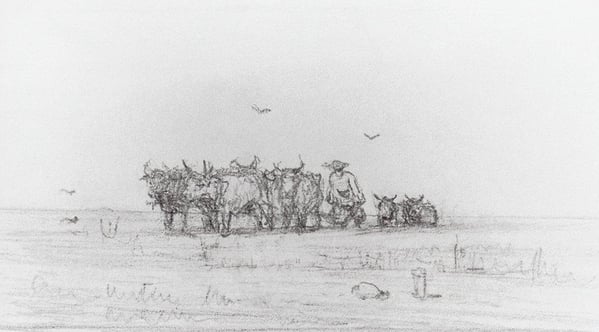
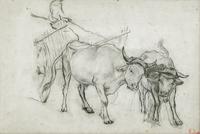
As a study and sketch in the Realist tradition, Ploughing on oxen offers a rare glimpse into the working method of one of Russia’s most celebrated landscape painters. While Kuindzhi is best known for his dramatic, almost luminous landscapes—such as Moonlit Night on the Dnieper—this piece demonstrates the foundational observational rigor that underpins his art.
Significance within the Realist movement and Kuindzhi’s oeuvre:
-
Documentary of Rural Labor
The subject—oxen ploughing a field—places the work within the broader 19th-century Russian Realist concern for depicting the lives of peasants with dignity and truth. Unlike idealized pastoral scenes, Kuindzhi’s sketch captures the physical effort of the yoke, the weight of the animals, and the texture of the earth, aligning with the moral purpose of Realism: to show the world as it is. -
Intimate Studio Practice
As a sketch and study, the artwork reveals Kuindzhi’s process. The loose, rapid handling of line and tone suggests he was exploring composition, light, and form before committing to a finished canvas. This piece likely served as a preparatory study for a larger painting, offering art historians insight into how he built his iconic scenes—balancing atmospheric effects with precise agricultural details. -
Precursor to His Luminous Style
Even in this modest study, one senses Kuindzhi’s signature attention to the quality of light. The contrast between the darkened oxen and the open field hints at his later mastery of chiaroscuro. The sketch may document his early experiments with capturing the specific quality of Ukrainian sunlight—a hallmark that would later make him a pivotal figure in Russian landscape painting, bridging Realism and the more symbolic, emotional use of color seen in the late 19th century. -
Cultural and Historical Value
Kuindzhi’s focus on ploughing—a timeless rural activity—reflects the agrarian identity of the Russian Empire in the 1870s–1880s. The work stands as a visual record of peasant technology and labor before industrialization, preserved through the artist’s direct observation. Its status as a sketch underscores the value Realists placed on capturing truth on the spot, free from academic contrivance.
In sum, Ploughing on oxen is significant not merely as a preparatory work, but as a testament to Kuindzhi’s dedication to realism, his sensitivity to the lived experience of the Russian peasantry, and the foundational role of plein-air observation in creating his transcendent landscapes. It anchors his more famous, atmospheric masterpieces in a concrete, earthy reality.
Visivamente simili
20 opere con composizione e palette affini
Ploughing
Spyros Vassiliou
Hard road
Nicolae Grigorescu
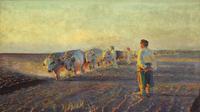
Plowing in Ukraine
Leon Wyczółkowski
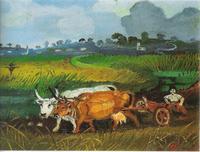
Plowing
Antonio Ligabue
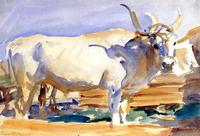
White Ox at Siena
John Singer Sargent
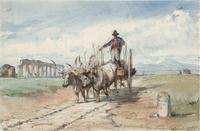
Farmer with an ox cart on the Appian Way near an aqueduct in the Roman Campagna
Ludwig Passini
Oxen Returning
Grace Albee
Oxcart
Nicolae Grigorescu
herd of Cattle Beside the Sea
Eugène Burnand
Ploughing in Tuscany
Elizabeth Thompson
Ploughing at Spring
Károly Lotz
Hills of Galilee
John Singer Sargent
Boeufs du Cantal
Rosa Bonheur
Fording the Rappahannock
Devin Leonardi
Car cu boi
Stefan Luchian
Herd near a stream
Ivan Shishkin
Cart for the Wounded
Vasily Vereshchagin
Oxen in Spring 1962
Maud Lewis
Study of a couple of oxen
Alfred Dehodencq
La Chanson Du Laboureur
Theophile Steinlen