
Analisi esperta di Boy di Richard Lindner
Stile: Mechanistic Cubism · Genere: portrait
Expert Analysis: "Boy" by Richard Lindner (Mechanistic Cubism)
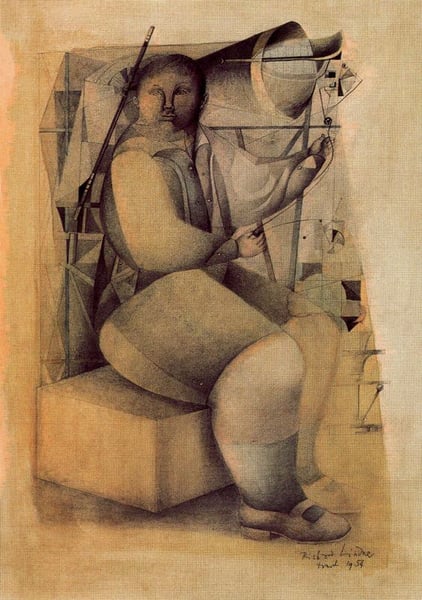
Richard Lindner's "Boy" stands as a compelling example of Mechanistic Cubism, a distinctive hybrid style that merges Cubist fragmentation with the cold, precise geometry of industrial machinery. Although Lindner is often associated with the New York School and Pop Art precursors, his Mechanistic Cubist works occupy a unique niche—they are both a continuation and a critical deconstruction of early 20th-century Cubism.
Significance within Style:
Lindner takes Cubism’s analytical approach to form and injects it with a machine-age aesthetic. In "Boy", the subject’s face and body are reduced to faceted, angular planes reminiscent of gears, pistons, or robotic components. This is not the organic, shifting perspective of Braque or Picasso; it is a deliberate, stiff geometry that evokes the dehumanizing power of technology. The painting’s surfaces appear lacquered or metallic, emphasizing a world where the human figure is reimagined as a mechanical construct. This treatment aligns with Lindner’s broader fascination with urban anonymity and the loss of individuality in modern society.
Significance within the Portrait Genre:
As a portrait, "Boy" defies traditional psychological depth. Instead of capturing an inner life, Lindner presents the sitter as an emblem of conformity and constructed identity. The boy’s expressionless, mask-like face—built from hard-edged, interlocking shapes—suggests a being conditioned by his environment, almost robotic in his stillness. This approach challenges the Romantic notion of portraiture as a window to the soul, offering instead a satirical, almost dystopian commentary on childhood and masculinity in an industrial age. The work anticipates later Pop-Art critiques of mass-produced identities while retaining Cubism’s formal rigor.
Why It Matters:
"Boy" is significant because it demonstrates how Cubist principles could be repurposed to critique modernity. Lindner’s Mechanistic Cubism bridges the gap between avant-garde abstraction and social commentary, paving the way for artists like James Rosenquist and even early computer-generated aesthetics. In this portrait, the boy becomes a cipher—neither innocent nor fully human, but a product of his mechanically ordered world. It remains a powerful, unsettling image that forces viewers to question what it means to be a “person” in a mechanized culture.
Visivamente simili
20 opere con composizione e palette affini
Woman with Animals
Albert Gleizes
Seated Nude
Lee Krasner
Seated Harlequin
Juan Gris
Man on a Balcony (Portrait of Dr. Théo Morinaud)
Albert Gleizes
Untitled (Cubist Figure)
Arshile Gorky
Couple 2
Richard Lindner
Woman at a Well
Diego Rivera
Moderne Movie Theater
Olga Rozanova
Woman with a shirt sitting in a chair
Pablo Picasso
Bortnyik Sándor, Lámpa Gyujtó
Sandor Bortnyik
Tetragramista II
Oswaldo Vigas
Woman in a Café: Compenetrations of Lights and Planes
Umberto Boccioni
Clarinetist
Pablo Picasso
Three Figures, One with Shotgun
Francis Bacon

Female portrait
Oleksandr Bogomazov
Quirinal Stables
Carlo Carra
HITO EN EL CAMINO SIN TIEMPO
Ramon Oviedo
Music
Marthe Donas
Portrait of Daniel-Henry Kahnweiler
Pablo Picasso
Man with guitar
Pablo Picasso